Ceuta migrant crisis: 34 dead, 50,000 enter Spain enclave in 2 days

Synopsis
Fifty thousand migrants crossing into a tiny Spanish enclave in under 48 hours — and 34 people dead in the attempt. The Ceuta crisis has shattered its own 2021 record fivefold, set off a Spain-Italy diplomatic row over Schengen, and forced France to harden its border with Spain. What began as a migration surge is rapidly becoming a European political emergency.
Key Takeaways
At least 34 people died attempting to reach Ceuta by sea, most drowning near the El Tarajal breakwater.
An estimated 50,000 migrants entered Ceuta from Morocco over two days — roughly five times the scale of the May 2021 crisis.
Prime Minister Pedro Sanchez visited Ceuta on Friday and announced floating barriers, accelerated returns, and reinforced security deployments.
Between 300 and 400 people also crossed into Spain's enclave of Melilla from Morocco overnight.
Italy called for Schengen suspension with Spain; Spain rejected the demand and summoned the Italian ambassador.
France activated a rapid-response border unit and reinforced checks along its border with Spain.
At least 34 people have died attempting to reach Spain's North African enclave of Ceuta by sea, while an estimated 50,000 migrants crossed into the territory from neighbouring Morocco over just two days — making it one of the largest irregular migration crises ever recorded on the enclave's border. Spanish Prime Minister Pedro Sanchez described the situation as a violation of Spain's territorial integrity.
How the Crisis Unfolded
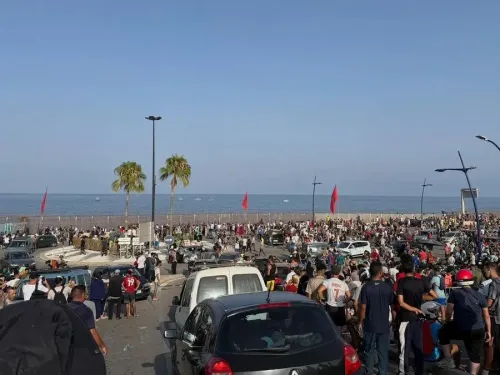
Most of the 34 confirmed fatalities drowned while attempting to swim around the El Tarajal border breakwater that separates Morocco from Ceuta, according to Spanish authorities. Large numbers of migrants have been moving through Ceuta's streets since Thursday, with many spending the night outdoors as crossings from Morocco continued into Friday.
The scale of this influx dwarfs Ceuta's previous major migration crisis in May 2021, when more than 10,000 migrants were estimated to have crossed the border irregularly — itself considered a record at the time. The current figure of 50,000 in under 48 hours marks a fivefold escalation.
What the Spanish Government Has Announced
Prime Minister Sanchez travelled to Ceuta on Friday alongside Interior Minister Fernando Grande-Marlaska to assess conditions on the ground. He announced a package of emergency measures, including the installation of floating barriers near the El Tarajal breakwater to prevent further sea crossings. He also pledged to accelerate the identification and return of irregular migrants and vowed to intensify action against human trafficking networks.
Sanchez thanked Morocco for its cooperation in border management and repatriation. Hundreds of migrants have already returned to Morocco through the breakwater crossing. The Spanish government has reinforced Ceuta with additional National Police officers, Civil Guard personnel, and military units, though emergency reception facilities remain under severe pressure.
Melilla Also Affected
In Spain's other North African enclave of Melilla, regional authorities reported that between 300 and 400 people crossed in from Morocco overnight — a smaller but related pressure point along the same frontier.
Diplomatic Fallout Across Europe
The crisis has triggered sharp diplomatic tensions beyond Spain's borders. Italian Foreign Minister Antonio Tajani called for the suspension of Schengen arrangements with Spain, a demand that Spanish Foreign Minister Jose Manuel Albares rejected as 'partisan demagoguery.' Albares announced he would summon the Italian ambassador in Madrid on Friday.
Meanwhile, France ordered the immediate reinforcement of checks along its border with Spain and activated a rapid-response border unit to conduct more extensive inspections — signalling that European neighbours regard the situation as a continent-wide pressure point, not merely a bilateral Spain-Morocco issue.
What Comes Next
Spanish authorities have stated they will seek to return those who entered irregularly as quickly as possible. With floating barriers yet to be installed, crossings reportedly continuing, and diplomatic tensions escalating across the Schengen zone, the situation in Ceuta remains fluid. The response of the European Union — and whether it steps in with coordinated support — will likely define how the crisis is managed in the days ahead.
Point of View
And Madrid knows it. Morocco has demonstrated before, most visibly in 2021, that it can turn migration flows on and off as diplomatic leverage. The fivefold jump from the 2021 record in under 48 hours did not happen by accident. Spain's immediate instinct — thank Morocco for cooperation while deploying the army — reflects the bind: Rabat is simultaneously the problem and the only available solution. The deeper issue is that Europe has no shared mechanism to absorb or deter surges of this scale; France's border hardening and Italy's Schengen threat are each nation acting alone, which is precisely the dynamic that makes the next crisis larger than the last.
NationPress
15 Sept 2026
Frequently Asked Questions
How many migrants have entered Ceuta and how many have died?
An estimated 50,000 migrants entered Spain's Ceuta enclave from Morocco over two days, and at least 34 people died — most drowning while attempting to swim around the El Tarajal border breakwater. It is one of the largest irregular migration events ever recorded at the enclave.
What measures has Spain announced to address the Ceuta crisis?
Prime Minister Pedro Sanchez visited Ceuta on Friday and announced floating barriers near the El Tarajal breakwater, accelerated identification and return of irregular migrants, and the deployment of additional National Police, Civil Guard, and military units. He also pledged intensified action against human trafficking networks.
How does this compare to the 2021 Ceuta migration crisis?
The May 2021 crisis saw more than 10,000 migrants cross into Ceuta irregularly — itself a record at the time. The current influx of around 50,000 in under 48 hours is approximately five times larger, making it the biggest such event ever recorded on the enclave's border.
What diplomatic tensions has the Ceuta crisis triggered?
Italian Foreign Minister Antonio Tajani called for the suspension of Schengen arrangements with Spain, which Spanish Foreign Minister Jose Manuel Albares rejected as 'partisan demagoguery,' announcing he would summon the Italian ambassador. France separately ordered reinforced border checks and activated a rapid-response unit along its frontier with Spain.
Is Melilla also affected by the migration surge?
Yes. Authorities in Melilla, Spain's other North African enclave bordering Morocco, reported that between 300 and 400 people crossed in from Morocco overnight — a smaller but related development along the same frontier.