AIMPLB condemns Taslima Nasrin's remarks on madrasas, seeks govt action
Synopsis
The AIMPLB has formally called on the Union government to act against Taslima Nasrin after the Bangladeshi author allegedly claimed madrasas produce 'jihadis' during a Kolkata media interaction. The Board, describing her as a foreign refugee, argues her remarks threaten communal harmony and could strain India-Bangladesh bilateral ties — raising questions about where India draws the line on public commentary by foreign nationals.
Key Takeaways
The All India Muslim Personal Law Board (AIMPLB) condemned Taslima Nasrin's remarks on 4 August as 'inflammatory, misleading, and factually baseless.' Nasrin allegedly stated in Kolkata that madrasas promote extremism and produce 'jihadis' — claims the AIMPLB called 'malicious slander.' The Board urged the Union government to prevent foreign nationals residing in India from interfering in the country's internal religious and constitutional affairs.
AIMPLB Spokesperson S.Q.R.
Ilyas warned that Nasrin's remarks on Bangladesh could also adversely affect bilateral relations between the two countries.
The episode intensifies an ongoing national debate over the role of madrasas and the Uniform Civil Code (UCC) .
The All India Muslim Personal Law Board (AIMPLB) on Tuesday, 4 August strongly condemned what it described as 'inflammatory, misleading, and factually baseless' remarks made by Bangladeshi author Taslima Nasrin against Islamic seminaries (madrasas) in India, calling on the Union government to take cognisance and prevent foreign nationals from interfering in the country's internal religious affairs.
What Taslima Nasrin Said
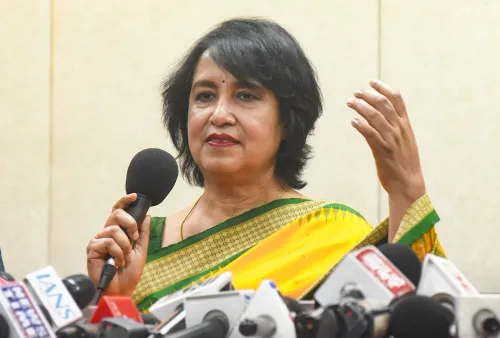
Taslima Nasrin, speaking to the media in Kolkata, reportedly made provocative statements on both the Uniform Civil Code (UCC) and Islamic seminaries, allegedly claiming that madrasas promote extremism and produce 'jihadis'. The AIMPLB characterised these remarks as an 'irresponsible attempt by a foreign national to interfere in India's internal affairs.'
AIMPLB's Strong Rebuttal
AIMPLB Spokesperson S.Q.R. Ilyas said that alleging madrasas promote extremism is 'nothing but a blatant falsehood, a malicious slander, and a deliberate attempt to malign an entire religious and educational tradition.' He added that such accusations not only hurt the sentiments of millions of Indian Muslims but also represent 'a calculated effort to vitiate the country's communal harmony.'
'Defaming such institutions, which render invaluable national service, is not only unjust but also detrimental to the country's educational and social harmony,' Ilyas said.
Call for Government Action
The Board urged the Union government to ensure that individuals — particularly those residing in India as refugees — remain within the bounds of the law. Ilyas emphasised that India cannot permit anyone, 'under the guise of freedom of expression, to spread hatred, defame religious institutions, or interfere in the country's internal affairs.'
He further noted that Nasrin's comments on Bangladesh were 'equally irresponsible and inconsistent with India's balanced foreign policy,' warning that such statements could adversely affect bilateral relations between the two neighbouring countries.
Broader Context
Taslima Nasrin has lived in India for several years after being forced to leave Bangladesh due to controversy over her writings. Her remarks on religious and social issues in India have periodically drawn criticism from Muslim organisations and political groups. This latest episode comes amid an ongoing national debate over the UCC and the role of madrasas in India's education system. The AIMPLB has previously engaged the government on matters concerning Muslim personal law and minority educational institutions.
The Board's appeal puts fresh pressure on the Centre to define the boundaries of permissible public commentary by foreign nationals residing in India on sensitive religious and constitutional matters.
Point of View
And the state's role in policing commentary on religious institutions. Nasrin is a polarising figure whose criticism of religious orthodoxy has historically drawn both admiration and condemnation — making it difficult to separate legitimate scrutiny of madrasas from motivated provocation. What the AIMPLB's statement does not address is the substance of the debate around madrasa reform, which a growing number of Indian voices — not just foreign ones — have raised. The government's response, or silence, will signal how it intends to manage that tension ahead of a politically charged UCC rollout.
NationPress
19 Sept 2026
Frequently Asked Questions
What remarks did Taslima Nasrin make about madrasas?
Taslima Nasrin reportedly claimed during a media interaction in Kolkata that Islamic seminaries promote extremism and produce 'jihadis.' The AIMPLB has described these allegations as factually baseless and a deliberate attempt to malign a religious and educational tradition.
What has the AIMPLB demanded from the Union government?
The AIMPLB has urged the Union government to take serious cognisance of Nasrin's remarks and to prevent foreign nationals residing in India from interfering in the country's internal religious, constitutional, and social affairs. It has also called for measures to ensure such provocative statements are not repeated.
Who is Taslima Nasrin and why does she live in India?
Taslima Nasrin is a Bangladeshi author who has lived in India for several years after being forced to leave Bangladesh due to controversy over her writings on religion and women's rights. The AIMPLB referred to her status as a 'foreign refugee' in India.
Why does the AIMPLB say her Bangladesh remarks are also problematic?
AIMPLB Spokesperson S.Q.R. Ilyas stated that Nasrin's comments on Bangladesh are 'inconsistent with India's balanced foreign policy' and could adversely affect bilateral relations between the two neighbouring countries, urging the government to take note of that dimension as well.
What is the broader context of this controversy?
The dispute comes amid a national debate over the Uniform Civil Code and the regulation of madrasas in India. The AIMPLB has long been a key stakeholder in matters of Muslim personal law, and its public intervention signals the sensitivity of any commentary — domestic or foreign — on Islamic educational institutions at this juncture.