Bangladesh exporters losing ground to India, Vietnam as costs surge 40%
Synopsis
Bangladesh's merchandise exports shrank 5% to $47.74 billion in 2025 even as Vietnam surged 16.8% and China grew 5.5%. With production costs up 30–40%, port tariffs rising 41%, and banks tightening credit, the country's decades-long edge as the world's cheapest garment hub is being seriously tested — and regional rivals are moving in.
Key Takeaways
Bangladesh's merchandise exports fell nearly 5 percent in 2025 to $47.74 billion , while Vietnam's exports rose 16.8 percent and China's grew 5.5 percent .
Production costs have surged 30–40 percent over several years due to higher energy prices, wages, interest rates, and currency depreciation.
Chattogram Port tariff revisions in 2025 pushed service charges up an average 41 percent ; a 20-foot container now costs Tk 16,243 , up from Tk 11,849 .
A 1–2 percent FOB price gap is enough for buyers to shift orders — on a one-million-piece garment order, that means $40,000–$80,000 in cost difference.
A US administration tariff of an additional 10 percent and Middle East conflict are adding further strain to Bangladeshi exporters.
Banks are reportedly withholding or delaying working capital despite government directives to support the sector.
Bangladesh's exporters are steadily losing market share to regional rivals including India, Vietnam, and China as surging energy, financing, and logistics costs erode already-thin profit margins, according to a report by Dhaka-based outlet The Daily Star. The findings underscore a structural vulnerability in Bangladesh's export economy at a time when global buyers are increasingly price-sensitive.
Scale of the Cost Pressure
Industry estimates indicate that production costs have surged nearly 30–40 percent over the past several years, driven by higher gas and electricity prices, rising wages, elevated interest rates, and exchange-rate depreciation. Exporters find limited room to pass these costs on to overseas buyers — a dynamic that is directly translating into lost orders and shrinking market share.
Compounding the challenge, Chattogram Port revised its tariffs in 2025, resulting in an average 41 percent hike in service charges. Charges for a 20-foot container rose 37 percent, climbing from Tk 11,849 to Tk 16,243, according to Fazlee Shamim Ehsan, executive president of the Bangladesh Knitwear Manufacturers and Exporters Association (BKMEA).
Export Numbers Tell the Story
Bangladesh's merchandise exports fell nearly 5 percent in 2025 to $47.74 billion, according to official data. In sharp contrast, Vietnam's exports rose 16.8 percent and China's grew 5.5 percent over the same period — highlighting how regional competitors are capitalising on Bangladesh's cost disadvantage.
This comes amid escalating conflict in the Middle East and a fresh 10 percent additional tariff imposed by the US administration, both of which are piling further pressure on Bangladeshi exporters already operating on razor-thin margins.
The Garment Sector at Risk
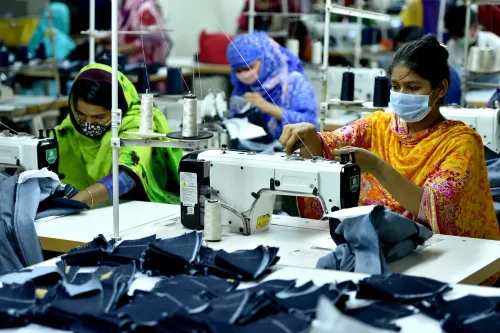
The garment industry — the backbone of Bangladesh's export economy — is particularly exposed. Buyers reportedly shift orders when Bangladesh's free-on-board (FOB) price is just 1–2 percent higher than a competitor's. A former director of the Bangladesh Garment Manufacturers and Exporters Association (BGMEA) noted that on a one-million-piece order for a $4 garment, even that marginal difference translates to a cost gap of $40,000–$80,000 — enough to swing a buyer's decision.
Financing Squeeze Adding to Woes
Access to working capital remains another critical bottleneck. Despite government calls for financial sector support, banks are reportedly reluctant to provide adequate working capital or take excessively long to process financing requests, further straining exporters' ability to fulfil orders competitively.
Notably, Bangladesh's garment sector had long been considered one of the world's most cost-competitive manufacturing hubs. The current convergence of domestic cost inflation, port tariff hikes, and an unfavourable global trade environment marks a significant departure from that historical advantage — and raises questions about the country's medium-term export trajectory.
Point of View
But that buffer has narrowed sharply. What is striking is the simultaneity of pressures: energy inflation, a port tariff shock, currency weakness, and tighter credit — all at once, with no single lever available to offset the others. Vietnam's 16.8 percent export surge in the same year Bangladesh contracted is not coincidental; it is a signal that buyers are already redirecting. Without urgent reform on energy costs and trade finance access, the risk is not just slower growth — it is a permanent loss of order books that will not return.
NationPress
21 Sept 2026
Frequently Asked Questions
Why are Bangladesh's exports falling?
Bangladesh's merchandise exports fell nearly 5 percent in 2025 to $47.74 billion, primarily because production costs surged 30–40 percent due to higher energy prices, wages, interest rates, and exchange-rate depreciation. With limited ability to pass these costs on to buyers, exporters are losing price-sensitive orders to rivals like Vietnam and China.
How do Bangladesh's export numbers compare to Vietnam and China?
While Bangladesh's exports contracted nearly 5 percent in 2025, Vietnam's exports rose 16.8 percent and China's grew 5.5 percent over the same period. The divergence highlights a growing competitiveness gap that is increasingly benefiting Bangladesh's regional rivals.
How much have Chattogram Port charges increased?
Chattogram Port revised its tariffs in 2025, resulting in an average 41 percent hike in service charges. The charge for a 20-foot container rose 37 percent, from Tk 11,849 to Tk 16,243, according to the BKMEA's executive president Fazlee Shamim Ehsan.
What role does the US tariff play in Bangladesh's export crisis?
The US administration's additional 10 percent tariff is adding to already elevated cost pressures on Bangladeshi exporters. Combined with Middle East conflict disrupting logistics and rising domestic costs, it is further eroding the price advantage Bangladesh once held over competitors.
Why is even a 1–2 percent price gap significant for Bangladesh's garment exporters?
Buyers reportedly shift orders when Bangladesh's FOB price is just 1–2 percent higher than a competitor's. On a one-million-piece order for a $4 garment, that small gap translates to a $40,000–$80,000 cost difference — large enough to redirect an entire order to a rival supplier, according to a former BGMEA director.