Bangladesh trade deficit hits 3-year high of $27.28 bn in FY26
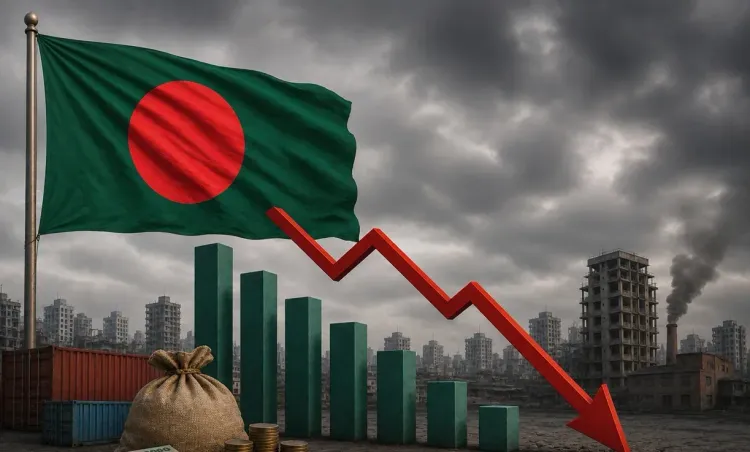
Synopsis
Bangladesh's trade deficit ballooned to a three-year high of $27.28 billion in FY26 — not because the economy is booming, but because petroleum-driven import costs surged while exports stalled. The real story is that capital machinery imports remain weak, meaning the import surge is not yet translating into productive investment. Record remittances of $35.6 billion are the only reason a balance of payments crisis has been avoided.
Key Takeaways
Bangladesh's trade deficit hit a three-year high of $27.28 billion in FY26 , up 34 per cent year-on-year.
Imports rose 10.5 per cent to $71.14 billion — the largest annual increase since FY22 — driven partly by higher petroleum prices linked to West Asian conflict .
Exports were nearly flat at $43.85 billion , weighed down by tariff barriers and supply disruptions in key markets.
Capital machinery and industrial raw material imports remained weak, signalling no broad-based investment revival, according to RAPID chairman Abdur Razzaque .
Record remittances of $35.6 billion contained the current-account deficit to around $1.6 billion , averting a BoP crisis.
Bangladesh's trade deficit widened to a three-year high of $27.28 billion in FY26, surging 34 per cent year-on-year as import costs climbed sharply while export earnings stayed largely flat, according to a new report citing central bank data.
Key Figures Behind the Widening Gap
Exports reached $43.85 billion in FY26, almost unchanged from the previous year, while imports rose 10.5 per cent to $71.14 billion — the largest annual import increase since FY22. The divergence between stagnant export receipts and surging import costs pushed the deficit to its highest level in three years.
What Drove the Import Surge
Khondaker Golam Moazzem, research director at the Centre for Policy Dialogue (CPD), said global factors rather than domestic demand were the primary drivers of the widening trade gap. He pointed to higher petroleum prices stemming from West Asian conflict as a key contributor to the elevated import bill, while tariff barriers in key export markets and supply disruptions dampened Bangladesh's outbound orders.
Notably, private credit growth stood at a historic low, according to another analyst cited in the report, signalling subdued domestic demand and investment activity — a pattern that complicates any straightforward reading of the import surge as economic strength.
Caution on Interpreting the Numbers
Abdur Razzaque, chairman of the Research and Policy Integration for Development (RAPID), cautioned against treating the higher import bill as evidence of stronger investment or domestic activity. He noted that imports of capital machinery and industrial raw materials remained weak, indicating the rise in aggregate imports had not yet been accompanied by a broad-based revival in productive investment.
Razzaque acknowledged, however, that the recovery in imports was 'not necessarily a bad sign' after years of import compression amid persistent inflation. Greater availability of food, fuel, essential consumer goods, and production inputs, he argued, could help ease domestic supply constraints, improve competition, and reduce price pressures. A larger trade deficit, he noted, can be deemed healthy when it reflects imports of machinery, technology, and inputs that expand future productive and export capacity.
Remittances Provide a Critical Buffer
Despite the deficit's scale, Bangladesh has not faced an immediate balance of payments (BoP) crisis. Remittances rose to a record $35.6 billion in FY26, providing, according to the report, a 'large cushion that helped contain the current-account deficit to around $1.6 billion.' This inflow of overseas worker earnings has effectively absorbed much of the external pressure that would otherwise have strained the country's foreign exchange position.
What to Watch Next
The sustainability of this buffer depends on whether remittance inflows hold and whether export orders recover as global trade conditions stabilise. With capital machinery imports still weak, a meaningful investment-led recovery in Bangladesh's export capacity remains, for now, a forward risk rather than a present reality.
Point of View
But the composition is the real concern. When import growth is led by petroleum rather than capital goods, it signals cost-push pressure rather than investment momentum — and Bangladesh's weak private credit growth reinforces that reading. The remittance cushion is substantial, but it is a household-driven inflow, not a structural fix. If West Asian tensions persist or global garment demand softens further, Dhaka could find itself with a shrinking buffer and a still-stagnant export base — a combination that would test its external account resilience far more severely than FY26's numbers suggest.
NationPress
27 Sept 2026
Frequently Asked Questions
What is Bangladesh's trade deficit in FY26?
Bangladesh's trade deficit reached a three-year high of $27.28 billion in FY26, surging 34 per cent year-on-year. Imports rose 10.5 per cent to $71.14 billion while exports stayed nearly flat at $43.85 billion.
Why did Bangladesh's trade deficit widen in FY26?
The widening was driven primarily by global factors, including higher petroleum prices linked to West Asian conflict, which pushed up import costs. Simultaneously, tariff barriers in key markets and supply disruptions dampened export orders, keeping outbound earnings stagnant.
Has the trade deficit caused a balance of payments crisis in Bangladesh?
No immediate BoP crisis has emerged, largely because remittances hit a record $35.6 billion in FY26, containing the current-account deficit to around $1.6 billion. Analysts describe remittances as a 'large cushion' absorbing the external pressure.
Does the import surge reflect stronger investment in Bangladesh?
Not according to analysts. RAPID chairman Abdur Razzaque noted that imports of capital machinery and industrial raw materials remained weak, indicating the aggregate import rise has not been accompanied by a broad-based revival in productive investment.
What should be watched to assess Bangladesh's economic trajectory?
Key indicators include whether remittance inflows are sustained, whether export orders recover as global trade stabilises, and whether capital machinery imports pick up — the latter being the clearest signal of a genuine investment-led recovery.