Indore Declaration: BRICS nations adopt farmer-first food security roadmap
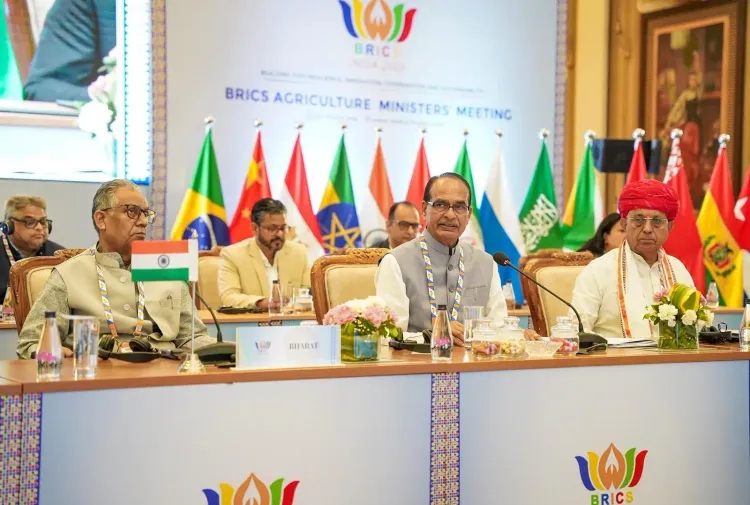
Synopsis
BRICS nations representing half the world's population and 42 per cent of global farmland have jointly adopted the Indore Declaration — a farmer-first roadmap that launches four concrete initiatives including an AI-powered digital agriculture network coordinated by IIT Delhi and a global forum to protect farmers' seed rights. India's BRICS Presidency has turned a ministerial meeting into a blueprint for the bloc's agricultural future.
Key Takeaways
The Indore Declaration was unanimously adopted at the BRICS Agriculture Ministers' Meeting in Indore on 14 June 2025 .
BRICS nations collectively account for nearly half the world's population , 42% of global agricultural land, and 42% of global foodgrain production.
Four new initiatives launched: BRICS Network on Agro-Ecology, BRICS Digital Agriculture Network (coordinated by IIT Delhi ), Global Forum on Farmers' Seed Rights, and BRICS AgriN .
India's total foodgrain production stands at 376 million tonnes ; wheat at nearly 118 million tonnes ; horticulture at over 378 million tonnes .
The existing BRICS Agricultural Research Platform will be upgraded into a 'Knowledge-to-Action Hub' to fast-track lab-to-field innovation transfer.
The declaration also explores a BRICS grain exchange and reaffirms support for a fair multilateral agricultural trading system.
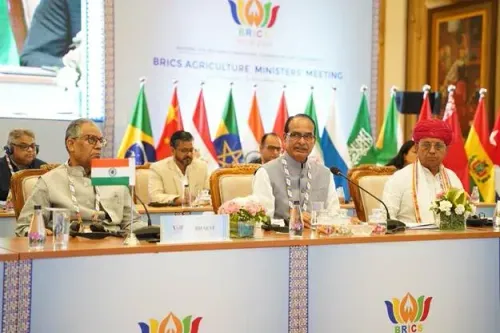
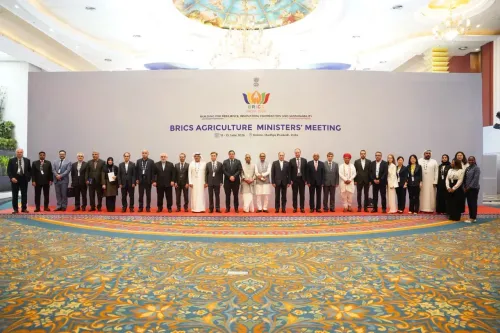
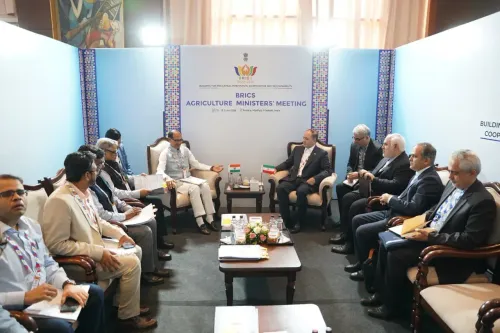
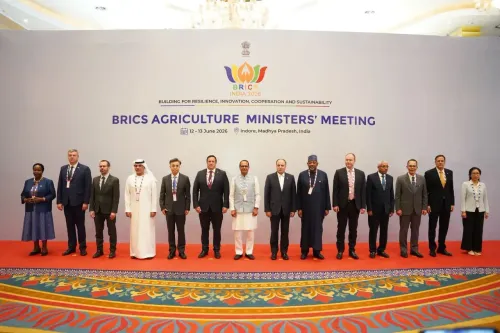
The BRICS Agriculture Ministers' Meeting concluded in Indore on 14 June 2025 with the unanimous adoption of the 'Indore Declaration', committing member nations to a coordinated strategy on food security, climate-resilient farming, and farmer empowerment. Hosted by India under its BRICS Presidency, the two-day ministerial gathering brought together nearly 100 delegates, including around 60 from BRICS member and partner countries.
What the Indore Declaration Commits To
The declaration is structured around four core priorities: ensuring food and nutritional security; promoting agricultural trade and cooperation; advancing regenerative, climate-resilient and sustainable practices; and strengthening innovation, technology, and partnerships. A dedicated session addressed the specific challenges facing small and marginal farmers — often termed family farmers — including access to inputs, credit, remunerative prices, and markets.
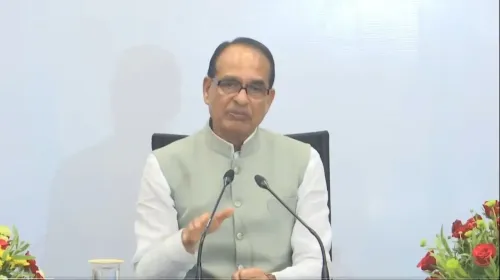
Union Minister for Agriculture and Farmers' Welfare Shivraj Singh Chouhan described the outcome as a 'strong message of hope, trust and collective responsibility'. Addressing the media alongside Ministers Ramnath Thakur and Bhagirath Choudhary, Chouhan noted that BRICS nations collectively represent nearly half the world's population, 42 per cent of global agricultural land, and 42 per cent of global foodgrain production.
Four New Initiatives Launched
At the heart of the declaration are four major new initiatives designed to convert commitments into on-ground action:
1. BRICS Network of Centres of Excellence on Agro-Ecology and Regenerative Agriculture — A platform for joint research, knowledge sharing, and capacity building in natural, organic, and regenerative farming. India's Indian Institute of Farming Systems Research, Modipuram, will serve as the country's nodal centre, aligned with Prime Minister Narendra Modi's push for natural and organic farming.
2. BRICS Network on Digital Agriculture — Coordinated by IIT Delhi, this network will deploy AI, geospatial technologies, and digital public infrastructure to deliver data-driven solutions directly to farmers.
3. Global Forum on Farmers' Rights in Seed Systems — Aimed at protecting farmers' rights over seeds, conserving indigenous varieties, and preserving traditional knowledge — critical for biodiversity and climate adaptation.
4. BRICS AgriN (Agro Inputs, Genetic Resources and Information Network) — A framework to promote sharing of superior crop varieties, genetic resources, and best practices across member countries.
Additionally, the existing BRICS Agricultural Research Platform is to be strengthened into a 'Knowledge-to-Action Hub', designed to accelerate the transfer of innovations from laboratories to farmers' fields.
Climate, Trade, and India's Agricultural Record
Discussions during the meeting also addressed pressing concerns including climate change, potential El Niño impacts, carbon credits, food loss, and rising fertiliser prices. Chouhan reaffirmed India's commitment to providing subsidised fertilisers to farmers and promoting balanced use alongside natural farming practices.
The declaration also reaffirms support for a fair multilateral trading system and explores proposals such as a BRICS grain exchange. Bilateral meetings on the sidelines focused on reducing trade barriers and enhancing technology exchange. Greater participation of youth and women in agriculture, along with support for agri-startups and mechanisation through custom hiring centres, also featured prominently.
Chouhan highlighted India's agricultural performance, noting that the sector has grown at an average annual rate of 4.5 per cent over the last decade. Total foodgrain production has reached 376 million tonnes, wheat production has touched nearly 118 million tonnes, horticultural output has crossed 378 million tonnes, and fish production has risen to over 19 million tonnes.
What Comes Next
Implementation of the Indore Declaration's initiatives is expected to benefit millions of farmers across BRICS nations in the years ahead. India's role as host and agenda-setter under its BRICS Presidency positions the country as a key driver of the bloc's agricultural cooperation framework going forward.
Point of View
Not just agree. Yet the proof will be in execution: BRICS agricultural cooperation has historically struggled with follow-through given the bloc's internal geopolitical tensions. Assigning IIT Delhi to coordinate the digital agriculture network is a concrete Indian win, but whether China, Russia, and newer partner countries align on data-sharing norms remains an open question. India's ability to use its BRICS Presidency to cement agricultural leadership is real — but the gap between declaration and delivery is where past multilateral farm frameworks have faltered.
NationPress
27 Oct 2026
Frequently Asked Questions
What is the Indore Declaration adopted at the BRICS Agriculture Ministers' Meeting?
The Indore Declaration is a consensus document unanimously adopted by BRICS Agriculture Ministers in Indore on 14 June 2025, committing member nations to coordinated action on food security, climate-resilient farming, agricultural trade, and farmer empowerment. It launches four new multilateral initiatives and upgrades the existing BRICS Agricultural Research Platform into a Knowledge-to-Action Hub.
What are the four new initiatives announced under the Indore Declaration?
The four initiatives are: the BRICS Network of Centres of Excellence on Agro-Ecology and Regenerative Agriculture (with India's IIFSR Modipuram as nodal centre); the BRICS Network on Digital Agriculture coordinated by IIT Delhi; the Global Forum on Farmers' Rights in Seed Systems; and BRICS AgriN, a network for sharing genetic resources and agro-inputs across member countries.
Why does the BRICS Agriculture Ministers' Meeting matter for global food security?
BRICS nations collectively represent nearly half the world's population, 42 per cent of global agricultural land, and 42 per cent of foodgrain production. A unified stance from this bloc on food security, trade, and climate-resilient farming carries significant weight in shaping international agricultural policy and multilateral trade frameworks.
What role is India playing in BRICS agricultural cooperation in 2025?
India is hosting the BRICS Presidency in 2025 and organised the two-day ministerial meeting in Indore. Union Minister Shivraj Singh Chouhan led the Indian delegation and championed initiatives aligned with Prime Minister Narendra Modi's push for natural farming. India's IIT Delhi will coordinate the BRICS Digital Agriculture Network, and IIFSR Modipuram will serve as the nodal centre for agro-ecology research.
What are India's key agricultural statistics highlighted at the Indore meeting?
India's agriculture sector has grown at an average annual rate of 4.5 per cent over the past decade. Total foodgrain production has reached 376 million tonnes, wheat production is nearly 118 million tonnes, horticultural output has crossed 378 million tonnes, and fish production exceeds 19 million tonnes, according to figures cited by Union Minister Chouhan.