BRICS Indore Declaration adopted: 4 new agri platforms, farmer rights focus
Synopsis
BRICS nations didn't just hold another ministerial meeting in Indore — they committed to four concrete cooperation platforms, from an AI-driven digital agriculture network coordinated by IIT Delhi to a first-of-its-kind Global Forum on Farmers' Rights in Seed Systems. With BRICS controlling 42% of global farmland and foodgrain output, the Indore Declaration could reshape how the bloc approaches food security amid mounting climate and trade pressures.
Key Takeaways
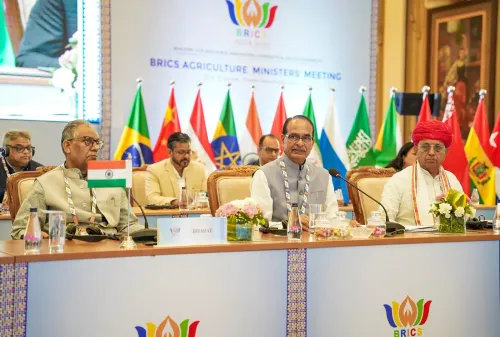
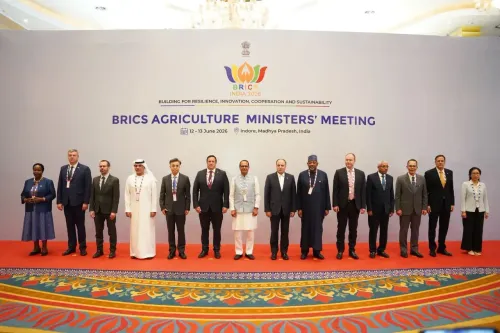
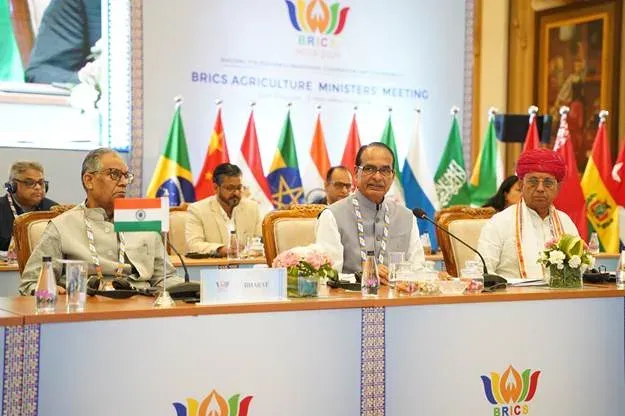
BRICS nations unanimously adopted the Indore Declaration on 13 June at the BRICS Agriculture Ministers' Meeting in Indore .
Four new cooperation platforms were announced, covering agro-ecology, digital agriculture, farmers' seed rights, and agri-inputs.
IIT Delhi will coordinate the BRICS Network on Digital Agriculture ; IIFSR Modipuram will anchor India's agro-ecology centre.
BRICS nations collectively hold ~42% of global agricultural land and produce ~42% of global foodgrain.
India reaffirmed subsidised input prices: urea at ₹266/bag and DAP at ₹1,350/bag despite global cost pressures.
The existing BRICS Agricultural Research Platform will be upgraded into a 'Knowledge-to-Action Hub' .
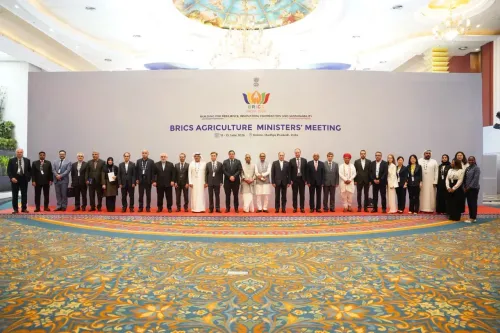
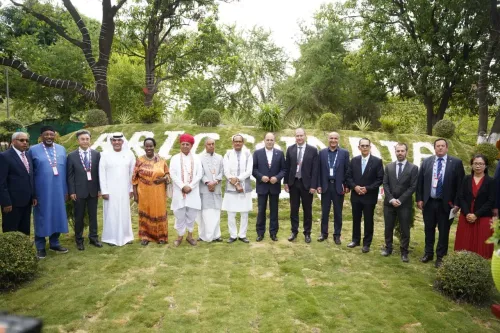
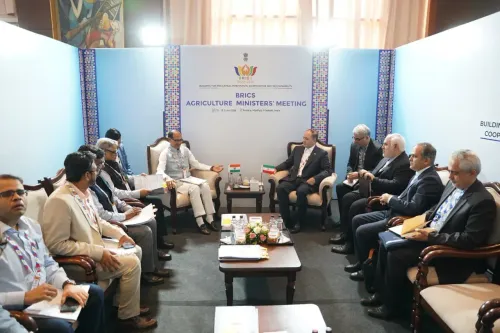
BRICS nations unanimously adopted the Indore Declaration on 13 June, committing to food security, farmer welfare, climate-resilient agriculture, and digital farming, the Ministry of Agriculture & Farmers Welfare confirmed. The landmark outcome emerged from the BRICS Agriculture Ministers' Meeting held in Indore under India's BRICS Presidency, with nearly 100 delegates — including around 60 representatives from BRICS member and partner countries — in attendance.
What the Indore Declaration Commits To
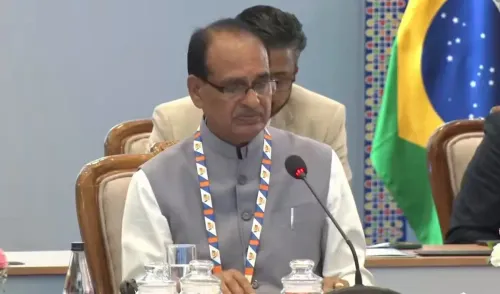
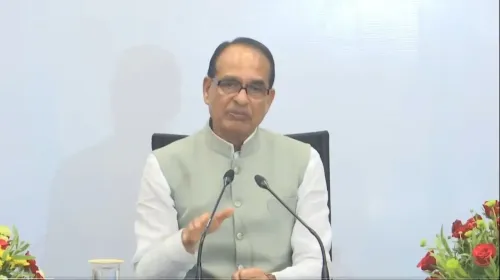
The declaration follows extensive deliberations across four priority areas: food and nutritional security, promotion of agricultural trade, climate-resilient and sustainable farming practices, and innovation and technology partnerships. Union Agriculture Minister Shivraj Singh Chouhan, addressing a press conference after the meeting, described the declaration as reflecting 'the collective resolve of BRICS nations to build a more secure, sustainable and prosperous future through agriculture.'
The significance of the grouping is hard to overstate. BRICS countries collectively account for nearly half the world's population, approximately 42 per cent of global agricultural land, and around 42 per cent of global foodgrain production.
Four New Cooperation Platforms Announced
As part of the declaration's outcomes, BRICS countries agreed to establish four new cooperation platforms.
The first is the BRICS Network of Centres of Excellence on Agro-Ecology and Regenerative Agriculture, targeting joint research, knowledge sharing, and capacity building in natural, organic, and regenerative farming. India's Indian Institute of Farming Systems Research, Modipuram, will serve as the country's Centre of Excellence under this initiative.
The second, the BRICS Network on Digital Agriculture, will drive cooperation in artificial intelligence, geospatial technologies, digital public infrastructure, and data-driven agricultural solutions. IIT Delhi will coordinate this network.
Third, a Global Forum on Farmers' Rights in Seed Systems will be created to protect farmers' seed rights, conserve indigenous seed diversity, and preserve traditional agricultural knowledge — an area of growing concern as commercial seed systems expand.
The fourth initiative, BRICS AgriN (Agro Inputs, Genetic Resources and Information Network), seeks to enhance cooperation in agricultural inputs, seeds, genetic resources, technical exchanges, and capacity building among member nations.
Upgrading the Agricultural Research Platform
Beyond the four new platforms, BRICS countries agreed to strengthen the existing BRICS Agricultural Research Platform, transforming it into a 'Knowledge-to-Action Hub' to accelerate the transfer of innovations from laboratories to farmers' fields. Chouhan said the move was aimed at ensuring research breakthroughs reach ground-level beneficiaries faster.
India's Domestic Commitment on Input Prices
Chouhan also reaffirmed the Indian government's commitment to keeping agricultural inputs affordable. He stated that urea would continue to be available at ₹266 per bag and DAP at ₹1,350 per bag, despite rising global input costs — a signal that domestic farmer support remains insulated from international price pressures for now.
The Indore Declaration marks a substantive step in multilateral agricultural cooperation, and the four new platforms will be watched closely for implementation timelines and actual resource commitments in the months ahead.
Point of View
Two anchored to Indian institutions, is a deliberate move to position India as the operational hub of BRICS agri-cooperation. But the history of multilateral agricultural initiatives is littered with well-designed platforms that never scaled. The real test will be whether the Knowledge-to-Action Hub and the Digital Agriculture Network attract genuine resource commitments from Brazil, China, and South Africa, or remain India-funded showcases. The Global Forum on Farmers' Rights in Seed Systems is the sleeper item: in an era of corporate seed consolidation, this could carry real policy weight — if member nations follow through with enforceable frameworks rather than declarations.
NationPress
13 Sept 2026
Frequently Asked Questions
What is the BRICS Indore Declaration?
The Indore Declaration is a multilateral agricultural commitment unanimously adopted by BRICS nations on 13 June at the BRICS Agriculture Ministers' Meeting in Indore. It covers food security, farmer welfare, climate-resilient agriculture, and digital farming, and establishes four new cooperation platforms among member countries.
What are the four new BRICS agricultural cooperation platforms?
The four platforms are: the BRICS Network of Centres of Excellence on Agro-Ecology and Regenerative Agriculture; the BRICS Network on Digital Agriculture (coordinated by IIT Delhi); the Global Forum on Farmers' Rights in Seed Systems; and BRICS AgriN, focused on agri-inputs, genetic resources, and capacity building.
Why does the Indore Declaration matter for global food security?
BRICS nations collectively account for nearly half the world's population, 42% of global agricultural land, and 42% of global foodgrain production. Coordinated policy on food security, digital farming, and climate-resilient agriculture among these nations could have significant global consequences for food supply and trade.
What is India's role in the BRICS agricultural cooperation initiatives?
India holds the BRICS Presidency under which the meeting was convened. Two Indian institutions — IIT Delhi and the Indian Institute of Farming Systems Research, Modipuram — will anchor key platforms, making India a central operational node in the new cooperation architecture.
What did India commit on fertiliser prices at the BRICS meeting?
Agriculture Minister Shivraj Singh Chouhan reaffirmed that urea will remain available at ₹266 per bag and DAP at ₹1,350 per bag, despite rising global input costs, signalling continued domestic subsidy support for Indian farmers.