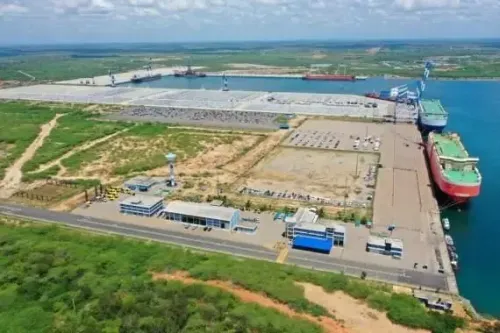
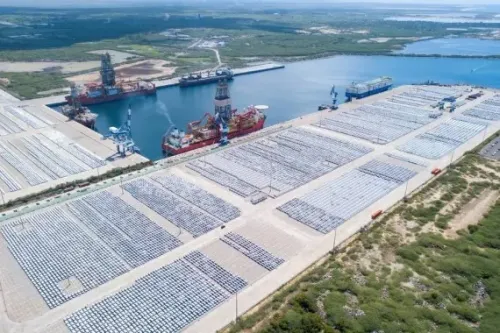
China exits Colombo port project, exposing BRI's commercial limits: Report
Synopsis
China Merchants Port Holdings has walked away from a $392 million logistics hub at Colombo Port — and a new report argues this is no isolated misfire. With Sri Lanka's post-2022 fiscal constraints clashing with BRI's standard terms, the exit exposes a structural tension at the heart of Beijing's infrastructure diplomacy: capital and construction expertise are not enough if the deal terms don't survive contact with host-country reality.
Key Takeaways
China Merchants Port Holdings and its Sri Lankan partners have abandoned a $392 million logistics and warehousing project at Colombo Port , originally announced in 2023 .
The collapse was driven by disagreements over tax concessions , commercial viability, and operational conditions.
Sri Lanka's IMF programme constraints, adopted after its 2022 economic crisis , made the proposed tax arrangements incompatible with national commitments.
Hambantota Port is cited as a parallel case where poor commercial returns led Sri Lanka to transfer operational control to a Chinese state-owned company .
The report by Maldives Insight warns that BRI influence should be measured by operational success and sustainable returns, not project announcements or capital pledges.
China's withdrawal from a proposed $392 million logistics hub at Sri Lanka's Port of Colombo highlights the mounting commercial and political obstacles confronting several Belt and Road Initiative (BRI) projects across the region, according to a new report released on 30 October 2026. The findings underscore growing questions about the real-world viability of Beijing's flagship infrastructure programme.
What Happened at Colombo Port
China Merchants Port Holdings and its Sri Lankan partners have jointly agreed to abandon the logistics and warehousing project at Colombo Port, originally announced in 2023, according to the report by Maldives Insight. The collapse followed irreconcilable disagreements over tax concessions, the project's commercial viability, and operational conditions — none of which the parties could resolve to mutual satisfaction.
The investment framework raised specific concerns about whether the proposed tax arrangements were compatible with Sri Lanka's commitments under its International Monetary Fund (IMF) programme, a constraint that gained fresh weight after the island nation's devastating 2022 economic crisis and debt restructuring. The project partners reportedly failed to secure the terms they deemed necessary for commercial sustainability.
A Pattern Across BRI Projects in Sri Lanka
The Colombo withdrawal is not an isolated incident. The report points to a recurring pattern in which Chinese-backed projects in Sri Lanka — from Hambantota Port to Colombo Port City — have repeatedly clashed with local political priorities, fiscal constraints, and commercial realities. The report notes that the failure is particularly significant because Sri Lanka has been among the most prominent destinations for BRI investment globally.
The case of Hambantota Port offers an instructive precedent: after the port failed to generate sufficient commercial returns under Sri Lankan management, the country transferred long-term operational control to a Chinese state-owned company — a move that drew significant international scrutiny and became a frequently cited example of so-called 'debt-trap diplomacy', a characterisation that Beijing disputes.
The Report's Broader Warning on BRI's Strategic Value
The Maldives Insight report argues that the true measure of Beijing's regional influence cannot rest on the volume of projects announced or the scale of capital committed. 'A port concession, refinery or logistics hub becomes strategically and economically meaningful only when it operates successfully, generates sustainable returns and meets the needs of the host country,' the publication stated.
It added that while 'Beijing may bring capital and construction expertise, it cannot guarantee that every project will proceed on its preferred terms.' The report attributes part of the Colombo failure to weaknesses in the original planning of the project, rather than solely to political friction.
Sri Lanka's Cautious Post-Crisis Stance
Since its 2022 economic collapse — one of the worst in its modern history — Sri Lanka has adopted a markedly more cautious posture toward large foreign-backed investments. Colombo is now more attentive to ensuring that tax incentives, exclusive operating rights, and long-term concessions are genuinely aligned with the public interest and do not conflict with its ongoing IMF recovery programme. This recalibrated approach is seen as a direct factor in the collapse of negotiations with China Merchants Port Holdings.
As Beijing continues to push BRI investments across South Asia and beyond, the Colombo episode suggests that host-country conditions — fiscal, political, and institutional — will increasingly determine whether announced projects translate into operational realities.
Point of View
Not a diplomatic one. What the report surfaces, but understates, is the cumulative reputational cost: each collapsed or restructured BRI project raises the due-diligence bar for the next host government, compressing the space in which Beijing can negotiate its preferred terms. India, which shares a strategic interest in a stable and sovereign Sri Lanka, should note that the most effective counter to BRI overreach is not rival infrastructure spending — it is strengthening the institutional capacity of partner nations to negotiate better deals from the outset.
NationPress
30 Oct 2026
Frequently Asked Questions
Why did China exit the Colombo Port logistics project?
China Merchants Port Holdings and its Sri Lankan partners abandoned the $392 million Colombo Port logistics hub due to unresolved disagreements over tax concessions, commercial viability, and operational terms. The proposed tax arrangements were also found to be incompatible with Sri Lanka's IMF programme commitments following the country's 2022 economic crisis.
What is the Belt and Road Initiative (BRI) and why is this significant?
The Belt and Road Initiative is China's flagship global infrastructure and investment programme spanning dozens of countries. The Colombo exit is significant because Sri Lanka has been one of BRI's most prominent host nations, and the failure of multiple projects there illustrates the gap between announced capital and commercially viable outcomes.
How does the Hambantota Port case relate to this development?
Hambantota Port is an earlier BRI project in Sri Lanka that failed to generate sufficient commercial returns under Sri Lankan management, eventually leading the country to transfer long-term operational control to a Chinese state-owned company. The report cites it alongside the Colombo exit as evidence of a recurring pattern of commercial and political friction in BRI projects on the island.
What broader lesson does the Maldives Insight report draw from these failures?
The report argues that Beijing's regional influence cannot be measured by the number of projects announced or billions pledged. A port, refinery or logistics hub only becomes strategically meaningful when it operates successfully, generates sustainable returns, and meets host-country needs — conditions that several BRI projects have failed to meet.
How has Sri Lanka's approach to foreign investment changed since 2022?
Following its severe 2022 economic crisis and subsequent debt restructuring, Sri Lanka has adopted a more cautious approach to large foreign-backed investments. Colombo now scrutinises whether tax incentives, exclusive operating rights, and long-term concessions are in the public interest and consistent with its IMF recovery programme obligations.