China's BRI push in Bangladesh deepens Bay of Bengal footprint: Analysis

Synopsis
A new analysis draws a striking parallel between China's BRI infrastructure push in Bangladesh and British colonial rail networks built to serve imperial trade — not local development. With Chinese-backed roads, bridges, and ports concentrated around Dhaka, Chittagong, and the river systems draining into the Bay of Bengal, Beijing is quietly building logistical reach into one of the Indian Ocean's most strategically sensitive corridors.
Key Takeaways
China's BRI projects in Bangladesh span roads, bridges, railways, and seaports, concentrated in the economically vital Dhaka and Chittagong divisions.
An analysis by Dr Sakariya Kareem compares China's infrastructure engagement to British colonial railways designed to serve the investor's economic interests, not the host nation's balanced development.
Chinese-backed projects link Dhaka and Chittagong to maritime gateways along the Padma , Jamuna , Meghna , and Karnaphuli river systems.
Inland waterways handle more than 50% of Bangladesh's cargo movement, compared to just 2% in India — making river-linked BRI projects strategically significant.
The infrastructure could potentially deepen China's influence in the Bay of Bengal and the broader Indian Ocean region , raising strategic concerns for New Delhi .
China's infrastructure drive in Bangladesh under the Belt and Road Initiative (BRI) is reshaping key economic corridors and opening wider channels for Chinese goods and industrial inputs, according to an analysis by Dr Sakariya Kareem cited in a report by Asian Lite International. The findings carry significant implications for India's strategic calculus in the Bay of Bengal and the broader Indian Ocean region.
Infrastructure Build-Up and Economic Access
The BRI's footprint in Bangladesh spans roads, bridges, railways, and seaport infrastructure, with Chinese-backed projects facilitating the flow of Chinese manufactured goods and semi-processed industrial inputs into Bangladeshi markets. According to the analysis, Beijing's engagement reflects a deliberate focus on advancing its own economic interests rather than promoting balanced development in the host country.
The geographical concentration of these projects is telling. Central and southeastern Bangladesh — particularly the Dhaka and Chittagong divisions, which are among the country's most developed economic zones — have received the bulk of BRI investment. Both regions are also critical centres of Bangladesh's readymade garment industry, the country's dominant manufacturing sector.
The Colonial Infrastructure Parallel
Dr Kareem draws a pointed historical comparison: China's current infrastructure engagement in Bangladesh mirrors the railway network built in India during British rule, when major ports — Bombay, Calcutta, and Madras — were connected to their hinterlands primarily to ferry raw materials to British industries and channel British manufactured goods back into Indian markets. The analogy suggests that BRI projects may be structurally designed to serve the investor's economic priorities rather than the recipient nation's long-term development needs.
Strategic Waterways and Bay of Bengal Access
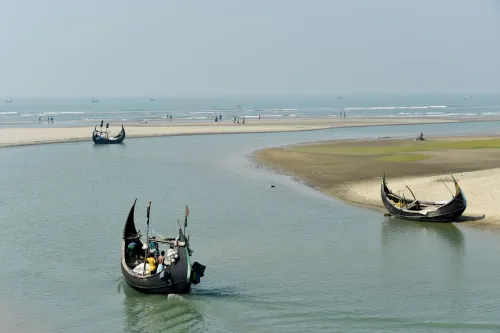
Bangladesh's three major river systems — the Padma, Jamuna, and Meghna — flow through the country before emptying into the Bay of Bengal, with several key ports clustered around their mouths. The Karnaphuli River in the east drains the Chittagong Hill Tracts toward the Bay near Chittagong, one of South Asia's busiest port cities.
Notably, inland waterways account for more than half of Bangladesh's total cargo movement and around a quarter of its passenger traffic — a stark contrast to India, where inland waterways handle only around 2% of total cargo. Many Chinese-assisted road and bridge projects are concentrated along these river systems, linking Dhaka and Chittagong directly to maritime gateways, reportedly enhancing China's logistical reach toward the Indian Ocean.
Wider Strategic Significance
The analysis argues that BRI-backed infrastructure in Bangladesh is acquiring a significance beyond trade facilitation. The combined effect of port development, road connectivity, and river-linked logistics could potentially extend China's strategic influence in the Bay of Bengal — a body of water that is increasingly contested among regional and global powers. This comes amid growing attention from India, the United States, and other Quad partners on Chinese infrastructure diplomacy across South and Southeast Asia.
As BRI projects in Bangladesh advance, analysts and policymakers in New Delhi are expected to scrutinise their dual-use potential and the pace at which Beijing consolidates its presence along India's eastern maritime flank.
Point of View
Not the host country's internal development. What mainstream coverage often misses is the waterway dimension: Bangladesh's inland river network is far more cargo-significant than India's, and Chinese road-bridge projects deliberately plug into that grid at the Dhaka-Chittagong axis. For New Delhi, the concern is not abstract — it is a Chinese logistical chain that now runs from Yunnan to the Bay of Bengal with Bangladesh as the transit corridor. India's own connectivity deficit with its northeastern states makes this asymmetry harder to counter than a headline map of BRI dots suggests.
NationPress
15 Sept 2026
Frequently Asked Questions
What are China's BRI projects in Bangladesh?
China's Belt and Road Initiative (BRI) projects in Bangladesh include roads, bridges, railways, and seaport infrastructure, concentrated largely in the Dhaka and Chittagong divisions. According to an analysis by Dr Sakariya Kareem, these projects primarily facilitate the movement of Chinese manufactured goods and industrial inputs into Bangladeshi markets.
Why is China's BRI presence in Bangladesh strategically significant?
The BRI infrastructure links key Bangladeshi economic corridors to maritime gateways along river systems that drain into the Bay of Bengal, potentially extending China's strategic influence in the Indian Ocean region. Analysts argue this gives Beijing logistical reach into one of South Asia's most geopolitically contested waterways.
How do China's BRI projects in Bangladesh compare to British colonial infrastructure?
Dr Kareem's analysis draws a parallel with British colonial railways in India, which connected ports like Bombay, Calcutta, and Madras to their hinterlands primarily to serve British industrial and trade interests rather than the subcontinent's own development. The analysis suggests BRI projects follow a similar investor-first logic.
Which regions of Bangladesh have received the most BRI investment?
Central and southeastern Bangladesh — particularly the Dhaka and Chittagong divisions — have been the primary focus of BRI projects. These are also the country's most economically developed zones and the heart of its readymade garment industry.
How important are inland waterways to Bangladesh's transport network?
Inland waterways account for more than half of Bangladesh's total cargo movement and around a quarter of passenger traffic — significantly higher than India, where they handle only about 2% of cargo. Many Chinese-assisted infrastructure projects are built around these river systems, amplifying their strategic value.