How is Congress Restructuring Its Chhattisgarh Unit?
Synopsis
In a bold move to revitalize its organizational structure before the 2028 elections, Congress President Mallikarjun Kharge has appointed 41 new District Congress Committee presidents in Chhattisgarh. This strategic overhaul aims to strengthen grassroots connections and enhance party performance following recent electoral setbacks.
Key Takeaways
41 new District Congress Committee presidents appointed in Chhattisgarh.
Strategic overhaul aimed at revitalizing the party before the 2028 elections .
Focus on grassroots representation and inclusivity.
New leadership includes at least eight women leaders .
Immediate tasks involve activating booth committees for upcoming elections.
New Delhi/Raipur Nov 28 (NationPress) In a significant shake-up of its organizational structure ahead of the 2028 Assembly elections, Congress President Mallikarjun Kharge has sanctioned the selection of 41 new District Congress Committee (DCC) presidents throughout Chhattisgarh effective immediately.
The changes, approved as part of the party’s ongoing ‘Sangathan Srijan Abhiyan’, followed an in-depth review conducted by AICC observers, who presented comprehensive reports after engaging in extensive consultations with block and booth-level workers, former legislators, and prominent leaders in each district.
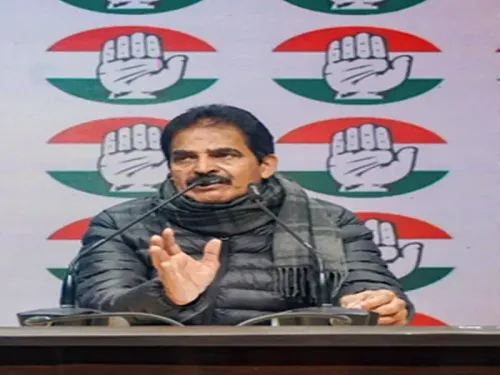
AICC General Secretary KC Venugopal, in an official announcement, noted that one-on-one conversations were conducted with each observer and senior state leaders to finalize the list, ensuring a connection to the grassroots, “winnability, and social representation.”
Key appointments include former minister and esteemed tribal figure Prem Shankar Shukla in Bastar Rural, ex-MLA Ashish Chhabra in Bemetara, veteran OBC leader Dwarkadhish Yadav in Mahasamund, and former Rajya Sabha member Rajendra Pappy Banjare in Raipur Rural.
In the pivotal Raipur City unit, Shrikumar Shankar Menan has been appointed president, while Harish Lakhma will lead Sukma, a district significantly affected by Left Wing Extremism.
This strategy is perceived as an effort to invigorate party members following the disappointing results in the 2023 Assembly elections, where Congress secured only 35 seats against the BJP’s 54.
According to state Congress sources, the new lineup maintains a balance between youth and experience while ensuring fair representation for women, SC/ST, OBC, and minority communities.
At least eight women leaders, including Sumitra Ghritlahare (Balodabazar), Tarini Chandrakar (Dhamtari), and Rashimi Gabhel (Sakti), have been selected.
This initiative also signifies the conclusion of prolonged uncertainty regarding district-level leadership, which had led to factional disputes in various regions.
With local body elections anticipated in 2026-27, the newly appointed DCC heads are expected to promptly activate booth committees and initiate membership drives.
Chhattisgarh PCC chief Deepak Baij endorsed the appointments, asserting that they demonstrate the high command’s dedication to a democratic and transparent organizational revival.
“These leaders possess credibility at the grassroots and will play a crucial role in fortifying the party and challenging the ruling BJP,” he stated.
The complete list encompasses all revenue districts as well as distinct city and rural units in larger constituencies, indicating Congress’s strategy to present a formidable challenge in both urban and tribal areas as well as the plains.
Point of View
The Congress party's recent restructuring in Chhattisgarh reflects a calculated approach to regain its foothold in the region following disappointing electoral outcomes. By infusing new leadership and ensuring diverse representation, Congress aims to reconnect with its base and mount a robust challenge against the ruling BJP in the upcoming elections. This move is crucial for revitalizing the party's image and strategy in a rapidly changing political landscape.
NationPress
29 Sept 2026
Frequently Asked Questions
What prompted the recent changes in the Chhattisgarh Congress leadership?
The changes were initiated as part of an organizational overhaul ahead of the 2028 Assembly elections, aiming to strengthen grassroots connections and address past electoral performance.
Who are some notable appointments in the new leadership?
Significant appointments include Prem Shankar Shukla in Bastar Rural, Ashish Chhabra in Bemetara, and Shrikumar Shankar Menan in Raipur City.
How does the new leadership reflect inclusivity?
The new team includes representation from women, SC/ST, OBC, and minority communities, ensuring a balance between youth and experience.
What are the immediate tasks for the new DCC presidents?
They are tasked with activating booth committees and preparing for membership drives in anticipation of local body elections in 2026-27.
What was the outcome of the 2023 Assembly elections for Congress?
In the 2023 Assembly elections, Congress secured only 35 seats, significantly trailing behind the BJP's 54 seats.