Will CM Rekha Gupta's Rs 3,386 Crore Investment Transform Delhi's Metro Phase IV?

Synopsis
Delhi's Metro Phase IV is set to expand significantly with a Rs 3,386 crore investment by CM Rekha Gupta, aimed at enhancing connectivity and combating pollution. This ambitious project includes three major corridors with a total length of 47.225 km, promising to revolutionize public transport in the capital. Discover how this initiative could reshape daily commutes in Delhi.
Key Takeaways
Investment of Rs 3,386 crore for Metro Phase IV.
Three corridors spanning 47.225 km.
Improved public transport to combat pollution .
Expected completion within four years .
Enhanced connectivity across Delhi and NCR region .
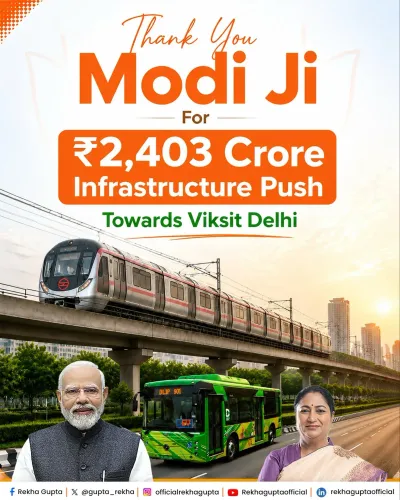
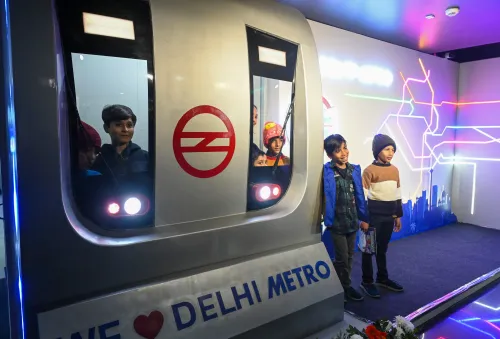
New Delhi, Jan 18 (NationPress) - To enhance Metro connectivity and fortify the public transport framework for combating pollution, Delhi Chief Minister Rekha Gupta has mandated the allocation of the national capital's portion of Rs 3,386 crore to construct three corridors under Metro Phase IV, as confirmed by an official on Sunday.
"The three Phase-IV Metro corridors will span a total of 47.225 km with an estimated budget of Rs 14,630.80 crore. Of this, the Delhi government will contribute Rs 3,386.18 crore," the official stated.
The Chief Minister indicated that the completion of these projects is anticipated within four years.
Efficient metro operations will also significantly aid in controlling pollution, he added.
"The first corridor is planned from Lajpat Nagar to Saket G-Block, stretching 8.385 km and featuring eight elevated Metro stations. The second corridor will run from Inderlok to Indraprastha, covering 12.377 km with a total of ten Metro stations, of which one will be elevated and nine will be underground," the statement elaborated.
This corridor has been incorporated into a shared financial plan with the Lajpat Nagar-Saket G-Block corridor.
The joint project cost for these two corridors is estimated at Rs 8,399.81 crore, with the Delhi government's contribution being Rs 1,987.86 crore.
The third and most extensive corridor will link Rithala to Kundli, extending connectivity to the adjacent state of Haryana. This corridor will measure 26.463 km and comprise 21 stations.
The overall project cost is projected at Rs 6,230.99 crore, with the Delhi government's share being Rs 1,398.32 crore. Out of this total, Rs 5,685.22 crore will be allocated for Delhi, while Rs 545.77 crore will go to Haryana.
These three corridors are set to provide enhanced travel options for residents in various parts of Delhi.
"The Lajpat Nagar-Saket G-Block corridor will traverse Lajpat Nagar, Andrews Ganj, GK-1, Chirag Delhi, Pushp Bhawan, Saket District Centre, and Pushp Vihar," the statement noted.
The Inderlok-Indraprastha corridor will connect areas including Inderlok, Dayabasti, Sarai Rohilla, Ajmal Khan Park, Jhandewalan, Nabi Karim, New Delhi Railway Station, Delhi Gate, and Delhi Secretariat-Indira Gandhi International Stadium.
The extensive Rithala-Kundli corridor will cover areas such as Rithala, Rohini Sectors 25, 26, 31, 32, 36, Barwala, Rohini Sectors 35 and 34, Bawana Industrial Area-I, Bawana JJ Colony, Sanoth, New Sanoth, Bhorgarh village, Narela Anaj Mandi, Narela DDA Sports Complex, Narela Sector-5, Kundli, and Nathupur.
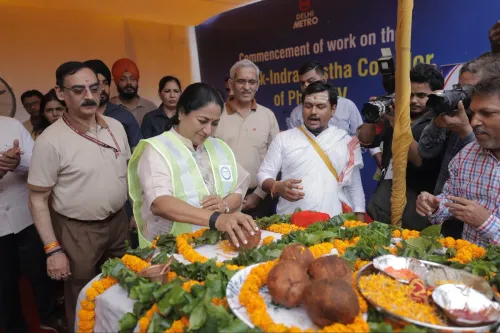
The tendering process for these corridors is currently ongoing, with preliminary work already initiated on some.
All three corridors are expected to be realized within a four-year timeframe.
The construction of these Metro corridors will bolster connectivity across the northern, central, and southern sectors of Delhi, as well as the Delhi-NCR region. This will alleviate traffic congestion on roads, save commuters' time, and encourage the use of public transport.
Chief Minister Gupta remarked that the three Phase-IV corridors will equip Delhi with a modern and robust public transport system that aligns with future needs.
She emphasized that the project will facilitate safe, convenient, and time-efficient travel for commuters, diminish reliance on private vehicles, and contribute to pollution mitigation.
The Chief Minister concluded by stating that the Delhi government is consistently taking pragmatic steps to transform the capital into a world-class city, with the expansion of the Metro network being a pivotal aspect of this commitment.
Point of View
The development of the Metro Phase IV initiative under CM Rekha Gupta's leadership marks a significant step towards addressing urban mobility and environmental concerns in Delhi. By enhancing public transport infrastructure, the project aims to promote sustainable commuting, reduce traffic congestion, and combat pollution, aligning with the capital's vision for modernization.
NationPress
30 Sept 2026
Frequently Asked Questions
What is the total investment for Metro Phase IV?
The total investment for Metro Phase IV is Rs 14,630.80 crore, with the Delhi government contributing Rs 3,386.18 crore.
How long will the new Metro corridors be?
The three Metro corridors will have a combined length of 47.225 km.
What are the key locations connected by these new corridors?
The corridors will connect areas such as Lajpat Nagar, Saket, Inderlok, Indraprastha, and Kundli.
When are the projects expected to be completed?
The projects are expected to be completed within four years.
How will these corridors help in pollution control?
By enhancing Metro connectivity, the project aims to reduce reliance on private vehicles, thus contributing to pollution mitigation.