Will Metro Services in Delhi be Enhanced with New Corridors?

Synopsis
The Union Cabinet has approved a significant expansion of the Delhi Metro, introducing three new corridors. This expansion promises to enhance connectivity across key areas, benefiting daily commuters and reducing pollution levels. Discover how this initiative will transform public transportation in Delhi.
Key Takeaways
Expansion adds 16 km to the Delhi Metro network.
Three new corridors enhance connectivity to key areas.
Project cost is Rs 12,014.91 crore.
Expected to benefit 60,000 office goers daily.
Helps reduce pollution and fossil fuel dependency.
New Delhi, Dec 24 (NationPress) The Union Cabinet, led by Prime Minister Narendra Modi, has recently sanctioned the expansion of the Delhi Metro. This initiative introduces three new corridors, contributing an additional 16 km to the existing network and enhancing metro services across Central Delhi, the domestic airport, and the southern suburbs.
The new routes in the Phase-V (A) project of the Delhi Metro include the connection from R.K. Ashram Marg to Indraprastha (9.913 km), Aerocity to Indira Gandhi Delhi Airport Terminal-1 (2.263 km), and Tughlaqabad to Kalindi Kunj (3.9 km).
This project, which spans a total distance of 16.076 km, carries a budget of Rs 12,014.91 crore. The funding will come from both the Union and Delhi governments, with additional support from international financial institutions.
A new Central Vista corridor will improve access to all the Kartavya Bhawans, a complex featuring ten buildings under the Central Vista redevelopment project.
This metro expansion is projected to benefit approximately 60,000 office workers and around two lakh visitors daily, contributing to decreased pollution levels and less reliance on fossil fuels, thereby enhancing the overall quality of life.
The link from R.K. Ashram Marg to Indraprastha will extend the existing corridor from Botanical Garden to R.K. Ashram Marg, facilitating access to the Central Vista. The Aerocity to Indira Gandhi Delhi Airport Terminal-1 and Tughlaqabad to Kalindi Kunj sections will further enhance connectivity between the airport terminal and the southern regions of the national capital.
Areas such as Tughlaqabad, Saket, and Kalindi Kunj will be directly linked, improving commuter convenience in Delhi.
The metro line from R.K. Ashram Marg to Indraprastha will bolster connections between West, North, and Old Delhi with Central Delhi. The other two lines will connect South Delhi with the domestic airport via Saket, Chattarpur, and other areas, simplifying travel for commuters.
These new extensions will integrate with the existing Magenta and Golden lines, alleviating road congestion and addressing pollution from vehicular traffic.
Stations planned along the R.K. Ashram Marg-Indraprastha route include R.K. Ashram Marg, Shivaji Stadium, Central Secretariat, Kartavya Bhawan, India Gate, War Memorial, High Court, Baroda House, Bharat Mandapam, and Indraprastha.
The Tughlaqabad-Kalindi Kunj section will feature stops at Sarita Vihar Depot, Madanpur Khadar, and Kalindi Kunj, while the Aerocity station will connect to Indira Gandhi Delhi Airport T-1.
Currently, construction on Phase-IV, which encompasses 111 km and 83 stations, is in progress, with approximately 80.43% of the civil works completed for the Phase-IV (3 Priority) corridors.
The corridors of Phase-IV are anticipated to be finalized in stages by December 2026.
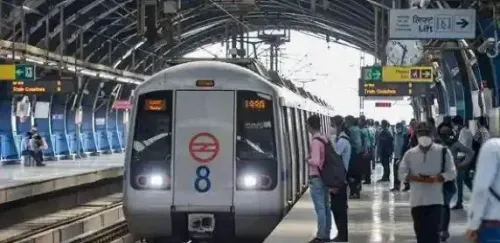
Currently, the Delhi Metro accommodates an average of 65 lakh passenger journeys daily, with the highest recorded at 81.87 lakh on August 8 of this year.
In total, the Delhi Metro comprises 12 lines covering 395 km and linking 289 stations, all operated by the Delhi Metro Rail Corporation in Delhi and the National Capital Region.
Notably, the Delhi Metro boasts the largest network of its kind in India, ranking among the largest globally.
Point of View
The expansion of the Delhi Metro is a crucial step towards improving urban mobility and reducing environmental impact. This initiative aligns with the government's commitment to enhancing infrastructure while prioritizing sustainable transport solutions.
NationPress
1 Oct 2026
Frequently Asked Questions
What is the total length of the new corridors?
The new corridors will add a total of 16.076 km to the existing Delhi Metro network.
How much will the expansion project cost?
The expansion project is estimated to cost Rs 12,014.91 crore.
Which areas will the new corridors connect?
The new corridors will connect Central Delhi, the domestic airport, and various southern suburbs.
What is the expected benefit of the new metro lines?
The new metro lines are expected to benefit around 60,000 office goers and two lakh visitors daily, while also reducing pollution.
When are the Phase-IV corridors expected to be completed?
The Phase-IV corridors are likely to be completed in stages by December 2026.