Delhi Police bust ISI-Dawood module: Shehzad Bhatti named key operative
Synopsis
Delhi Police's Special Cell has cracked an ISI-Dawood Ibrahim terror network with nine arrests, exposing a handler named Shehzad Bhatti who allegedly directed reconnaissance of Mumbai's commuter bridges and Delhi government offices. The bust reveals the ISI's deepening reliance on India's underworld as a domestic terror proxy — a strategy officials say accelerated after Operation Sindoor.
Key Takeaways
Delhi Police Special Cell arrested nine persons linked to an alleged ISI-Dawood Ibrahim terror network.
Handler Shehzad Bhatti is identified as the module's key operative, reportedly directing reconnaissance of Mumbai bridges and Delhi government offices.
A person from Nepal was detained for allegedly arranging funds; operatives from Delhi , Pune , and Punjab were on the network's payroll.
The ISI has reportedly been pushing the Dawood syndicate to execute attacks in India since 2015 ; a similar module was busted in Gujarat that year.
Officials say the strategy intensified after Operation Sindoor , with the ISI shifting to home-grown modules to reduce cross-border exposure.
Investigators are probing whether the conspiracy targets cities beyond Delhi and Mumbai .
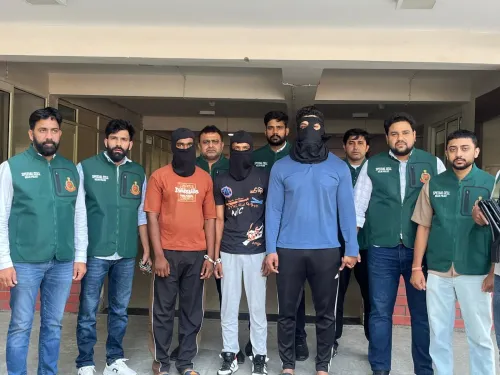
The Special Cell of the Delhi Police has arrested nine individuals linked to a terror network allegedly coordinated by Pakistan's Inter-Services Intelligence (ISI) and the Dawood Ibrahim syndicate, with investigators identifying a handler named Shehzad Bhatti as the module's central operational figure. According to officials, the network had planned coordinated attacks across Delhi and Mumbai, targeting critical urban infrastructure including commuter bridges.
Who Is Shehzad Bhatti
According to investigators, Bhatti has been operationally active for several months and is currently described by intelligence agencies as the ISI's most significant asset in anti-India operations. He allegedly directed the arrested accused to conduct reconnaissance of key locations in both Delhi and Mumbai. Officials say he operates primarily through social media platforms and coordinates between India's underworld figures and ISI handlers.
Beyond planning physical strikes, Bhatti was reportedly also tasked with running a disinformation and fake narrative campaign targeting India — indicating a dual-track strategy of kinetic and information warfare, according to officials.
Targets and Scope of the Plot
Investigators found that bridges used by daily commuters in Mumbai were on the module's target list. The intent, an official said, was not merely to cause casualties but to disrupt city infrastructure and trigger widespread panic. Government offices in Delhi were also reportedly under surveillance by the network.
The module's payroll reportedly included individuals from Delhi, Pune, and Punjab. A person from Nepal was also taken into custody, allegedly recruited to arrange funding for the operation. Officials said funds were channelled through multiple routes, all of which remain under active investigation.
The ISI-Underworld Nexus
An Intelligence Bureau official said the ISI has been systematically deploying underworld networks and gangsters as proxies to execute strikes inside India — a strategy described as its 'home-grown terror module' approach. Dawood Ibrahim remains a central asset in this framework, with his syndicate being used for both narcotics smuggling and terror operations, the official added.
According to officials, the ISI has been pushing the Dawood syndicate to execute attacks in India since 2015. A comparable module was busted in Gujarat in 2015, which had allegedly prepared a hit list of prominent individuals with the aim of provoking communal violence. The Delhi module, officials said, was similar in design but significantly larger in scale and ambition.
Operation Sindoor and the Shifting ISI Strategy
Officials drew a direct line between the busted module and the aftermath of Operation Sindoor, the Indian armed forces' recent cross-border strikes. Since that operation, the ISI has reportedly intensified efforts to activate home-grown modules rather than deploying cross-border operatives — reducing its exposure while maintaining operational tempo.
The approach mirrors the ISI's alleged strategy in Punjab, where it has sought to leverage the gangster-terror nexus to revive the Khalistan movement. Officials say a similar template is now being applied through the Dawood network to target cities across the country. Investigators are working to establish whether the conspiracy extends beyond Delhi and Mumbai to other urban centres.
Point of View
Established logistics, and no need for cross-border movement — the ISI has effectively outsourced its risk. The Gujarat precedent from 2015 was treated as an isolated incident; a decade later, it looks like a pilot. The addition of a disinformation mandate to Bhatti's brief is also significant: it signals the ISI is no longer content with kinetic disruption alone, but is layering narrative warfare on top. Indian agencies will need to treat the gangster-terror nexus not as a law-and-order problem but as a national security architecture.
NationPress
15 Oct 2026
Frequently Asked Questions
Who is Shehzad Bhatti and what is his alleged role?
Shehzad Bhatti is identified by Delhi Police investigators as the key handler of the busted ISI-Dawood terror module. He allegedly directed reconnaissance of Mumbai's commuter bridges and Delhi government offices, coordinated between underworld figures and ISI handlers, and was also tasked with running a disinformation campaign against India.
How many people were arrested in the Delhi Police Special Cell bust?
Delhi Police's Special Cell arrested nine individuals in connection with the ISI-Dawood network. Among those taken into custody was a person from Nepal, who was allegedly recruited to arrange funds for the operation.
What were the alleged targets of the ISI-Dawood module?
According to officials, the module had planned coordinated attacks in both Delhi and Mumbai. In Mumbai, commuter bridges were identified as targets to disrupt infrastructure and cause panic; in Delhi, various government offices were reportedly under surveillance by the network.
How does this relate to Operation Sindoor?
Officials say that since the Indian armed forces carried out Operation Sindoor, the ISI has intensified efforts to activate home-grown terror modules rather than deploying cross-border operatives. The Delhi module is described as part of this post-Sindoor strategic shift.
Is this the first time such an ISI-Dawood module has been busted in India?
No. A comparable module was busted in Gujarat in 2015, which had allegedly prepared a hit list of prominent individuals with the aim of triggering communal violence. Officials say the Delhi module was similar in design but larger in scale, and that the ISI has been pushing the Dawood syndicate to execute attacks in India since 2015.