Europe's Inconsistent Strategy Reveals Flaws in China Policy: Report
Synopsis
A recent report uncovers how European leaders are increasingly engaging with China, signaling a significant shift in foreign policy. The traditional calls for distancing have transformed into an acknowledgment that collaboration is essential. This change reflects deeper issues in Europe's approach to China amid uncertain US relations.
Key Takeaways
Increasing engagement with China reflects a shift in European foreign policy priorities.
European leaders are prioritizing economic ties over ideological concerns.
Visits by key leaders signify a notable trend towards collaboration.
The binary choice between China and the US is viewed as a flawed perspective.
Europe's response to US unpredictability is neither coherent nor sustainable.
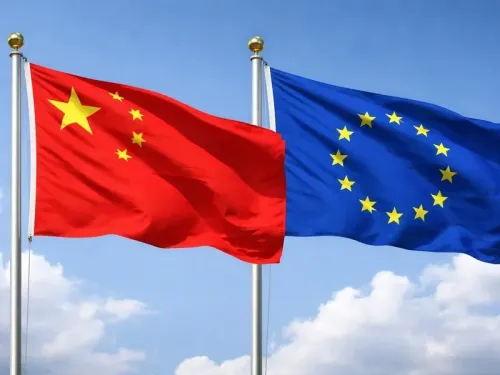
Taipei, March 4 (NationPress) Western leaders, including those from Europe, are increasingly leaning towards engagement with Beijing, signaling a significant transformation in foreign policy. The previous emphasis on "decoupling" and "de-risking" from China has shifted to a collective understanding that engagement has become essential, as highlighted in a recent report.
The 'Taipei Times' recently noted that China has gained from the 'America First' strategy adopted by former US President Donald Trump, leading nations worldwide to reassess their interests and standings amid an erratic and self-serving US foreign policy.
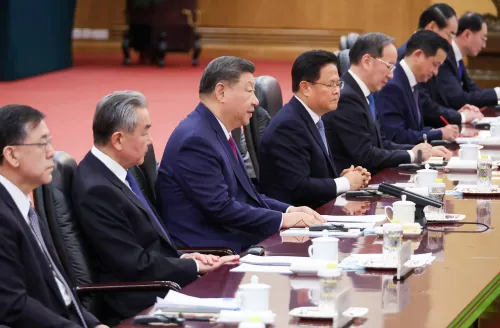
As a consequence, many countries are adjusting their foreign policy objectives, increasingly viewing China as a viable economic partner. This is evident as Beijing entertains Western leaders—"not with a red carpet but on its own terms," the report mentioned.
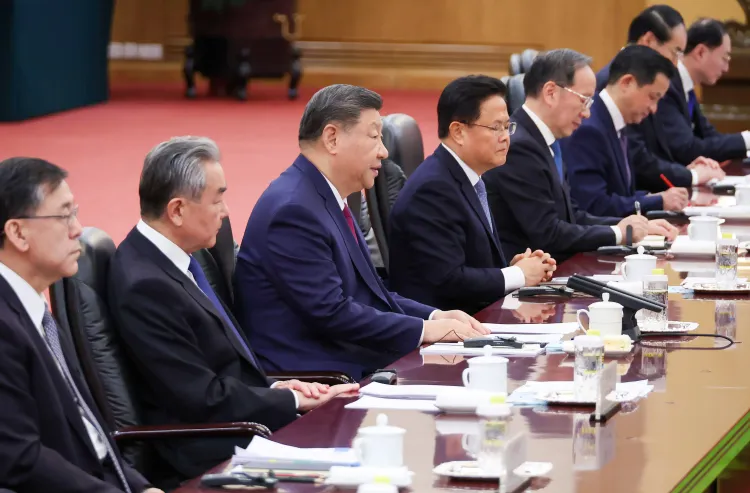
In January, leaders from Ireland, Finland, and the UK, including Irish Prime Minister Micheal Martin, Finnish Prime Minister Petteri Orpo, and British Prime Minister Keir Starmer, made visits to China.
The report emphasizes a growing trend where Western powers are prioritizing economic and diplomatic ties over ideological stances. For Europe, this shift indicates that economic interests are taking precedence over strategic caution and normative values.
However, this does not signify a comprehensive revision of Europe's China policy, nor does it entail a clear geopolitical shift. European leaders are more inclined to adapt to circumstances rather than actively choosing China. The prevailing assumption seems to be that as relations with Washington become increasingly unpredictable, it is crucial to maintain functional connections with Beijing, often at any cost.
The report indicates that for numerous European nations, the decision appears binary—China or the US—though this perspective is described as "flawed."
It highlights that the challenges posed by China are distinct from Europe's relationships with Washington, yet leaders are increasingly interpreting Beijing's actions through the lens of US-China rivalry. This narrow view overlooks the implications of deeper ties with Beijing.
While China's behavior remains unchanged, the report suggests that Europe's relationship with the US is what has evolved.
"Adjusting China policy in response to US unpredictability lacks coherence and sustainability. Equally concerning is the almost complete disregard for democratic principles in this recalibration, despite their significance in Europe's foreign policy identity. Engagement is being sought, yet there is little clarity regarding its boundaries or costs," it noted.
The report concludes: "While high-level interactions will unlikely shift the global balance in favor of China, they signal a transient interest. They affirm that China is increasingly regarded as an alternative to the US, which is troubling in itself. This surge of engagement reveals the inconsistencies in Europe's China policy and its absence of a coherent strategy for managing Beijing amid deteriorating US-China relations."
Point of View
It's essential to recognize that Europe's current inclination towards China reflects a complex interplay of geopolitical dynamics. While engagement may seem pragmatic, it's crucial to scrutinize the long-term implications of such a shift, especially in the context of deteriorating relations with the US.
NationPress
3 Oct 2026
Frequently Asked Questions
What factors are driving Europe's shift towards China?
The shift is largely driven by an increasingly unpredictable US foreign policy, prompting European leaders to seek alternative economic partnerships with China.
Who are the key European leaders visiting China?
Notable leaders include Irish Prime Minister Micheal Martin, Finnish Prime Minister Petteri Orpo, and British Prime Minister Keir Starmer.
How does this shift affect Europe's foreign policy?
The shift indicates a prioritization of economic engagement over ideological values, revealing inconsistencies in Europe's approach to China.
What is the broader implication of Europe's engagement with China?
The engagement may undermine Europe's commitment to democratic values and complicate its stance in US-China relations.
Is there a clear strategy in Europe's China policy?
Currently, there is no coherent strategy; the approach seems reactive and circumstantial rather than strategically planned.