Did FM Sitharaman Really Increase STT on Futures to 0.05% in Budget 2026?
Synopsis
On February 1, Finance Minister Nirmala Sitharaman revealed a significant hike in the Securities Transaction Tax on futures and options during the Union Budget 2026-27. This move could impact trading volumes and liquidity in India's derivatives market, sparking discussions among market experts.
Key Takeaways
STT on futures increased to 0.05% .
Options tax raised to 0.15% .
Significant increase in trading costs for derivatives.
Potential negative impact on liquidity and market depth.
Government aims to boost short-term tax collections.
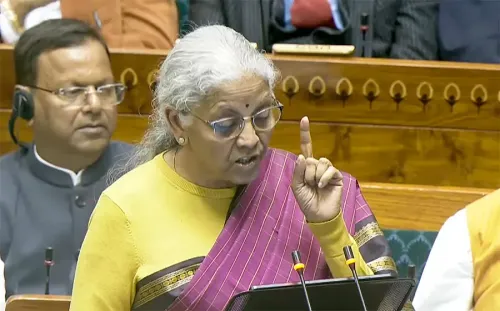
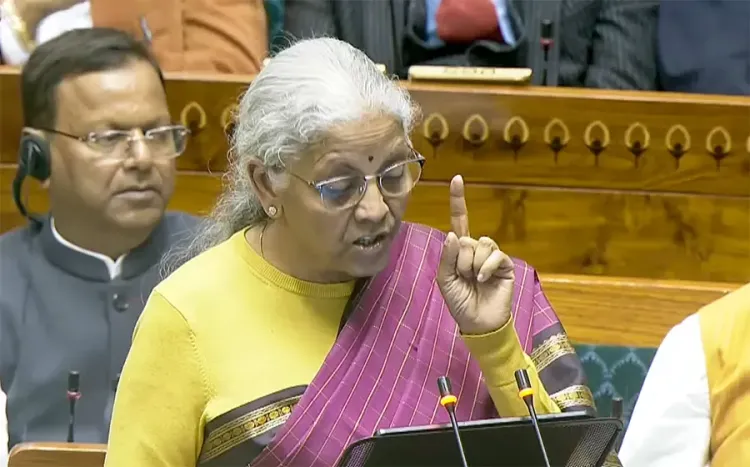
New Delhi, Feb 1 (NationPress) Finance Minister Nirmala Sitharaman declared a substantial increase in the Securities Transaction Tax (STT) on futures and options during her presentation of the Union Budget 2026-27 in Parliament.
This decision represents a significant boost in transaction expenses for traders operating in the derivatives market.
The STT on futures has been elevated to 0.05% from the previous 0.02%, reflecting a remarkable 150% increase.
For options, the tax has risen to 0.15% from 0.10%, a notable 50% hike.
“This is not merely a minor adjustment; it is an impactful change, likely to suppress F&O volumes, especially among high-frequency traders, proprietary desks, and those utilizing cost-sensitive strategies,” stated Aakash Shah from Choice Equity Broking.
“Although this move may enhance tax revenues in the short term, it poses a risk to liquidity and market depth in the derivatives sector, particularly when regulators are striving to balance speculation control with maintaining India’s status as a competitive global trading hub,” he added.
The Securities Transaction Tax is imposed on the value of securities trades conducted on approved stock exchanges in India.
This tax applies to transactions in equities, equity mutual funds, and derivatives, including futures and options.
The tax is collected at the point of transaction, regardless of whether the investor makes a profit or suffers a loss.
The STT was first introduced in India on October 1, 2004, with the aim of simplifying tax collection and reducing evasion in equity and derivatives trading.
It was established following the elimination of the long-term capital gains (LTCG) tax on equities.
However, the LTCG tax on listed equities was reinstated in the Union Budget 2018, while the STT remained applicable.
In the previous budget, the government also increased capital gains taxes, raising the LTCG tax to 12.5% from 10% and increasing the short-term capital gains (STCG) tax to 20% from 15%.
Point of View
It's essential to observe the implications of the recent changes in the Securities Transaction Tax announced by Finance Minister Nirmala Sitharaman. While the increase aims to boost tax collections, it raises concerns among traders regarding liquidity and market depth in the derivatives segment. The government must carefully balance regulation with the need for India to remain competitive in global markets.
NationPress
24 Sept 2026
Frequently Asked Questions
What is the new STT on futures after the Budget 2026?
The Securities Transaction Tax on futures has been raised to 0.05% from the earlier 0.02%, marking a 150% increase.
How will this tax increase affect traders?
This substantial increase in STT is likely to dampen trading volumes, especially among high-frequency traders and those with cost-sensitive strategies.
What is the purpose of the STT?
The STT is designed to simplify tax collection and reduce tax evasion in securities transactions on recognized stock exchanges in India.
When was the STT introduced?
The Securities Transaction Tax was introduced in India on October 1, 2004.
What are the current tax rates for options?
The STT on options has increased to 0.15% from the previous rate of 0.10%, representing a 50% rise.