Could Germany and India Take Their Bilateral Relations to New Heights?
Synopsis
German Chancellor Friedrich Merz's visit to India marks a significant step towards strengthening bilateral relations. His emphasis on shared values and economic collaboration highlights the potential for a robust partnership between India and Germany amidst global geopolitical shifts.
Key Takeaways
Strengthened bilateral ties between Germany and India.
Focus on defense collaboration and economic ties.
Shared fundamental values and strategic interests.
Commitment to free trade and open markets.
Addressing global challenges together.
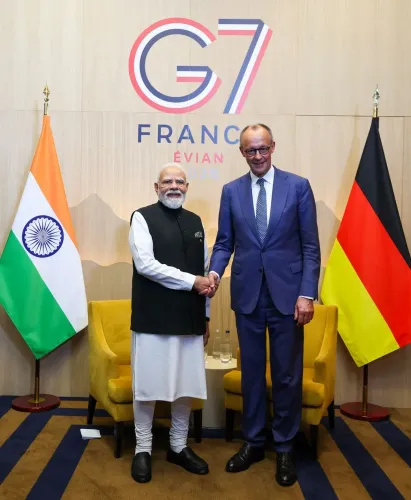
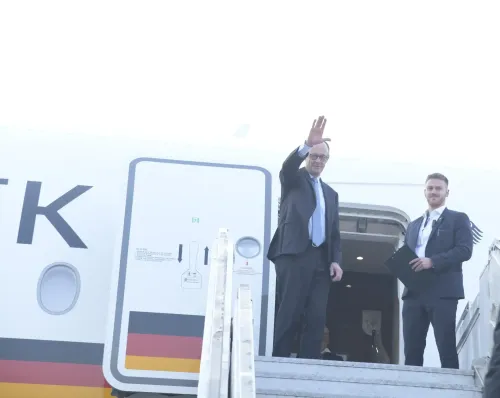
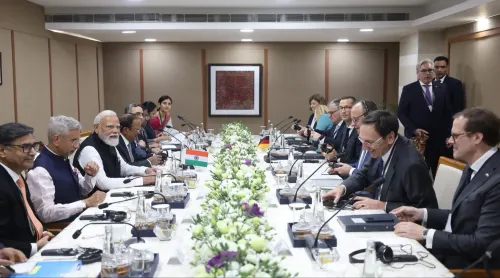
Gandhinagar, Jan 12 (NationPress) German Chancellor Friedrich Merz on Monday indicated a desire to advance bilateral relations with India to a more significant level. He noted that the two nations possess a shared fundamental interest in enhancing their strategic partnership in light of global geopolitical shifts and disruptions.
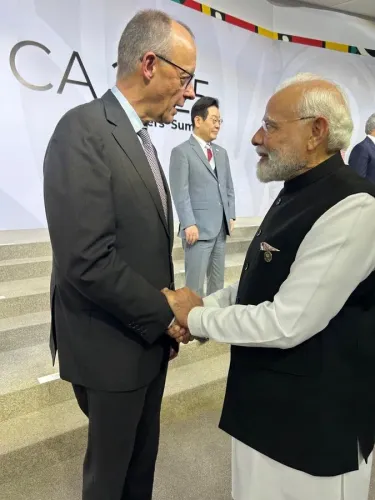
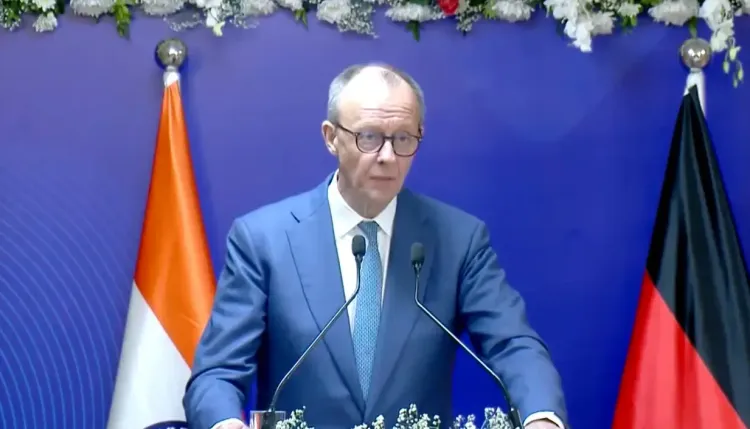
During a joint press conference with Prime Minister Narendra Modi after discussions in Ahmedabad, Merz remarked, "Our nations aim to strengthen and expand our collaboration. This morning, I had the privilege to visit the birthplace of Mahatma Gandhi. Gandhi once said: 'Be the change you wish to see in the world.' Together, dear Narendra Modi, we aspire to heed that message and elevate the relationship between India and Germany to an even higher level."
Merz expressed appreciation to PM Modi for welcoming him to his home state, interpreting it as a reflection of the "deep connections" between the two countries and a "testament to our friendship."
"The city we are visiting today, Ahmedabad, can be regarded as the birthplace of modern India. It was here that Gandhi initiated his non-violent struggle for freedom, self-determination, and democracy. This part of India, Gujarat, showcases remarkable economic dynamics from the textile sector to advanced industrial parks and a vibrant startup ecosystem. Our visit here underscores what is vital for both of us—shared political values, significant economic potential, and our growing interconnections in skilled labor and education. Amid profound geopolitical changes, we have a mutual interest in reinforcing our strategic partnership," he stated.
Merz highlighted the focus of India and Germany on the principles of free trade and open markets, especially as the world faces a resurgence of protectionism. He voiced their opposition to major powers leveraging supply chains and raw materials as tools of power.
"We are witnessing a revival of protectionism that contradicts the principles of free trade and open markets. Countries like India and Germany are committed to these principles and will continue to uphold them. We see major powers increasingly using supply chains and raw materials as instruments of influence. Together, we aim to counter this trend, reducing unilateral dependencies in our supply chains, thereby enhancing the resilience of both our economies. As the fastest-growing economy within the G20, India is a crucial partner in the Indo-Pacific," he said.
Referring to India as a "desired partner" and "partner of choice" for Germany, Merz emphasized the shared fundamental values and interests between the two nations.
"Europe and transatlantic relations remain vital to us. We must create a broader network of partnerships swiftly and sustainably. India stands as a desired partner for Germany, and the conditions for a renewed, deepened, and intensified partnership have never been more favorable. Germany is the most populous and economically robust state in the European Union, while India is the largest democracy worldwide. We share fundamental values—Germany's technological prowess and India's dynamic growth—forming the foundation upon which we can build," he elaborated.
Merz articulated Germany’s advocacy for an international order that allows people to live freely and securely, while acknowledging the shifting global landscape, characterizing Russia's military actions in Ukraine as the "most drastic manifestation" of these changes.
"I want to highlight three priorities. First, we advocate for an international order in which we can live freely and securely, as the global landscape is increasingly characterized by great power politics and influence spheres. We must brace ourselves against these challenges. Russia's aggression in Ukraine exemplifies these upheavals. Together, we will uphold the values and interests we share in this new reality. Disagreements may exist on various issues, but our common ground is substantial, enabling us to enhance our cooperation in security policy," he stated.
Expressing a desire to deepen collaboration with India in defense and economic sectors, Merz stated, "We conduct joint naval and air force exercises, and engage in military joint visits and consultations. We aim to bolster our defense industries and cooperation, which is strategically significant and reduces India's dependency on Russia. Recently, we signed a groundbreaking memorandum of understanding that fosters closer cooperation in defense industry development, production, innovation, and strengthening global supply chains. We are not only enhancing our defense industrial collaboration but also intensifying our economic ties."
Point of View
I firmly believe that the strengthening of ties between India and Germany is a strategic necessity in today's rapidly changing geopolitical landscape. Both nations share common values and interests that can lead to enhanced cooperation, especially in areas of defense and trade. This partnership is not only beneficial for both countries but also for global stability and economic growth.
NationPress
1 Oct 2026
Frequently Asked Questions
What is the significance of Merz's visit to India?
Chancellor Merz's visit underscores Germany's commitment to strengthening bilateral relations with India, focusing on shared values and economic cooperation amidst changing global dynamics.
How do Germany and India plan to enhance their partnership?
Both nations aim to deepen their strategic partnership by focusing on free trade, defense collaboration, and addressing global challenges together.
What challenges do India and Germany face in their partnership?
They face challenges from rising protectionism and geopolitical tensions, which necessitate a strengthened alliance based on shared interests and values.