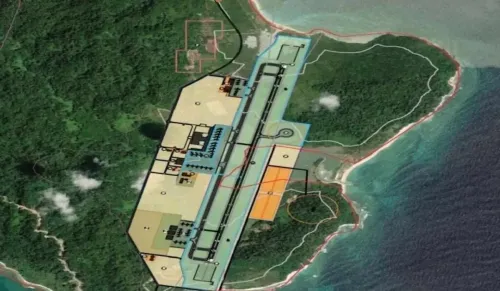
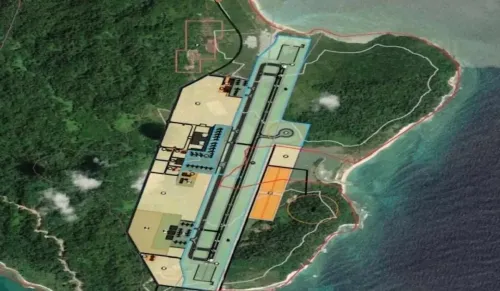
Great Nicobar Project to boost India's military reach in Six Degree Channel: Retd. Maj Gen Katoch
Synopsis
A retired Major General argues the Great Nicobar Project is India's most consequential strategic bet in decades — not just a port, but a military foothold over the Six Degree Channel, through which 90 per cent of global container traffic will flow. Paired with the Zojila Tunnel breakthrough, it signals a quiet but sweeping upgrade to India's defence infrastructure on two fronts simultaneously.
Key Takeaways
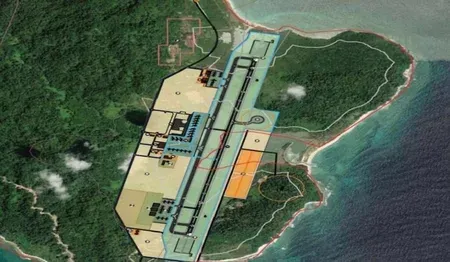
Retired Major General Dhruv Katoch says the Great Nicobar Project will give India military leverage over the Six Degree Channel , through which 90% of global container traffic is projected to pass.
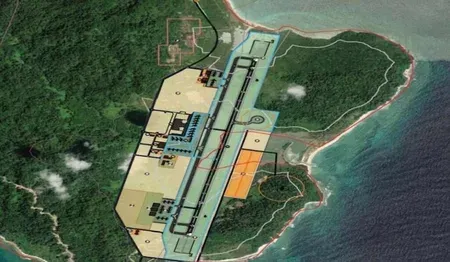
The project is planned as both a military installation and a trans-shipment port , reducing India's dependence on Sri Lanka and Singapore .
The Zojila Tunnel breakthrough will connect Ladakh and Kargil with Srinagar year-round, cutting transit time from 2–3 hours to 15–20 minutes .
Katoch cited the Strait of Hormuz disruption during the West Asia conflict as a warning for why the Six Degree Channel must remain open.
SIPRI ranks India as the world's fifth-largest defence spender ; Katoch says the figure is proportionate to India's population and operational needs.
India's nuclear triad capability — land, sea, and air — is described as a deterrent against escalation, not an offensive posture.
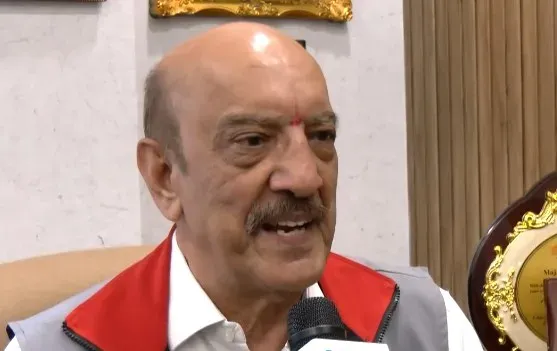
Retired Major General Dhruv Katoch has said the Great Nicobar Project will significantly expand India's military capability and give the country strategic leverage in the Six Degree Channel — the primary shipping lane connecting the Indian Ocean to the South China Sea — through which an estimated 90 per cent of the world's container traffic is projected to pass. Speaking on 9 June, Katoch also hailed the breakthrough of the country's longest Zojila Tunnel as a landmark achievement for military logistics and civilian connectivity in Ladakh.
Strategic Value of the Six Degree Channel
Katoch explained that the Andaman and Nicobar Islands form a natural arc connecting Myanmar in the north and Indonesia in the south, with the Ten Degree Channel running between the two island groups. More critically, the Six Degree Channel — south of Great Nicobar Island — serves as the principal maritime corridor from the Indian Ocean into the South China Sea and onward to the Pacific Ocean.
'Therefore, 90 per cent of the world's container traffic will pass through the Six Degree Channel. This gives India leverage by having a strong military presence there,' Katoch said. He argued that a credible Indian presence there would allow New Delhi to help ensure a 'free and open Indo-Pacific' in line with its own strategic interests.
Notably, Katoch drew a direct parallel with the Strait of Hormuz disruption during the West Asia conflict, pointing out how India was 'severely impacted' when that chokepoint came under threat. He stressed that the Six Degree Channel, which connects to the Strait of Malacca, must similarly be kept open as a matter of India's vital interest.
Trans-Shipment Port and Reduced Regional Dependence
Beyond its military dimension, the Great Nicobar Project is also being planned as a major trans-shipment port, according to Katoch. He noted that Great Nicobar offers natural deep-water harbour conditions, describing it as 'a natural harbour' with sufficient depth for large commercial vessels.
The former Army officer said the trans-shipment facility, once operational, would reduce India's dependence on Sri Lanka and Singapore for container relay operations — a significant commercial and strategic shift. On environmental concerns surrounding the project, Katoch said: 'We are preserving the environment and still doing the development.'
Zojila Tunnel: Year-Round Connectivity for Ladakh
Responding to questions on the Zojila Tunnel breakthrough, Katoch called it 'a major milestone for the country.' He said the tunnel ends a decades-long vulnerability in which Ladakh and Kargil were cut off from Srinagar by road for up to six months each year due to heavy snowfall.
'Earlier, the Army had to do winter stocking because the roads would be blocked for six months in a year. That problem is over,' he said. The tunnel will reduce transit time through the Zojila Pass from 2–3 hours to just 15–20 minutes, lowering both cost and logistical complexity for military supply chains and civilian movement alike.
India's Defence Posture and Nuclear Deterrence
Commenting on the latest Stockholm International Peace Research Institute (SIPRI) report, which ranked India as the world's fifth-largest defence spender, Katoch said the figure must be viewed in proportion to India's status as the world's most populous country. 'Our defence expenditure is commensurate with our operational requirements,' he said.
He also addressed India's nuclear triad — the ability to deliver nuclear weapons from land, sea, and air — saying it strengthens deterrence rather than signalling offensive intent. 'India having this capability is not to promote but prevent nuclear war,' Katoch said, adding that long-range missile capability ensures that adversaries are deterred from escalation. 'It is always good to be prepared,' he noted.
Point of View
But the two objectives carry inherent tensions — deep-water military infrastructure and high-traffic civilian trans-shipment do not always coexist cleanly, as Singapore's own history shows. Katoch's invocation of the Hormuz disruption is a legitimate data point, but the Six Degree Channel analogy holds only if India can project credible enforcement capability there, which requires sustained naval investment well beyond a single island base. The Zojila Tunnel is a clearer win: year-round logistics access to Ladakh addresses a documented vulnerability that has constrained Army readiness for decades. On the SIPRI ranking, the per-capita framing is fair but sidesteps the harder question of whether India's defence rupee is being spent efficiently across its three-front exposure.
NationPress
21 Sept 2026
Frequently Asked Questions
What is the Great Nicobar Project and why is it strategically important?
The Great Nicobar Project is a large-scale development initiative planned as both a trans-shipment port and a military installation on India's southernmost island. Its strategic importance lies in its proximity to the Six Degree Channel, through which an estimated 90 per cent of global container traffic is projected to pass, giving India leverage over a critical Indo-Pacific shipping lane.
What is the Six Degree Channel and why does it matter to India?
The Six Degree Channel runs south of Great Nicobar Island and is the primary maritime corridor connecting the Indian Ocean to the South China Sea and the Pacific Ocean. Retired Major General Dhruv Katoch argues that an Indian military presence there is essential to keeping the lane open — a vital national interest, especially given past disruptions in the Strait of Hormuz.
How will the Zojila Tunnel change military operations in Ladakh?
The Zojila Tunnel will provide year-round road connectivity between Ladakh, Kargil, and Srinagar, ending a six-month annual road blockage due to snow. Transit time through the Zojila Pass will drop from 2–3 hours to 15–20 minutes, enabling uninterrupted military logistics supply to forward areas.
What did the SIPRI report say about India's defence spending?
The Stockholm International Peace Research Institute (SIPRI) ranked India as the world's fifth-largest defence spender. Retired Major General Katoch said the figure is proportionate to India's status as the world's most populous country and is aligned with its operational requirements.
How does India's nuclear triad contribute to deterrence?
India's nuclear triad — the capacity to deliver nuclear weapons from land, sea, and air platforms — is designed to make any first strike by an adversary strategically untenable. Katoch described it as a deterrence mechanism, stating that India's capability is 'not to promote but prevent nuclear war.'