What Major Progress Has Gujarat Made in Urban Sustainability During 'Urban Development Year-2025'?
Synopsis
Gujarat's ambitious 'Urban Development Year-2025' initiative has resulted in significant strides in sustainable urban planning, focusing on rainwater harvesting, green cover, waste management, and renewable energy. Discover how these efforts aim to enhance the quality of life for urban residents.
Key Takeaways
Gujarat is making significant advancements in sustainable urban planning .
The state has increased urban rainwater storage capacity significantly.
Over 240 hectares of new green spaces are being developed.
Nearly 90 lakh trees have been planted to enhance urban green cover.
Efforts are underway to scientifically dispose of legacy waste by 2026.
Gandhinagar, February 9 (NationPress) Gujarat has achieved remarkable advancements in sustainable urban development and infrastructure during its "Urban Development Year-2025". This includes notable enhancements in rainwater harvesting, the expansion of green spaces, waste management, and the adoption of renewable energy across various cities and towns, according to officials on Monday.
The state government has proclaimed 2025 as the Urban Development Year under the guiding principle of "Earning Well, Living Well", aimed at bolstering urban infrastructure and enhancing the living conditions for residents.
Throughout this year, Gujarat has emerged as a benchmark for sustainable urban growth, executing a range of large-scale initiatives within municipal corporations and municipalities.
A pivotal result has been a notable rise in urban rainwater storage capacity through the 'Catch the Rain' initiative.
Officials reported that rainwater storage capacity has surged by approximately 4.19 lakh kilolitres, following the establishment of nearly 2,900 rainwater harvesting systems across 17 municipal corporations and 152 municipalities.
Moreover, 2,603 rainwater harvesting projects are currently in progress, with 1,230 at the tendering phase, and another 6,642 new projects in the planning stage.
The expansion of urban green infrastructure has also been considerable.
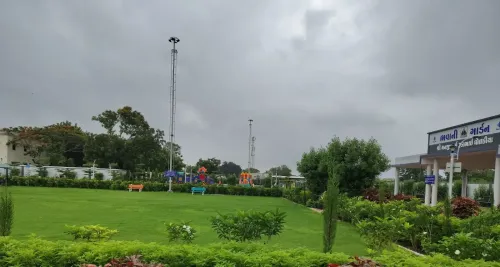
The state aims to develop over 240 hectares of new green areas in urban locales, including gardens, sponge parks for groundwater recharge, and urban forests.
Out of more than 340 urban development projects slated for completion this year, 146 have been finished, while the others are at various execution stages.
Large-scale tree plantation efforts are underway to enhance the green cover in urban settings.
Against a target of planting 99 lakh trees during the Urban Development Year, nearly 90 lakh trees have been planted across 17 municipal corporations and 152 municipalities.
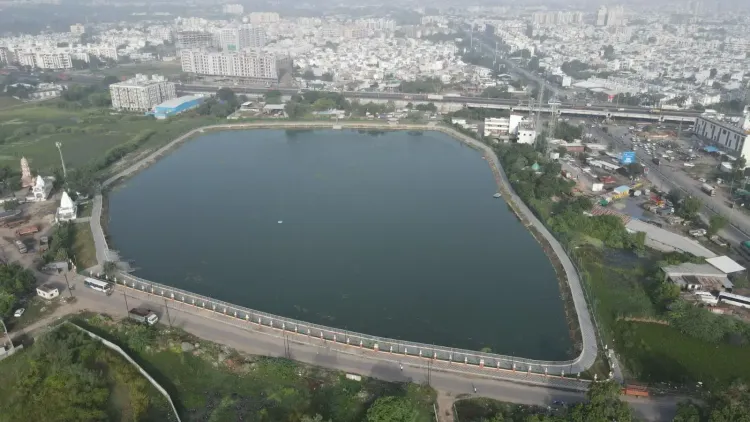
Lake redevelopment and restoration have been integral components of the initiative.
A total of 140 lakefront projects have been planned statewide, with 54 already completed.
According to official data, 57 projects are currently active, nine at the tender phase, and 20 in the planning stage.
To foster renewable energy and curtail carbon emissions in urban settings, the state government has set a target to initiate over 285 solar projects.
In tandem, 20 Reuse of Treated Waste Water (RTWW) projects are being executed, expected to provide approximately 656 million litres per day of treated water for reuse.
Efforts to combat urban air pollution are also advancing.
Clean Air Action Plans have been developed for all municipal corporations within the state.
Plans have also been finalized for Bhavnagar, Jamnagar, Junagadh, and Gandhinagar, ensuring comprehensive statewide coverage.
The state government has reiterated its commitment to scientifically disposing of legacy waste in urban regions.
A bold target has been set to achieve 100% disposal of legacy waste by March 2026.
Of the total identified 304.09 lakh metric tonnes of legacy waste in urban areas, 281.802 lakh metric tonnes have already been disposed of scientifically.
Furthermore, prioritizing urban sanitation and waste management, over 1,823 projects valued at more than Rs 2,756 crore have been sanctioned across the state.
Authorities have pinpointed 1,533 garbage-prone areas in public spaces within cities, with efforts underway to remedy these as part of the initiative to enhance urban cleanliness and environmental conditions.
Point of View
Gujarat's efforts in sustainable urban development during 'Urban Development Year-2025' showcase a proactive approach to addressing urban challenges, setting a precedent for other states. The initiatives are commendable and align with national goals for sustainability and urban resilience.
NationPress
26 Sept 2026
Frequently Asked Questions
What is the 'Urban Development Year-2025' initiative in Gujarat?
The 'Urban Development Year-2025' initiative is a state government program aimed at enhancing urban infrastructure and sustainability, focusing on rainwater harvesting, green spaces, waste management, and renewable energy adoption.
How many trees have been planted in Gujarat during this initiative?
Nearly 90 lakh trees have been planted across 17 municipal corporations and 152 municipalities, with a target of 99 lakh trees.
What are the key projects under the 'Catch the Rain' initiative?
The 'Catch the Rain' initiative has led to an increase in urban rainwater storage capacity by approximately 4.19 lakh kilolitres through nearly 2,900 rainwater harvesting systems.
How many urban development projects are planned for completion in 2025?
More than 340 urban development projects are targeted for completion during this year, with 146 already finished.
What measures are being taken to combat urban air pollution?
Clean Air Action Plans have been prepared for all municipal corporations in Gujarat, focusing on improving air quality throughout the state.