IIT Kharagpur ranks 39th globally in debut at AIAA Design/Build/Fly 2025
Synopsis
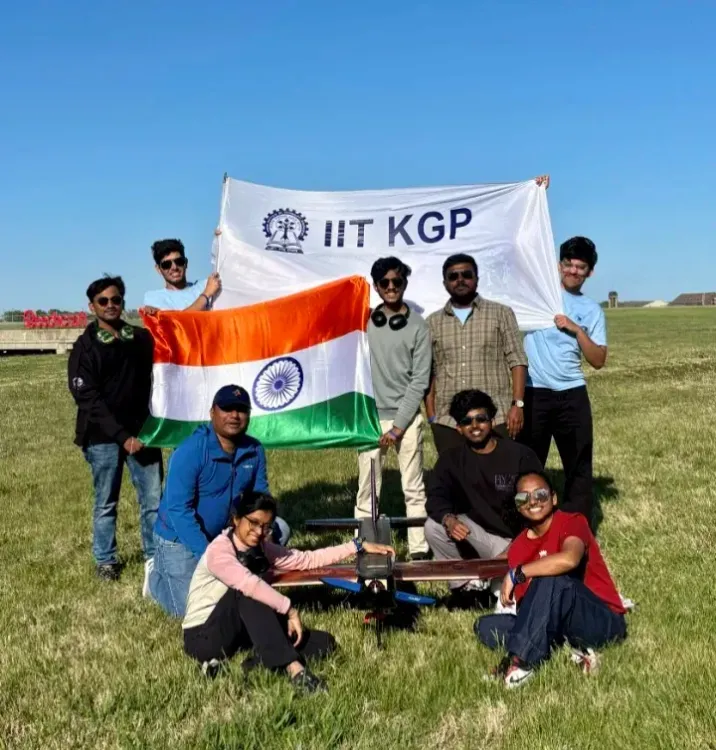
On its very first entry into the AIAA Design/Build/Fly competition — one of the world's toughest student aircraft contests — IIT Kharagpur finished 39th out of 98 global teams, 5th in Asia, and topped all Indian participants. A 21-member team built and flew a complete aircraft in just four months, putting Indian aerospace education on the global map.
Key Takeaways
IIT Kharagpur ranked 39th globally and 5th in Asia on its maiden entry at the AIAA Design/Build/Fly Competition in Wichita, Kansas .
The team recorded the highest total score among all Indian teams in the competition.
A 21-member student team designed, built, tested, and flew a complete aircraft in just four months .
The competition drew 98 teams from 12 countries , with 1,179 students participating in its 30th edition .
First place went to the University of Ljubljana ; University of Washington-Seattle and UCLA finished second and third.
Only 17 of 89 teams completed all four missions; IIT Kharagpur was mentored by Prof Arnab Roy and four other faculty members.
IIT Kharagpur made a commanding debut at the AIAA Design/Build/Fly (DBF) Competition held in Wichita, Kansas, finishing 39th globally, 5th in Asia, and recording the highest total score among all Indian teams in the event's 30th edition. Competing against 98 university teams and 1,179 students from 12 countries, the institute's first-ever entry at the prestigious aeronautics contest exceeded expectations on the global stage.
A First Appearance That Made History
The 21-member student team from IIT Kharagpur designed, built, tested, and successfully flew a complete aircraft — all within four months. The feat spanned disciplines from aerodynamics, structures, and propulsion to avionics, computer-aided design, manufacturing, and flight validation. The team was backed by the Department of Aerospace Engineering and the Aerial Robotics Kharagpur (ARK) Lab.
Mentorship was provided by Prof Arnab Roy, Anup Ghosh, Naba Kumar Peyada, Prof Sandeep Saha, and Prof Somesh Kumar, according to the institute. IIT Kharagpur described the outcome as 'more than just a ranking' — calling it the institution's first footprint on one of the world's most demanding student aircraft design competitions.
How the Competition Worked
This year's contest theme was a Banner Towing Bush Plane, requiring teams to complete four missions — one ground and three flight missions. The first flight mission required the aircraft to complete three laps within five minutes. The second was a charter flight scored on passengers (rubber ducks), cargo (hockey pucks), laps flown, and battery capacity. The third was a banner-towing flight scored on banner length, laps flown, and wingspan (RAC).
The ground mission tested the efficiency of loading and unloading passengers and converting the plane into a banner-towing configuration. Of the 197 official flight attempts, 143 resulted in a successful score. Only 17 teams completed all missions.
Scale and Global Competition
The 30th edition of the AIAA DBF competition drew 175 proposals, of which 102 teams were invited to the design report phase. 98 teams submitted reports, 89 teams attended the fly-off (including 17 international teams), and 83 cleared technical inspection. Over 1,200 students, faculty, and guests were present at the event.
The University of Ljubljana claimed first place, with the University of Washington-Seattle finishing as runners-up and the University of California, Los Angeles taking third. The AIAA described the quality of teams, readiness, and flight execution as exceptional.
What This Means for Indian Aerospace Education
IIT Kharagpur's performance signals a maturing culture of hands-on, competition-driven aerospace engineering in India. The institute framed the result as a step toward strengthening experiential learning and innovation — not merely a ranking milestone. Notably, no other Indian team scored higher in the competition, underlining the gap IIT Kharagpur has set as a benchmark for future Indian participation in global aerospace contests.
Point of View
But the more significant signal is institutional: a 21-member student team reached a global top-40 finish in a field of 98 universities across 12 countries, on their first attempt. Indian aerospace education has long been strong on theory; what competitions like AIAA DBF test is execution under real-world constraints — timelines, manufacturing tolerances, flight dynamics. That IIT Kharagpur outscored every other Indian team in its debut year suggests the ARK Lab model of hands-on, competition-driven training deserves wider replication. The question now is whether this result catalyses more Indian institutions to enter — and whether the government's aerospace education push will fund the infrastructure needed to compete at the top tier consistently.
NationPress
17 Oct 2026
Frequently Asked Questions
What is the AIAA Design/Build/Fly competition?
The AIAA Design/Build/Fly (DBF) competition is an annual international student aeronautics contest organised by the American Institute of Aeronautics and Astronautics, where university teams design, build, and fly remote-controlled aircraft to complete a set of scored missions. Now in its 30th year, it drew 98 teams from 12 countries in 2025.
How did IIT Kharagpur perform at AIAA DBF 2025?
IIT Kharagpur finished 39th globally and 5th in Asia on its maiden appearance, recording the highest total score among all Indian teams. The 21-member student team designed and flew a complete aircraft within four months.
Which university won the AIAA DBF 2025 competition?
The University of Ljubljana claimed first place. The University of Washington-Seattle finished as runners-up and the University of California, Los Angeles took third place.
What was the theme of the AIAA DBF 2025 competition?
The 2025 contest theme was a Banner Towing Bush Plane. Teams had to complete one ground mission and three flight missions, including a test flight, a charter flight carrying passengers and cargo, and a banner-towing flight.
Who mentored the IIT Kharagpur team at AIAA DBF 2025?
The team was supported by the Department of Aerospace Engineering and the Aerial Robotics Kharagpur (ARK) Lab, with mentorship from Prof Arnab Roy, Anup Ghosh, Naba Kumar Peyada, Prof Sandeep Saha, and Prof Somesh Kumar.