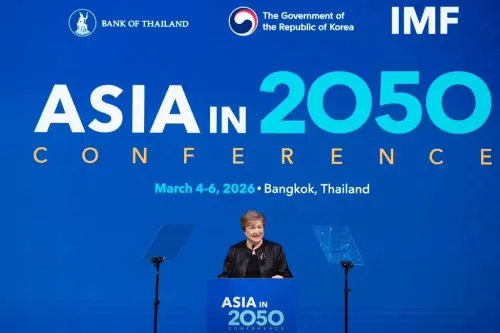
IMF Chief: Asia Needs Agility in Face of Global Disruptions

Synopsis
As global uncertainties rise, IMF's Kristalina Georgieva urges Asian nations to enhance their economic resilience. Emphasizing swift action and innovation, she outlines key strategies for navigating a volatile future.
Key Takeaways
Asia must improve economic resilience amid global disruptions.
Investments in AI and digital infrastructure are crucial.
Proactive policies can mitigate the impact of external shocks.
Energy security should be a priority for Asian nations.
Swift conflict resolution is essential for global stability.
New Delhi, March 5 (NationPress) Asia's policymakers and business leaders must stay nimble and financially robust as global disruptions become increasingly common, according to Kristalina Georgieva, the Managing Director of the International Monetary Fund, who spoke on Thursday.
During a conference in Bangkok, Georgieva emphasized that the global economy is entering a phase characterized by ongoing uncertainty, necessitating that nations prepare for unforeseen challenges that may arise at any moment.
She urged governments to concentrate on bolstering their domestic economies rather than stressing over uncontrollable external factors.
“The world is undergoing significant changes in technology, demographics, trade, and geopolitics,” Georgieva remarked.
“These developments, coupled with recurring global shocks, are fostering a more unpredictable economic landscape,” she added.
She also referenced the recent conflict in the Middle East, warning that its continuation could destabilize global economic conditions.
“An extended conflict may impact global energy prices, market confidence, economic growth, and inflation, while adding pressure on policymakers worldwide,” she cautioned.
For many economies in Asia, energy security is a critical issue, with recent events already causing fluctuations in regional stock markets.
“A swift resolution to the conflict would greatly benefit the global economy,” Georgieva asserted.
Simultaneously, she acknowledged that Asia has made remarkable strides in its economic development over the last 25 years.
“Since the early 2000s, as various countries in the region were emerging from financial crises, Asia has enhanced oversight of its financial sectors, built substantial reserves, and improved overall economic stability,” Georgieva detailed.
Looking forward, she indicated that Asian nations must prioritize boosting productivity and competitiveness, especially by leveraging new technologies like Artificial Intelligence.
“Realizing the advantages of AI will necessitate significant investments in digital infrastructure, internet access, and skills training,” she stated.
Georgieva also highlighted the importance of robust policies that promote innovation, eliminate regulatory hurdles, and strengthen financial markets to facilitate private sector investment.
“Establishing adequate safeguards around AI will be crucial as the technology proliferates across economies,” she concluded.
Point of View
It is essential for Asia to not only adapt to global economic shifts but also to take proactive steps in strengthening its economic foundations. The emphasis on agility and innovation is a call to action for Asian leaders to ensure sustained growth despite external pressures.
NationPress
19 Sept 2026
Frequently Asked Questions
Why is agility important for Asian economies?
Agility allows Asian economies to respond swiftly to unpredictable global shocks, ensuring financial stability and resilience.
What role does AI play in improving competitiveness?
AI can enhance productivity and innovation, making it a vital tool for Asian economies to boost their competitiveness.
How can Asia achieve better energy security?
By investing in renewable energy sources and diversifying energy supply, Asia can strengthen its energy security.
What impact can global conflicts have on economies?
Global conflicts can disrupt supply chains, affect energy prices, and create inflationary pressures, impacting overall economic stability.
What policies are needed to support innovation?
Robust policies that encourage research and development, eliminate regulatory barriers, and support private investment are essential for fostering innovation.