IMF raises India growth forecast to 7% citing strong fundamentals amid energy shock
Synopsis
The IMF has lifted India’s growth forecast to 7% — the highest among major economies — even as the Iran war drives an energy shock that is pressuring the rupee and investment inflows. IMF Asia-Pacific chief Krishna Srinivasan’s pointed rebuttal of the ‘disconnect’ narrative, and his endorsement of MoSPI’s GDP methodology revamp, add layers of credibility to India’s macroeconomic story at a volatile moment.
Key Takeaways
The IMF raised India’s growth projection to 7% from 6.5% forecast in April 2024 , citing stronger-than-expected Q1 performance.
Krishna Srinivasan , IMF Asia and Pacific Department Director, credited India’s strong fundamentals , fiscal prudence , and large foreign reserves for its resilience.
Srinivasan dismissed the apparent ‘disconnect’ between high growth and rupee pressure, saying exchange rates reflect global interest rates and oil prices, not domestic economic failure.
India remains the highest-growth major economy despite headwinds from the Iran war energy shock.
The IMF endorsed MoSPI’s GDP methodology revision — including rebasing and use of PPI and IIP — calling it consistent with global best practices.
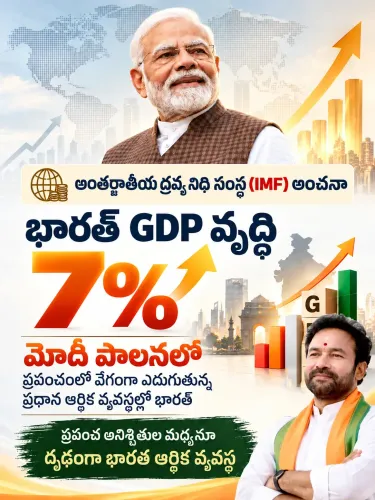
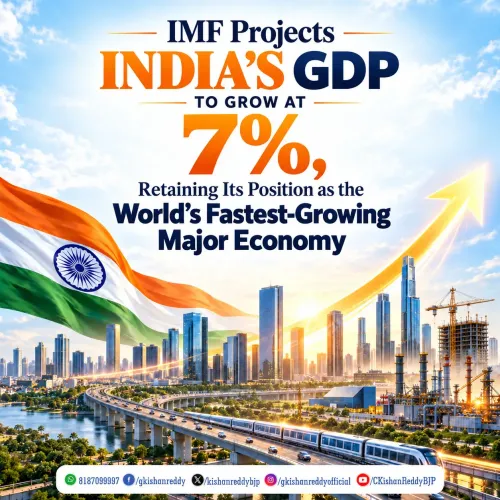
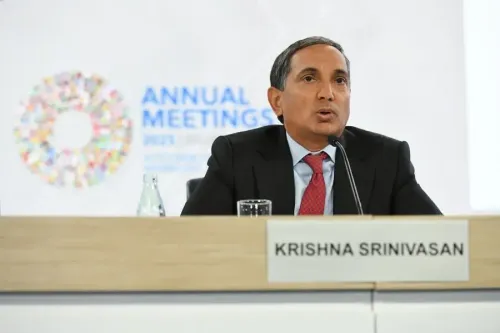
The International Monetary Fund (IMF) has revised India's growth projection upward to 7% from 6.5% forecast in April, citing the country's resilient response to global energy disruptions stemming from the Iran war, along with its strong fundamentals, fiscal prudence, and substantial foreign reserves. The revision was explained by Krishna Srinivasan, Director of the IMF's Asia and Pacific Department, at a news conference in Bangkok, where the Fund is holding its annual meeting.
Why the IMF Revised India's Growth Upward
Srinivasan attributed the upgrade primarily to a stronger-than-expected performance in the first quarter (Q1) of the current fiscal year. “We’ve revised up growth because Q1 of this fiscal year came out much stronger than we had anticipated,” he said. He further noted that India entered the current phase of energy stress from a position of strength, with growth already robust and fiscal discipline firmly established.
“India entered this with very strong fundamentals; growth was strong, fiscal prudence was pretty much enshrined,” Srinivasan said. “They had lots of reserves and so on.” Taken together, these factors enabled India to absorb external shocks more effectively than many peer economies, he added.
On the Rupee, Investment Flows and the ‘Disconnect’ Question
Srinivasan was pressed on what observers have called a puzzling gap between India’s headline growth rate — the highest among major economies — and concurrent pressures on the rupee, weakening investment inflows, and elevated oil price risks. He pushed back firmly on the characterisation, arguing that exchange rate behaviour is driven by distinct global variables.
“The so-called disconnect is not really a disconnect because what happens to the exchange rate is a function of global interest rates, investor risk appetite, and oil prices,” he explained. “And India, being an oil importer, has been affected by the energy shock.” He cautioned against treating the exchange rate as a reliable proxy for economic health, particularly in a period of overlapping global shocks.
“Exchange rate should not be viewed as a barometer of economic success or failure, given the multiplicity of shocks we have seen,” Srinivasan said, adding that allowing the exchange rate to function as a buffer against shocks remains an important policy tool.
IMF Backs India’s GDP Methodology Overhaul
Separately, Srinivasan endorsed the revision of GDP measurement methodology carried out this year by the Ministry of Statistics and Programme Implementation (MoSPI), calling it a “welcome development” and consistent with advice the IMF’s own statistics department had previously offered.
“These revisions to the methodology are entirely consistent with the advice we’ve been giving them, including from our statistics department,” he said. “What they have done is consistent with good practices.” He specifically cited MoSPI’s decision to rebase GDP figures and incorporate the Producer Price Index (PPI) and the Index of Industrial Production (IIP) on the production side as methodologically sound steps.
Broader Context: India in a Turbulent Global Landscape
India’s upgrade comes at a time when the IMF is navigating a complex global outlook shaped by the Iran war’s energy price spillovers, sticky inflation in advanced economies, and shifting capital flows away from emerging markets. India’s ability to maintain a 7% trajectory under these conditions marks a notable divergence from many of its peers. Notably, this is the second consecutive upward revision to India’s growth forecast within a single calendar year, reflecting a pattern of IMF estimates playing catch-up with actual Indian economic momentum.
With the IMF annual meeting underway in Bangkok, further commentary on India’s fiscal trajectory and monetary policy stance from Fund officials is expected in the days ahead.
Point of View
But the more revealing moment was Srinivasan’s explicit defence of the rupee’s weakness as a structural shock-absorber rather than a sign of distress — a framing that conveniently aligns with the government’s own narrative. The endorsement of MoSPI’s GDP methodology revision deserves scrutiny too: while the IMF calls it a ‘welcome development’, revised methodologies that produce higher GDP readings have historically been contested by economists who see them as benchmark-laundering. India’s growth story is real, but the confidence with which the IMF is now attaching its brand to both the number and the method of counting it warrants independent verification.
NationPress
15 Oct 2026
Frequently Asked Questions
Why has the IMF raised India’s growth forecast to 7%?
The IMF raised India’s growth projection to 7% from 6.5% forecast in April because Q1 of the current fiscal year came in stronger than anticipated, and because India entered the global energy shock with robust fundamentals, fiscal discipline, and large foreign reserves. IMF Asia-Pacific Department Director Krishna Srinivasan made the announcement at the Fund’s annual meeting in Bangkok on 15 October 2024.
What is the energy shock mentioned in the IMF’s India assessment?
The energy shock refers to the spike in global oil prices triggered by the Iran war, which has disrupted energy markets and raised import costs for oil-dependent economies like India. As a major oil importer, India has felt the impact through a weaker rupee and elevated energy costs, even as its overall growth trajectory has remained strong.
Why is the rupee under pressure despite India’s strong growth?
According to IMF’s Krishna Srinivasan, the rupee’s pressure is driven by global factors — higher international interest rates, reduced investor risk appetite, and rising oil prices — rather than domestic economic weakness. He cautioned against treating the exchange rate as a barometer of economic success or failure.
What did the IMF say about India’s GDP methodology revision?
The IMF called MoSPI’s GDP methodology revision a ‘welcome development,’ saying it is consistent with advice the Fund’s own statistics department had previously provided. The revision involved rebasing GDP and incorporating the Producer Price Index (PPI) and Index of Industrial Production (IIP) on the production side.
Where is the IMF annual meeting being held, and who spoke on India?
The IMF’s annual meeting is being held in Bangkok. Krishna Srinivasan, Director of the IMF’s Asia and Pacific Department, addressed the India growth upgrade and related macroeconomic questions at a news conference on 15 October.