India-Japan 16th Summit: Defence, semiconductors and AI pact signal deeper integration
Synopsis
At their 16th Annual Summit, India and Japan did not just sign agreements — they laid the scaffolding of a multi-sector strategic partnership. A first-ever co-developed naval defence system, a semiconductor roadmap, an AI pact, and a reaffirmed bullet-train commitment signal two democracies choosing integration over insulation at a time when the Indo-Pacific's fault lines are sharpening.
Key Takeaways
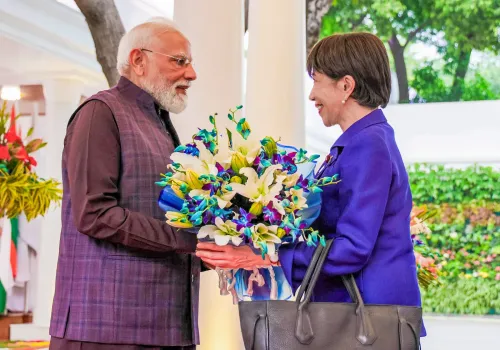
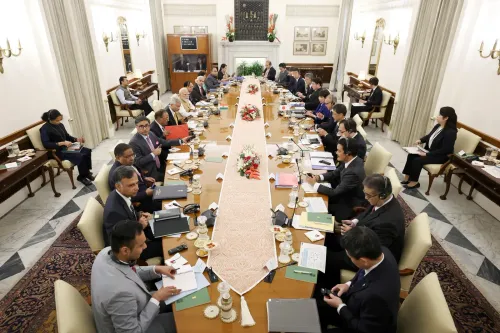
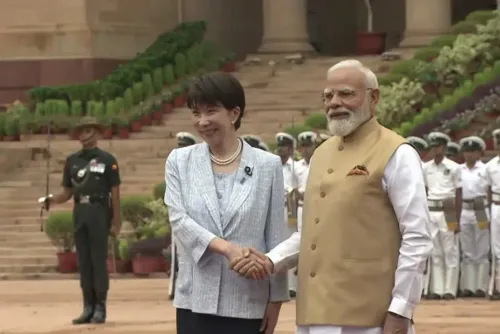
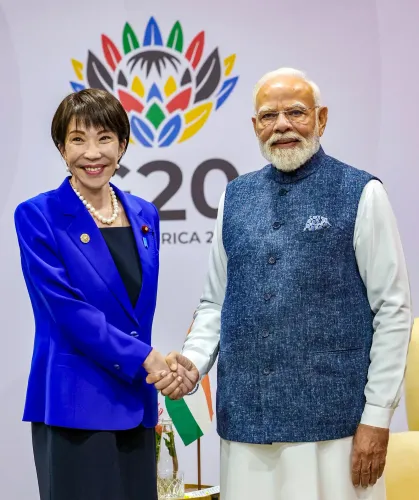
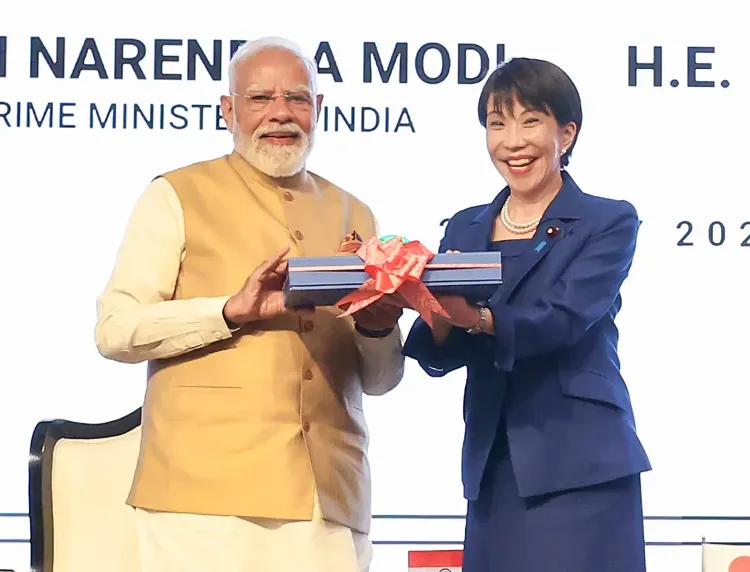
Prime Minister Narendra Modi and Japanese PM Sanae Takaichi held the 16th Annual India-Japan Summit at Hyderabad House, New Delhi on 2 July 2025 .
The two nations announced a first-ever co-developed naval communications defence system — a bilateral first.
A joint semiconductor and critical minerals roadmap and an AI partnership pairing Japanese engineering with Indian software talent were formalised.
Japan reaffirmed support for the Mumbai–Ahmedabad high-speed rail corridor .
The joint statement addressed the East and South China Seas , North Korea , and a shared vision of a free, prosperous and rules-based Indo-Pacific .
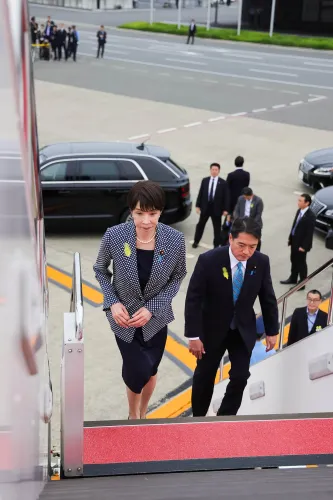
Takaichi's visit ( 1–3 July 2025 ) was her first to India since assuming office.
India and Japan have chosen deeper interdependence over self-sufficiency, committing to co-develop defence systems, align on semiconductors, and partner on artificial intelligence during the 16th Annual India-Japan Summit held at Hyderabad House, New Delhi on 2 July 2025. The summit, which brought Japanese Prime Minister Sanae Takaichi to India on her first visit since assuming office, produced a range of agreements spanning defence, technology, energy, infrastructure, and health.
Key Agreements from the Summit
The two nations announced a first-ever co-developed defence system for naval communications — a landmark in bilateral defence cooperation. Alongside this, a joint roadmap on semiconductors and critical minerals was unveiled, pairing Japan's manufacturing precision with India's supply chain ambitions. An artificial intelligence partnership was formalised, designed to combine Japanese engineering expertise with Indian software talent, and a biogas initiative was also included in the summit's deliverables, according to a report in One World Outlook.
Prime Minister Narendra Modi and Takaichi discussed the full spectrum of bilateral ties at Hyderabad House, covering trade and investment, economic security, energy, emerging technologies, defence, and people-to-people exchanges. Both leaders also addressed regional and global developments of mutual interest.
High-Speed Rail and Infrastructure Continuity
Takaichi reaffirmed Japan's commitment to the Mumbai–Ahmedabad high-speed rail corridor, one of the flagship infrastructure projects in the bilateral relationship. Analysts note this signals continuity in Japanese financing and technical support for the project regardless of domestic political transitions in Tokyo. The reaffirmation was widely read as a signal that the partnership's long-term architecture remains intact beyond individual administrations.
The Strategic Context: Indo-Pacific and China
The summit's joint statement addressed the East and South China Seas, North Korea, and the shared vision of a 'free, prosperous and rules-based Indo-Pacific' — language that reflects the strategic convergence of two democracies that have each experienced friction with great-power assertiveness. Notably, neither capital framed the partnership as confrontational; the emphasis remained on constructive integration rather than containment.
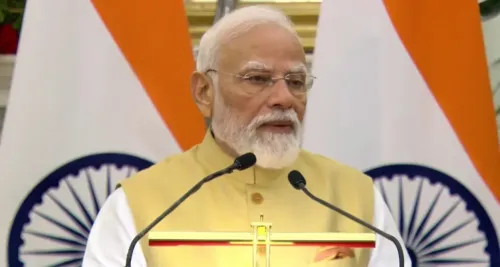
According to the One World Outlook report, the summit represents 'two large, democratic economies choosing integration over insulation' at a moment when decoupling narratives and hardening blocs have dominated the Indo-Pacific discourse for years. The report described Modi's assertion that 'mutual trust is Asia's greatest strategic asset' not as diplomatic rhetoric but as a working thesis for how stability in the region will be constructed — through patient, wide-ranging cooperation between capable, like-minded states.
Why This Summit Stands Apart
What distinguishes the 16th Annual Summit from earlier iterations is the breadth of its commitments. No single domain carries the full weight of the bilateral relationship; instead, defence, technology, energy, health, and infrastructure are advancing simultaneously. This multi-sector architecture reduces dependence on any one pillar and makes the partnership more resilient to external shocks or shifts in global supply chains.
Takaichi's three-day visit to India ran from 1–3 July 2025, making it the first bilateral summit since she took office. The pace and scope of commitments made during this visit suggest both capitals are accelerating the partnership's operational depth, with the region — and the wider world — watching the model it represents.
Point of View
But the simultaneous advances on semiconductors, AI, biogas, and high-speed rail suggest a deliberate strategy to make the partnership too multi-dimensional to unwind. The joint statement's careful language on the South China Sea and North Korea — assertive enough to signal alignment, restrained enough to avoid provocation — reflects a shared diplomatic grammar that has taken years to develop. The real question is execution: India and Japan have a history of ambitious announcements that move slowly through bureaucratic and procurement channels. Whether the naval communications system and semiconductor roadmap translate into deployed capability and real supply-chain integration within a measurable timeframe will determine whether this summit is remembered as a turning point or another high-water mark that receded.
NationPress
5 Oct 2026
Frequently Asked Questions
What was agreed at the 16th India-Japan Annual Summit?
India and Japan announced a first-ever co-developed naval communications defence system, a joint semiconductor and critical minerals roadmap, an AI partnership, and a biogas initiative at the 16th Annual Summit held on 2 July 2025 in New Delhi. Japan also reaffirmed its commitment to the Mumbai–Ahmedabad high-speed rail project.
Who represented Japan at the summit and when did the visit take place?
Japanese Prime Minister Sanae Takaichi represented Japan and visited India from 1–3 July 2025 — her first trip to India after assuming office. She met Prime Minister Narendra Modi at Hyderabad House in New Delhi on 2 July.
Why does the India-Japan summit matter for the Indo-Pacific?
The summit is significant because it demonstrates two major democracies choosing deeper economic and defence integration rather than self-sufficiency or bloc formation, at a time of rising great-power friction in the Indo-Pacific. Their joint statement addressed the East and South China Seas, North Korea, and a shared vision of a free and rules-based Indo-Pacific.
What is the India-Japan AI partnership about?
The AI partnership is designed to combine Japan's precision engineering strengths with India's software development talent, according to reports. It is one of several technology-focused agreements from the 16th Annual Summit aimed at deepening economic and strategic integration.
What is the current status of the Mumbai–Ahmedabad high-speed rail project?
Prime Minister Takaichi reaffirmed Japan's commitment to the Mumbai–Ahmedabad high-speed rail corridor during her India visit, signalling continuity in Japanese financing and technical support for the project. The corridor is one of the flagship infrastructure undertakings in the bilateral relationship.