How Will the India-New Zealand FTA Boost Investor Confidence?

Synopsis
The India-New Zealand Free Trade Agreement is a significant milestone that promises to enhance investor confidence by improving market access and fostering collaboration in various sectors. With a commitment of $20 billion, this deal aims to strengthen economic ties and stimulate growth in both nations.
Key Takeaways
India and New Zealand have signed a Free Trade Agreement.
The FTA aims to boost investor confidence.
It includes a $20 billion investment commitment over 15 years.
Market access has been improved for Indian goods and services.
Employment opportunities are expected to rise across various sectors.
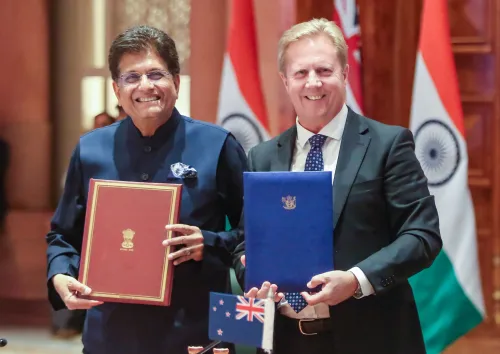
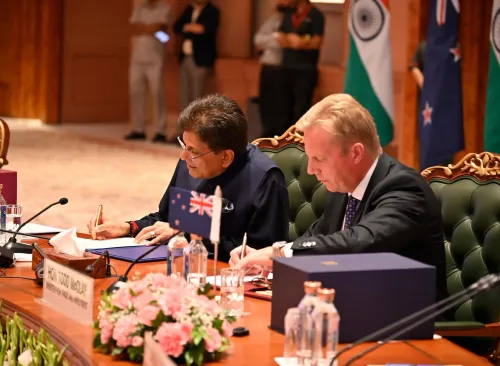
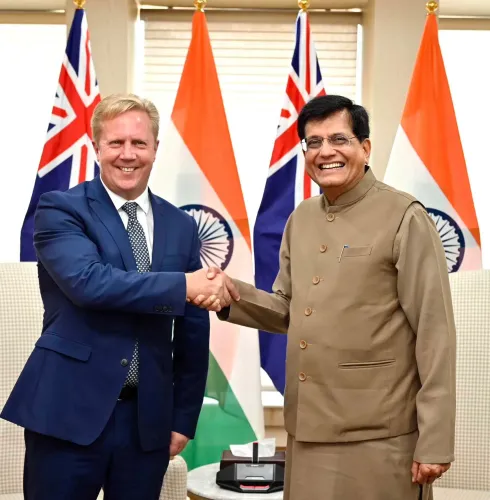
New Delhi, Dec 23 (NationPress) The Free Trade Agreement (FTA) between India and New Zealand is set to boost investor confidence as both nations enhance access to each other's markets, according to Ved Jain, an economist and former president of the Institute of Chartered Accountants of India (ICAI), who spoke on Tuesday.
This Agreement facilitates improved access for Indian exports, broadens service and mobility opportunities, and promotes collaboration in agriculture, investment, and emerging sectors, yielding significant advantages for the economy.
“When two nations like India and New Zealand forge a free trade agreement, granting each other enhanced access, and with both countries' leadership dedicated to economic growth, it instills greater confidence in investors. They feel optimistic about both the Indian and New Zealand economies,” Jain stated in an interview with IANS.
The FTA abolishes tariffs on 100% of Indian exports and includes a commitment of $20 billion in investments over the next 15 years to reinforce long-term economic and strategic relations.
India has extended market access on 70.03% of tariff lines while excluding 29.97%. Exclusions include various products such as Dairy (milk, cream, whey, yogurt, cheese, etc.), animal products (excluding sheep meat), vegetable products (onions, chana, peas, corn, almonds, etc.), sugar, artificial honey, animal, vegetable or microbial fats and oils, arms and ammunition, gems and jewellery, copper products (cathodes, cartridges, rods, bars, coils, etc.), aluminium and its derivatives (ingots, billets, wire bars), among others.
Dr. Shikha Darbari, former Chief Commissioner of Income Tax, remarked to IANS that reduced tariffs in the New Zealand market will heighten demand for Indian products and bolster the global presence of domestic industries. “This agreement is also expected to create job opportunities across these sectors, providing a much-needed boost to the Indian economy,” she highlighted.
She added that this long-term trade agreement, valued at about $20 billion, aims to double the bilateral trade between India and New Zealand in the next five years. “This exemplifies Prime Minister Modi’s global economic vision and reflects the increasing confidence of international investors in India,” Dr. Darbari concluded.
Point of View
This initiative is poised to create significant benefits for both economies, reflecting an optimistic outlook for international trade relations.
NationPress
20 Sept 2026
Frequently Asked Questions
What is the India-New Zealand Free Trade Agreement?
The India-New Zealand FTA is a trade deal aimed at enhancing market access between the two countries, promoting economic cooperation and investment.
How will the FTA benefit Indian investors?
The FTA will provide improved access to the New Zealand market, reduce tariffs, and create new opportunities in various sectors, enhancing investor confidence.
What is the investment commitment associated with the FTA?
The agreement includes a commitment of $20 billion over the next 15 years to strengthen economic and strategic cooperation between India and New Zealand.
What products are excluded from the FTA?
Exclusions include various dairy products, animal products (except sheep meat), certain vegetable products, arms and ammunition, and gems and jewellery.
What is the expected impact on job creation?
The agreement is anticipated to generate employment opportunities across sectors as demand for Indian products increases in New Zealand.