India-New Zealand FTA: Tariff-free exports, $20 bn investment in landmark deal
Synopsis
Signed on 27 April 2025, the India–New Zealand FTA eliminates tariffs on all of India's exports and covers a $20 billion investment pledge, 5,000 skilled-worker visas annually, and a first-ever student mobility annex — all framed globally as a direct counter to Trump-era trade disruption.
Key Takeaways
India and New Zealand signed an FTA on 27 April 2025 , removing tariffs on 100% of India's exports to New Zealand.
Tariffs on 95% of New Zealand's exports to India are reduced or eliminated under the deal.
Bilateral trade grew from $900 million in 2019–20 to $1.3 billion in 2024–25.
New Zealand will invest $20 billion in India over 15 years under the agreement.
A quota of 5,000 visas annually for skilled Indians covers sectors including IT, healthcare, AYUSH, and engineering.
India has excluded all dairy products and farm produce from the FTA's tariff concessions.
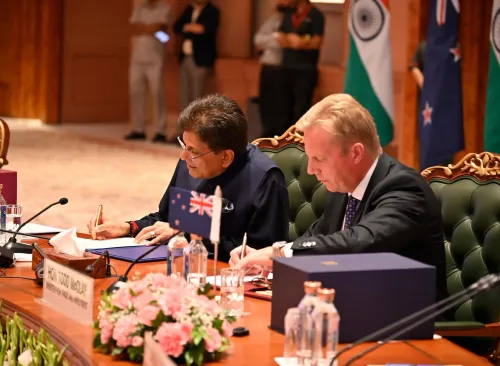
India and New Zealand have signed a landmark Free Trade Agreement (FTA) on 27 April 2025, removing tariffs on 100% of India's exports to New Zealand and reducing or eliminating duties on 95% of imports from New Zealand into India. The deal, according to global commentary, is being viewed as a significant corrective to the disruption in international trade triggered by US President Donald Trump's tariff policies.
Trade Growth and Economic Context
Bilateral trade between India and New Zealand has shown consistent upward momentum in recent years. Total trade rose from approximately $900 million in 2019–20 to $1.3 billion in 2024–25. India's exports to New Zealand surged sharply from $379 million to $711 million during the same period, while New Zealand's exports to India grew more moderately from $522 million to $587 million. The FTA is designed to accelerate this trajectory and deepen the two nations' strategic partnership beyond trade alone.
South Africa's Independent Online (IOL) described the agreement as a
Point of View
The numbers are small — but the architecture of the deal, particularly the $20 billion investment commitment and the first-ever student mobility annex, mirrors the template India used with the European Free Trade Association. What deserves scrutiny is whether investment 'commitments' in such FTAs translate into actual capital flows — the EFTA deal set a similar headline figure with limited binding enforcement. India's decision to wall off dairy and farm products, meanwhile, reflects the enduring political sensitivity of agriculture, even as the government pushes trade liberalisation on other fronts.
NationPress
21 Sept 2026
Frequently Asked Questions
What is the India–New Zealand Free Trade Agreement?
The India–New Zealand FTA, signed on 27 April 2025, is a bilateral trade agreement that eliminates tariffs on 100% of India's exports to New Zealand and reduces or removes duties on 95% of New Zealand's exports to India. It also includes provisions on investment, skilled worker visas, student mobility, and working holiday visas.
How much will New Zealand invest in India under the FTA?
New Zealand has committed to investing $20 billion in India over 15 years as part of the FTA. This mirrors a similar investment commitment made by the European Free Trade Association in its own FTA with India.
What are the visa provisions in the India–New Zealand FTA?
The FTA includes a quota of 5,000 visas annually for skilled Indians to work in New Zealand for up to three years in sectors such as IT, healthcare, engineering, AYUSH, yoga, and construction. Additionally, 1,000 young Indians per year can avail the Working Holiday Visa for multiple entries over 12 months.
What does the student mobility annex mean for Indian students?
New Zealand has signed a student mobility and post-study work visa annex — the first such annex it has signed with any country. Indian students studying in New Zealand can work up to 20 hours per week and are eligible for extended post-study work visas.
Which Indian products are excluded from the FTA?
India has kept all dairy products — including milk, cream, whey, yoghurt, and cheese — as well as farm products outside the scope of the FTA's tariff concessions, protecting sensitive domestic agricultural sectors.