What are the benefits of the India-New Zealand FTA?
Synopsis
The India-New Zealand Free Trade Agreement is a transformative step in India's trade strategy, promising broad economic benefits. This landmark accord enhances market access for Indian exports, supports farmers, and fosters MSME growth, positioning India as a pivotal global player in the economic landscape. Discover how this FTA can shape India's future!
Key Takeaways
India-New Zealand FTA marks a significant trade milestone.
Zero-duty access for various Indian exports enhances competitiveness.
Focus on agricultural productivity benefits farmers significantly. $20 billion investment over 15 years strengthens economic ties.
Exclusion of sensitive products protects local industries.
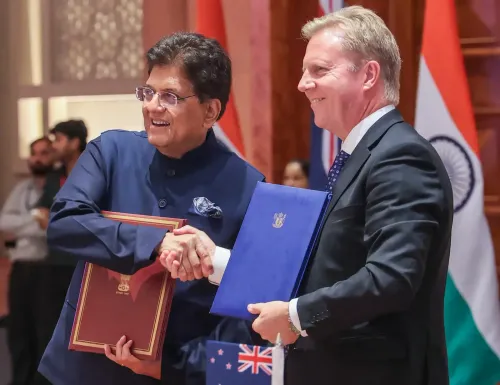
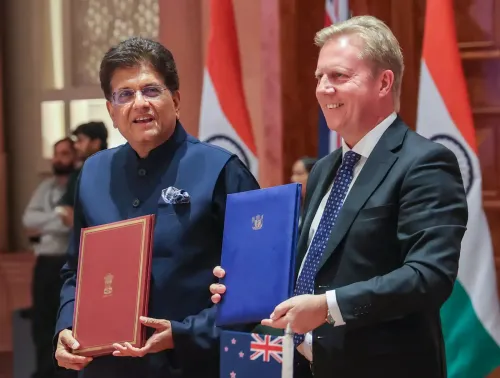
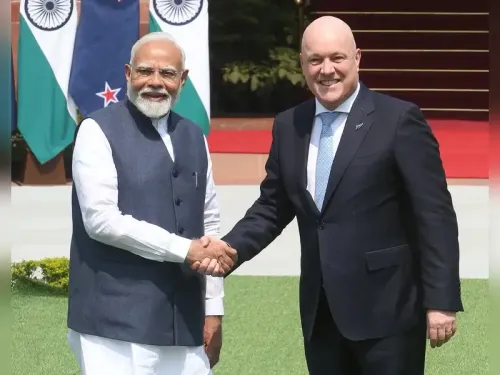
New Delhi, Dec 23 (NationPress) The India-New Zealand Free Trade Agreement marks a pivotal moment in India’s trade diplomacy, unlocking new pathways for extensive economic collaboration, as stated by officials.
By achieving enhanced market access for Indian products, broadening opportunities in services and mobility, and strengthening partnerships in agriculture, investment, and emerging sectors, this Agreement generates significant and diverse benefits throughout the economy.
The FTA removes duties on 100% of Indian exports and includes a $20 billion investment initiative over 15 years to bolster long-term economic and strategic ties.
“Through the Agricultural Productivity Partnership, the FTA works alongside farmers to enhance productivity and connect them to global value chains. The FTA supports MSMEs and job creation by providing zero-duty access for labor-intensive sectors such as textiles, apparel, leather, footwear, gems & jewellery, engineering products, and processed foods,” the statement emphasized.
India has provided market access in 70.03% of tariff lines while retaining 29.97% in exclusion. Certain items are excluded, including dairy products (milk, cream, whey, yogurt, cheese, etc.), animal products (excluding sheep meat), various vegetable products (onions, chana, peas, corn, almonds, etc.), sugar, artificial honey, animal, vegetable, or microbial fats and oils, arms and ammunition, as well as gems and jewellery, copper articles (cathodes, cartridges, rods, bars, coils, etc.), and aluminum products (ingots, billets, wire bars), among others.
New Zealand’s market access offer entails the immediate elimination of duties (zero duty) on 100% of its tariff lines (8,284 tariff lines) from the “Entry into Force” (EIF).
New Zealand has maintained tariffs around 10% on approximately 450 lines of key Indian exports, covering products like textiles/apparel, leather and headgear, ceramics, carpets, automobiles, and auto components. Furthermore, the average applied tariff, which stands at 2.2% in 2025, will drop to zero from EIF.
New Zealand has committed to focused Action Plans for kiwifruit, apples, and honey to enhance productivity, quality, and sector capabilities for fruit growers in India. This collaboration includes the establishment of Centres of Excellence, improved planting materials, capacity building for growers, technical assistance for orchard management, post-harvest practices, supply chains, and food safety.
“The advantages of this Agreement are anticipated to be widespread, benefiting farmers, MSMEs, students, and skilled professionals alike. This reinforces India’s standing as a reliable, forward-thinking global partner and supports the vision of a globally integrated Viksit Bharat 2047,” the statement concluded.
Point of View
The India-New Zealand FTA represents a significant advancement in trade relations. The deal is poised to yield substantial economic benefits, emphasizing mutual growth and cooperation. As India navigates its path towards becoming a developed nation by 2047, such agreements are crucial in establishing its global presence and fostering sustainable development.
NationPress
6 Oct 2026
Frequently Asked Questions
What is the India-New Zealand FTA?
The India-New Zealand FTA is a comprehensive trade agreement aimed at enhancing economic cooperation between the two nations by improving market access and fostering collaboration in various sectors.
How does the FTA benefit Indian farmers?
The FTA includes an Agricultural Productivity Partnership that supports farmers by increasing productivity and integrating them into global value chains.
What sectors are positively impacted by the FTA?
The FTA is expected to benefit sectors such as textiles, apparel, leather, engineering goods, and processed foods through zero-duty access for labor-intensive industries.
What are the exclusion items in the FTA?
Certain products like dairy, animal products, sugar, and gems & jewellery are excluded from the FTA, allowing India to protect sensitive industries.
What investment commitment is included in the FTA?
The FTA includes a $20 billion investment commitment over 15 years to enhance long-term economic and strategic cooperation between India and New Zealand.