CCEA clears ₹4,415 crore NH-347B upgrade in Madhya Pradesh
Synopsis
The Modi-chaired CCEA has cleared a ₹4,415 crore upgrade of NH-347B in Madhya Pradesh, stitching together 233.65 km across four districts — including two aspirational and three tribal districts. With links to six Gati Shakti economic nodes and a 16.20 km Khargone bypass, this is a targeted bet on central India's logistics backbone.
Key Takeaways
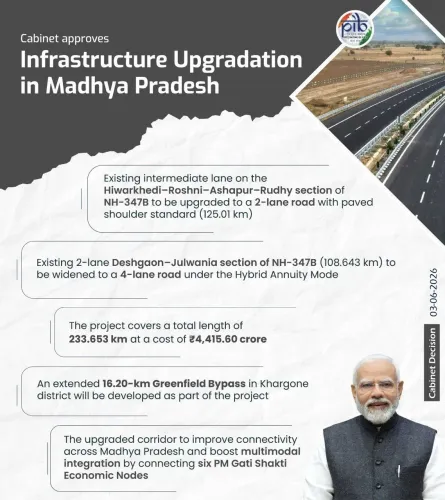
CCEA , chaired by PM Modi , approved a ₹4,415.60 crore upgrade of NH-347B in Madhya Pradesh .
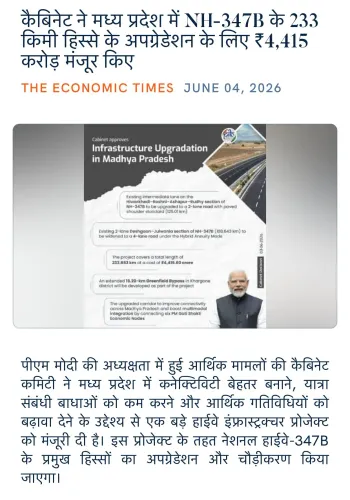
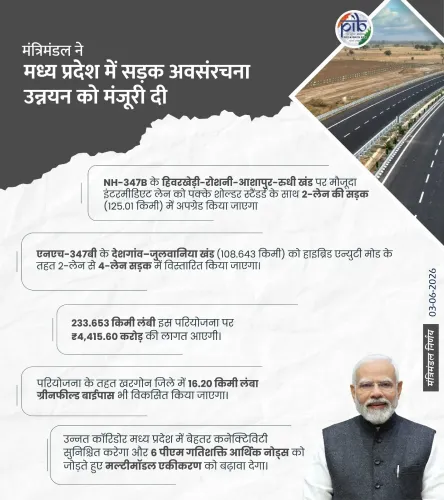
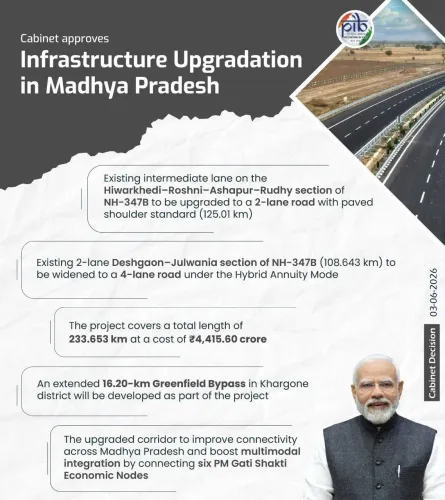
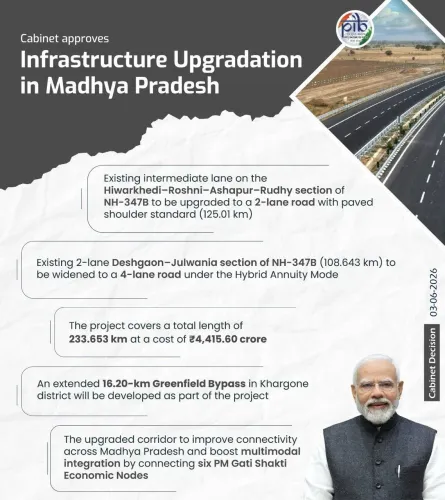
The project covers 125.01 km (Hiwarkhedi–Roshni–Ashapur–Rudhy) as two-lane with paved shoulders and 108.643 km (Deshgaon–Julwania) as four lanes.
A 16.20 km greenfield bypass will be built around Khargone .
It will integrate with six PM Gati Shakti Economic Nodes and five logistics nodes , including two airports and a multi-modal logistics park.
The corridor covers two aspirational districts (Khandwa, Barwani) and three tribal districts (Betul, Khandwa, Khargone).
Execution will be under the Hybrid Annuity Mode (HAM) .
The Cabinet Committee on Economic Affairs (CCEA), chaired by Prime Minister Narendra Modi, on 3 June approved a ₹4,415.60 crore upgradation and widening of key stretches of National Highway 347B in Madhya Pradesh, covering a combined 233.65 km across central India's tribal and aspirational belt. The project will be executed under the Hybrid Annuity Mode (HAM) and is positioned as a strategic connector for industrial, logistics and social nodes in the state.
What the project covers
The clearance involves two distinct stretches. The 125.01 km Hiwarkhedi–Roshni–Ashapur–Rudhy section will be upgraded from an intermediate lane to a two-lane highway with paved shoulders. The 108.643 km Deshgaon–Julwania section will be widened from two lanes to four lanes.
A 16.20 km greenfield bypass around Khargone district will also be built to ease congestion in built-up areas. Officials cited severe geometric deficiencies, sharp curves and chokepoints in town stretches as the operational case for the upgrade.
Districts and regions impacted
The corridor passes through Betul, Khandwa, Khargone and Barwani — a belt that includes two aspirational districts (Khandwa and Barwani) and three tribal districts (Betul, Khandwa, Khargone). The government has framed the project as a connectivity push for under-served pockets of central India.
Why it matters
The upgraded NH-347B will integrate with six PM Gati Shakti Economic Nodes, including one textile cluster, two mega food parks, one industrial park and two super thermal power plants. It will also link five logistics nodes — two major railway stations, two airports and one multi-modal logistics park — strengthening the freight backbone of western Madhya Pradesh.
According to the government, the upgrade is expected to lift average travel speeds, cut journey times, improve fuel efficiency and lower vehicle operating costs. Notably, this is part of a broader pattern of HAM-mode highway clearances aimed at accelerating execution while sharing fiscal load with private developers.
What's next
Implementation will now move to the tendering and execution stage, with authorities tasked to maintain quality benchmarks and timelines. The corridor's completion is expected to unlock investment flows, reduce logistics costs and improve market access for tribal and aspirational districts along the alignment.
Point of View
But the strategic value sits in the alignment: a corridor that threads together two aspirational and three tribal districts with Gati Shakti economic nodes is exactly the kind of last-mile integration India's logistics index has been missing. The HAM structure is sensible — it shares risk and historically delivers faster than EPC on stretches of this length. The execution test, as always, will be land acquisition and the Khargone bypass, where built-up area disputes have stalled comparable projects elsewhere. If delivered on time, this is a quiet but consequential push for central India's freight economics.
NationPress
18 Oct 2026
Frequently Asked Questions
What has the CCEA approved for NH-347B in Madhya Pradesh?
The CCEA, chaired by PM Narendra Modi, has approved a ₹4,415.60 crore upgradation and widening of NH-347B in Madhya Pradesh, covering 233.65 km in total. The project will be executed under the Hybrid Annuity Mode (HAM).
Which sections of NH-347B will be upgraded?
Two stretches will be developed: a 125.01 km Hiwarkhedi–Roshni–Ashapur–Rudhy section will be upgraded to a two-lane highway with paved shoulders, and a 108.643 km Deshgaon–Julwania section will be widened from two to four lanes. A 16.20 km greenfield bypass will also be built around Khargone.
Which districts will benefit from the NH-347B upgrade?
The corridor will improve connectivity across Betul, Khandwa, Khargone and Barwani districts. This includes two aspirational districts (Khandwa and Barwani) and three tribal districts (Betul, Khandwa and Khargone).
How does the project link with PM Gati Shakti?
The upgraded NH-347B will integrate with six PM Gati Shakti Economic Nodes — one textile cluster, two mega food parks, one industrial park and two super thermal power plants. It will also connect five logistics nodes, including two railway stations, two airports and one multi-modal logistics park.
What is the Hybrid Annuity Mode used for the project?
Hybrid Annuity Mode (HAM) is a public-private partnership structure where the government funds a share of the project cost upfront and pays the developer the balance as annuities over the concession period. It is used to share risk and accelerate highway execution.