Why Does the World Trust India to Build the Future of Semiconductors?
Synopsis
Prime Minister Modi highlights India's increasing significance in the semiconductor market, announcing major investments and reforms aimed at establishing the country as a global leader in chip manufacturing and innovation. Join us as we explore India's journey toward becoming a semiconductor powerhouse.
Key Takeaways
India is establishing itself as a global semiconductor leader.
Investments of $18 billion have been made in semiconductor projects.
The global semiconductor market is set to exceed $1 trillion.
Next-gen reforms will enhance the competitive landscape.
Design centers in Noida and Bengaluru are developing advanced chips.
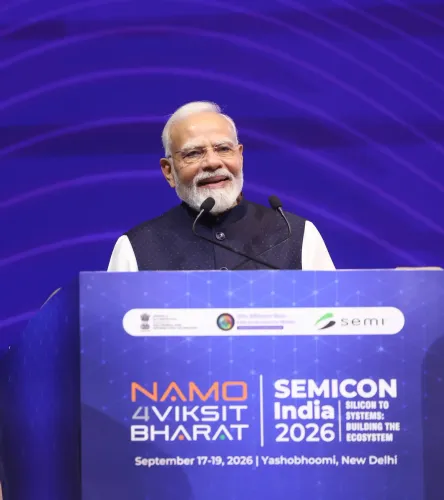
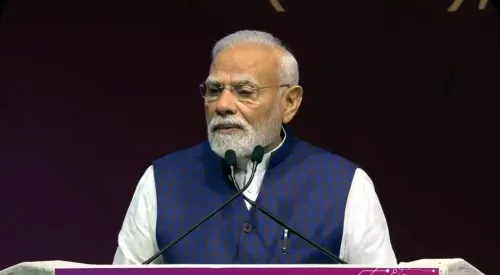
New Delhi, Sep 2 (NationPress) Prime Minister Narendra Modi stated on Tuesday that the global community now has confidence in India and is eager to collaborate in shaping the future of the semiconductor industry. He announced that the government is preparing to unveil a series of next-generation reforms for this sector.
During the inauguration of the ‘Semicon India 2025’ event, PM Modi emphasized India's expanding influence in the international chip market, asserting that the nation is poised to play a crucial role in the trillion-dollar semiconductor industry.
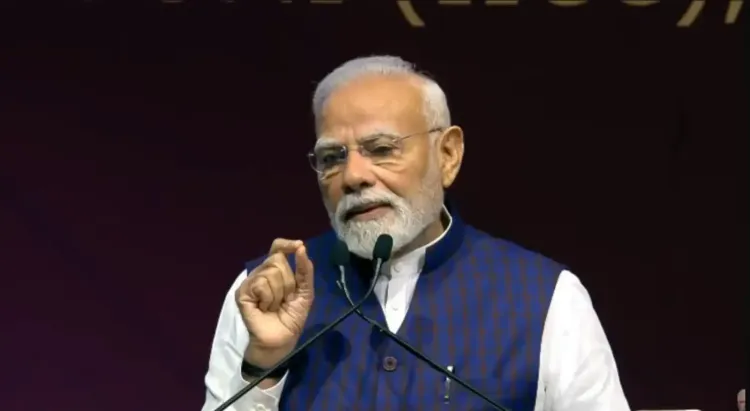
“Since 2021, investments totaling $18 billion have been allocated to 10 semiconductor projects,” PM Modi remarked. “The world has faith in India, believes in India, and is ready to partner with India for the future of semiconductors,” he added, highlighting that while the previous century was driven by oil, the upcoming era will be defined by chips.
He noted that the global semiconductor market has already reached $600 billion and is on the verge of surpassing $1 trillion, with India set to play a significant role in this growth.
“Our semiconductor ecosystem goes beyond chip manufacturing; we are establishing a competitive and Atmanirbhar environment in the industry,” PM Modi asserted.
He mentioned that design centers in Noida and Bengaluru are engaged in developing some of the world’s most sophisticated chips, addressing the challenges within the global semiconductor landscape.
The Prime Minister also showcased India’s economic resilience, revealing that the country achieved a 7.8 percent growth in the April-June quarter amidst worldwide uncertainty.
“Recently, GDP figures for the first quarter of this year were published. Once more, India has exceeded all expectations and assessments. In a time of global economic challenges, India has managed a growth rate of 7.8 percent,” the Prime Minister conveyed to the audience.
PM Modi expressed that this achievement illustrates that India is on the right path toward becoming a product-driven nation.
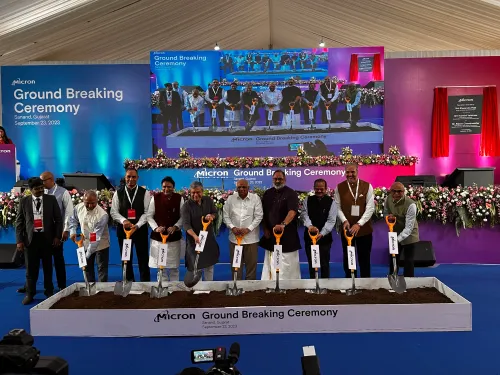
Union Electronics and IT Minister Ashwini Vaishnaw also spoke at the event, encouraging international companies to establish manufacturing operations in India, stating that the nation has built a robust foundation for the semiconductor industry within a short span.
The three-day ‘Semicon India 2025’ conference, taking place from September 2 to 4 at Yashobhoomi, is themed “Building the Next Semiconductor Powerhouse.”
Co-organized by the India Semiconductor Mission (ISM) under the Ministry of Electronics and Information Technology (MeitY) and SEMI, the global semiconductor industry association, this event stands as one of the largest industry congregations in South Asia, featuring over 350 exhibitors from 33 countries, more than 15,000 visitors, six country roundtables, four country pavilions, and participation from nine Indian states. Sessions will delve into semiconductor fabs, advanced packaging, research and development, artificial intelligence, smart manufacturing, state-level policies, and investment opportunities.
Point of View
The optimism surrounding India's semiconductor initiatives reflects the nation's potential to innovate and compete globally. With strategic investments and reforms, India is positioned to become a significant player in the semiconductor market, reinforcing its commitment to economic independence and technological advancement.
NationPress
20 Sept 2026
Frequently Asked Questions
What is the significance of the 'Semicon India 2025' event?
The 'Semicon India 2025' event serves as a platform for showcasing India's advancements in the semiconductor industry, attracting global participation and investment, and discussing future opportunities in the sector.
How much investment has India made in semiconductor projects?
India has allocated $18 billion to 10 semiconductor projects since 2021, highlighting its commitment to developing a robust semiconductor ecosystem.
What role will India play in the global semiconductor market?
India is expected to play a crucial role in the global semiconductor market, which is projected to exceed $1 trillion. The country aims to establish a competitive and self-reliant semiconductor industry.
What are the expected outcomes of the upcoming semiconductor reforms?
The upcoming semiconductor reforms are anticipated to enhance India's manufacturing capabilities, attract foreign investment, and foster innovation in chip design and production.
What sectors will be discussed at the 'Semicon India 2025' conference?
The conference will cover various topics, including semiconductor fabs, advanced packaging, research and development, artificial intelligence, smart manufacturing, and investment opportunities.