Will Jamaat-e-Islami Foster ‘Constructive’ and ‘Peaceful’ Relations with India in Bangladesh Polls?

Synopsis
As Bangladesh gears up for the upcoming elections, Jamaat-e-Islami's manifesto pledges to foster peaceful ties with India and other neighboring countries. This commitment, rooted in mutual respect, highlights the party's broader foreign policy goals and its focus on international cooperation while navigating regional complexities. Explore how Jamaat plans to reshape Bangladesh's foreign relations.
Key Takeaways
Jamaat-e-Islami pledges to build constructive relations with neighboring countries.
The manifesto highlights mutual respect as a foundation for foreign relations.
Cooperation with developed nations is emphasized for diplomatic engagement.
Active participation in regional organizations like SAARC and ASEAN is reaffirmed.
Jamaat aims to address the Rohingya crisis collaboratively with the international community.
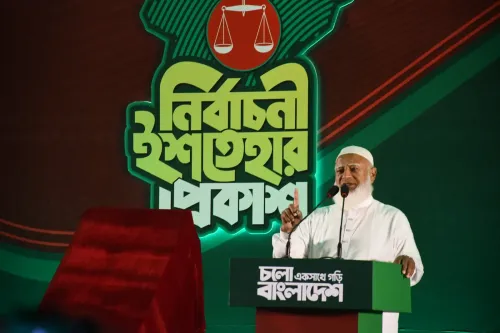
Dhaka, Feb 5 (NationPress) As Bangladesh approaches its elections next week, the radical Islamist party Jamaat-e-Islami has made a commitment in its election manifesto to cultivate peaceful and cooperative relations with neighboring nations, including India, grounded in mutual respect and fairness.
According to the manifesto released by Jamaat, it states, “Constructive relations with neighboring countries will be established: Peaceful, friendly, and cooperative ties will be nurtured with neighboring and nearby nations -- including India, Bhutan, Nepal, Myanmar, Sri Lanka, Maldives, and Thailand -- based on mutual respect and fairness.”
Emphasizing its foreign policy goals, the party indicated a commitment to strengthening connections with countries within the Muslim world.
Additionally, it outlined a strategy to bolster cooperation with developed nations such as the United States, United Kingdom, European Union, Japan, and Canada -- while expanding diplomatic, economic, and strategic partnerships with regions in Eastern Europe, Africa, and South America.
“Engagement with the developed world: Constructive and mutually beneficial relations will be nurtured with developed nations, including the United States, United Kingdom, European Union, Japan, and Canada,” the party highlighted.
“Expanding ties with Eastern Europe, Africa, and South America: Proactive measures will be taken to broaden and deepen diplomatic, economic, and strategic relations with nations in Eastern Europe, Africa, and South America,” it further elaborated.
The manifesto stressed the importance of enhancing Bangladesh’s role within the United Nations and other international organizations to address global challenges, including peace, security, human rights, and economic development.
“Active engagement with the United Nations and international organizations: Bangladesh’s active participation in the United Nations and its affiliated bodies will be intensified to confront global challenges such as peace, security, human rights, and economic development,” it noted.
Jamaat also reaffirmed Bangladesh’s ongoing involvement in regional organizations like SAARC and ASEAN.
“Active participation in regional organizations: Bangladesh will maintain its active engagement in regional bodies such as SAARC and ASEAN,” it stated.
The party further declared that, in collaboration with the global community, “a peaceful and sustainable resolution to the Rohingya crisis will be sought, ensuring their safe, dignified, and voluntary repatriation.”
Jamaat also committed to continuing “Bangladesh’s participation in United Nations peacekeeping missions,” while promising to “support and cooperate in the establishment of transparent, orderly, and lawful migration management systems.”
The election manifesto, ahead of the February 12 election, outlines a wider and collaborative foreign policy outreach across several nations; however, it notably omits any direct reference to Pakistan.
Point of View
Jamaat-e-Islami's commitment to fostering peaceful relations with India and other neighboring nations is a strategic move amidst the political complexities of the region. While their manifesto emphasizes cooperation and mutual respect, it remains crucial for the party to address the broader implications of their foreign policy on national security and regional stability.
NationPress
16 Sept 2026
Frequently Asked Questions
What does Jamaat-e-Islami's manifesto promise regarding foreign relations?
Jamaat-e-Islami's manifesto promises to cultivate peaceful and cooperative relations with neighboring countries, including India, based on mutual respect and fairness.
Which countries does Jamaat plan to strengthen ties with?
Jamaat plans to strengthen ties with India, Bhutan, Nepal, Myanmar, Sri Lanka, Maldives, Thailand, and engage with developed nations like the US, UK, EU, Japan, and Canada.
How does Jamaat plan to address the Rohingya crisis?
Jamaat aims to pursue a peaceful and sustainable solution to the Rohingya crisis, ensuring their safe and dignified repatriation in collaboration with the international community.
What role does the United Nations play in Jamaat's foreign policy?
Jamaat emphasizes active engagement with the United Nations to tackle global challenges such as peace, security, human rights, and economic development.
Will Jamaat continue participating in regional organizations?
Yes, Jamaat reaffirms its commitment to active participation in regional organizations like SAARC and ASEAN.