Jal Sanchay Jan Bhagidari builds 1.55 crore water recharge structures across India

Synopsis
India's Jal Sanchay Jan Bhagidari programme has crossed a landmark 1.55 crore artificial water recharge structures, with an official impact evaluation crediting them with 2.43 billion cubic metres of groundwater recharge between June and December 2025 — one of the most ambitious community-led water security drives in the country's history.
Key Takeaways
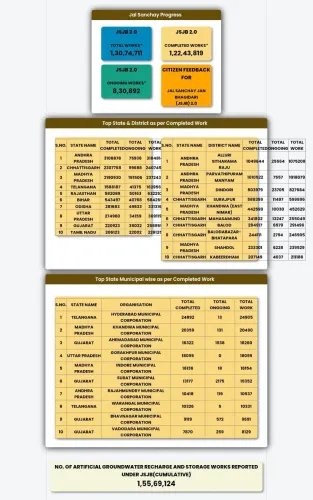
Over 1.55 crore artificial recharge and storage structures built under the Jal Sanchay Jan Bhagidari (JSJB) initiative.
Impact evaluation estimates 2.43 billion cubic metres of groundwater recharged from 23 lakh structures assessed between June and December 2025 .
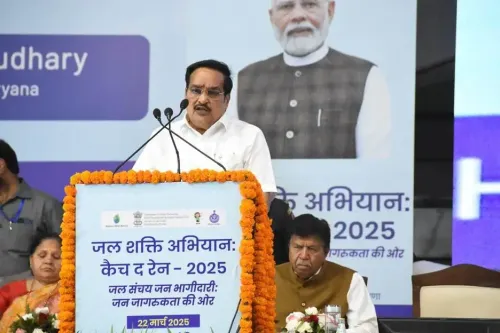
The JSJB is integrated with the Jal Shakti Abhiyan: Catch the Rain campaign, which promotes rainwater harvesting and water body restoration.
A dedicated JSJB portal and mobile app enable real-time monitoring, transparency, and public feedback.
The programme builds on Jal Shakti Abhiyan 2019 , which covered 1,592 water-stressed blocks across 256 districts .
Stakeholders include Panchayati Raj Institutions , women's groups, youth, civil society, and urban local bodies.
More than 1.55 crore artificial recharge and storage structures have been built under the Jal Sanchay Jan Bhagidari (JSJB) initiative, according to an official factsheet released on Monday, 26 October 2026. An independent impact evaluation estimates that 2.43 billion cubic metres of groundwater has been recharged from 23 lakh structures assessed using rainfall data between June and December 2025 — marking one of the largest community-driven water conservation efforts in India's recent history.
What the Initiative Covers
The JSJB has been integrated with the Jal Shakti Abhiyan: Catch the Rain (CTR) campaign, which focuses on rainwater harvesting, groundwater recharge, water conservation, creation of water assets, and community participation. The programme promotes locally appropriate, low-cost interventions and aims to strengthen climate resilience through sustainable water management practices.
A dedicated JSJB: CTR portal and mobile application have been deployed to improve transparency, monitoring, and public feedback mechanisms — embedding digital oversight into what is fundamentally a grassroots effort.
Community Stakeholders at the Core
The initiative has mobilised a wide coalition of actors including Panchayati Raj Institutions, urban local bodies, women's groups, youth organisations, educational institutions, civil society groups, and local communities. These stakeholders support planning, implementation, and community-led water conservation in a Jan Andolan — or people's movement — framework.
'By linking community ownership with convergence, digital oversight, and asset creation, JSJB: Catch the Rain campaign is laying the foundation for a water-secure Bharat,' the official statement said.
Building on Earlier Groundwork
The JSJB campaign builds on the earlier Jal Shakti Abhiyan 2019, which covered 1,592 water-stressed blocks across 256 districts and promoted rainwater harvesting, groundwater recharge, watershed development, water body rejuvenation, and afforestation. The current iteration expands both scale and scope, adding digital infrastructure and a convergence model that draws on multiple government schemes simultaneously.
'Water conservation has evolved into a community-driven movement focused on sustainable water management. Initiatives such as Catch the Rain and Jal Sanchay Jan Bhagidari promote rainwater harvesting, groundwater recharge, and restoration of water bodies,' the official statement noted.
Why It Matters for India's Water Future
India is among the world's most water-stressed nations, with groundwater depletion accelerating in agricultural belts across Punjab, Haryana, Rajasthan, and parts of peninsular India. The JSJB model — combining scientific planning, local ownership, and convergence of government resources — is being positioned as a scalable template for water security, rural livelihoods, and long-term climate resilience. The scale of structures created and the quantum of recharge estimated will, however, require sustained monitoring to verify impact beyond the initial assessment window.
Point of View
But the critical question is durability: were these structures built to last, and is there a maintenance model in place once the campaign momentum fades? India has a long history of water infrastructure created in Mission Mode that falls into disuse within a few monsoon cycles. The 2.43 billion cubic metres recharge estimate covers only 23 lakh of the 1.55 crore structures — barely 15% — leaving the overall impact largely unquantified. Scaling up independent, third-party impact verification to cover the full asset base would give the programme the credibility it needs to become a genuine policy anchor rather than a headline milestone.
NationPress
26 Oct 2026
Frequently Asked Questions
What is the Jal Sanchay Jan Bhagidari initiative?
The Jal Sanchay Jan Bhagidari (JSJB) is a government-led water conservation programme integrated with the Jal Shakti Abhiyan: Catch the Rain campaign. It focuses on building artificial recharge and storage structures, promoting rainwater harvesting, and mobilising community participation for sustainable water management across India.
How many structures have been built under JSJB?
Over 1.55 crore artificial recharge and storage structures have been constructed under the JSJB initiative, according to an official factsheet released on 26 October 2026.
How much groundwater has been recharged under the JSJB programme?
An impact evaluation estimates that 2.43 billion cubic metres of groundwater has been recharged from 23 lakh structures assessed using rainfall data between June and December 2025. This covers roughly 15% of the total structures built under the initiative.
How does JSJB differ from the earlier Jal Shakti Abhiyan 2019?
While the 2019 Jal Shakti Abhiyan targeted 1,592 water-stressed blocks across 256 districts, the JSJB expands the scale significantly and adds digital infrastructure — a portal and mobile app — for real-time monitoring and public feedback, along with a broader convergence model drawing on multiple government schemes.
Who are the key stakeholders involved in JSJB?
The initiative brings together Panchayati Raj Institutions, urban local bodies, women's groups, youth organisations, educational institutions, civil society organisations, and local communities, all supporting planning, implementation, and community-led water conservation under a Jan Andolan framework.