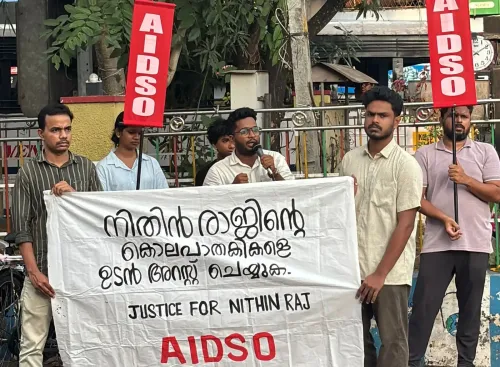
Nithin Raj case: Kerala orders fresh SIT probe after accused walks free on procedural lapses

Synopsis
The prime accused in the Nithin Raj suicide case walked free from a Kannur court because the Crime Branch forgot to follow basic arrest procedures — after 101 days of absconding and higher courts refusing anticipatory bail. Kerala's Home Minister has now ordered a fresh SIT, but the family says their faith in the system is already gone.
Key Takeaways
Kerala Home Minister Ramesh Chennithala ordered a fresh probe into the death of Dalit BDS student Nithin Raj on 21 July .
Prime accused Dr M.K.
Ram was released by the Thalassery Principal Sessions Court after the Crime Branch failed to provide written grounds of arrest and delayed notifying the Public Prosecutor.
A new SIT headed by IG Ajitha Begum has been constituted; the North Zone IG will examine what went wrong in the earlier probe.
Ram had been absconding for 101 days before being traced to Kodagu via a new mobile number used while in Bengaluru .
Nithin Raj's family alleged police collusion with the accused and said they have lost faith in the Crime Branch.
Nithin Raj, a Dalit BDS student, died by suicide on 10 April ; his family alleges sustained caste-based humiliation drove him to the extreme step.
Kerala Home Minister Ramesh Chennithala has ordered a fresh investigation into the death of Dalit BDS student Nithin Raj after the prime accused, Dr M.K. Ram, was released by a Kannur court on 21 July due to serious procedural lapses in the Crime Branch probe. The development has drawn sharp criticism from the student's family and raised questions about the integrity of the investigation into what they allege was a caste-driven suicide.
What Went Wrong in the Arrest
The Thalassery Principal Sessions Court ordered Ram's release after finding that mandatory legal procedures had not been followed during his arrest. The investigating team allegedly failed to provide Ram with written grounds of arrest and delayed informing the Public Prosecutor about the detention — both fundamental requirements under Indian law.
Immediately after the court ordered his release, the Crime Branch took Ram back into custody from the court premises, a move the defence criticised as illegal. Later that night, Ram was served a notice to appear before the probe team after two days.
New SIT Constituted, DGP Asked for Urgent Report
Expressing strong displeasure, Chennithala sought an urgent report from the Director General of Police (DGP) and directed the Crime Branch chief to explain the lapses. A new Special Investigation Team (SIT), headed by IG Ajitha Begum, has been constituted to take over the probe. The North Zone IG has separately been tasked with examining what went wrong in the earlier investigation.
Chennithala maintained that there had been no deliberate lapse on the part of the police, saying the fresh probe was being ordered to address all doubts raised by the family. Critics, however, argue that the procedural failures — particularly after higher courts had already refused Ram anticipatory bail — point to more than mere oversight.
Family Alleges Collusion, Loss of Faith in Crime Branch
Nithin Raj's family welcomed the appointment of the new probe team but said they had completely lost faith in the existing Crime Branch investigators. The student's mother alleged that collusion between the police and the accused had enabled Ram to secure release. The family had earlier accused local police of diverting the investigation towards a loan-app angle, which they say allowed Ram to remain absconding for 101 days.
Ram was eventually tracked to Kodagu after investigators identified a new mobile number he allegedly obtained while staying at his daughter's apartment in Bengaluru. Despite this pursuit, the arrest itself has now become the subject of scrutiny.
Background: A Dalit Student's Death and Caste Allegations
Nithin Raj, a Dalit BDS student, died by suicide on 10 April. His family has consistently alleged that sustained caste-based humiliation by faculty members drove him to take the extreme step. The case has attracted widespread attention, with student groups and Dalit rights organisations demanding accountability.
This is not the first time a high-profile Kerala case has seen procedural missteps undermine an investigation, but the combination of a Dalit victim, caste allegations, and a senior accused figure has amplified scrutiny at every stage. With the new SIT now in place, the family and observers will be watching closely to see whether the reinvestigation delivers accountability or becomes another procedural exercise.
Point of View
Timely prosecutor notification — after a 101-day manhunt is not a clerical slip; it is an institutional failure that handed the accused a procedural escape route. The fact that higher courts had already refused anticipatory bail makes the lapse harder to explain away as inadvertent. Chennithala's insistence that there was no deliberate wrongdoing may be politically necessary, but it does not address the family's core allegation: that the investigation has been shaped by forces other than evidence. A fresh SIT is only meaningful if it is insulated from the same institutional pressures that appear to have compromised the first one — and that insulation is precisely what the government has not yet guaranteed.
NationPress
20 Oct 2026
Frequently Asked Questions
Why was Dr M.K. Ram released by the court in the Nithin Raj case?
The Thalassery Principal Sessions Court ordered Dr M.K. Ram's release because the Crime Branch failed to follow mandatory legal procedures during his arrest — specifically, the team did not provide him with written grounds of arrest and delayed informing the Public Prosecutor. These are fundamental requirements under Indian law, and their absence gave the court grounds to grant relief to the accused.
Who is leading the new SIT in the Nithin Raj case?
The newly constituted Special Investigation Team (SIT) is headed by IG Ajitha Begum. Additionally, the North Zone IG has been tasked with separately examining the lapses in the earlier Crime Branch investigation.
Who was Nithin Raj and what happened to him?
Nithin Raj was a Dalit BDS student who died by suicide on 10 April. His family has alleged that sustained caste-based humiliation by faculty members drove him to take the extreme step, and they have accused the local police of initially diverting the probe towards a loan-app angle.
How long was the prime accused absconding before his arrest?
Dr M.K. Ram was absconding for 101 days before investigators tracked him to Kodagu, after identifying a new mobile number he had allegedly obtained while staying at his daughter's apartment in Bengaluru.
What has Kerala Home Minister Ramesh Chennithala said about the lapses?
Chennithala maintained that there was no deliberate lapse on the part of the police, saying the fresh probe was ordered to address all doubts raised by the family. He sought an urgent report from the Director General of Police and directed the Crime Branch chief to explain what went wrong.