South Korea and France Unite for Maritime Safety and Economic Resilience
Synopsis
In a significant diplomatic move, South Korea and France have committed to working together to ensure safe passage through the Strait of Hormuz. This collaboration aims to address the economic challenges posed by the ongoing conflict in the Middle East, with ambitious trade goals set for the future.
Key Takeaways
Collaboration: South Korea and France are working together to secure safe passage through the Strait of Hormuz.
Trade Goals: The two nations aim to reach $20 billion in bilateral trade by 2030.
Energy Security: Increased cooperation in nuclear and offshore wind sectors is planned.
International Stability: Joint efforts to promote peace on the Korean Peninsula have been emphasized.
Advanced Technologies: A focus on AI, quantum tech, and critical minerals is part of the collaboration.
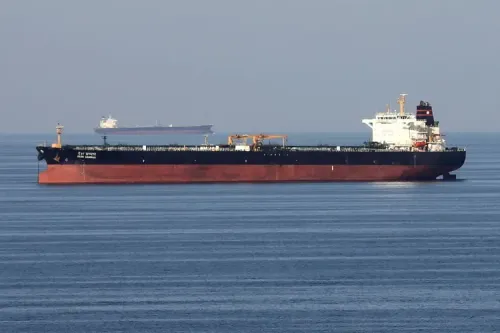
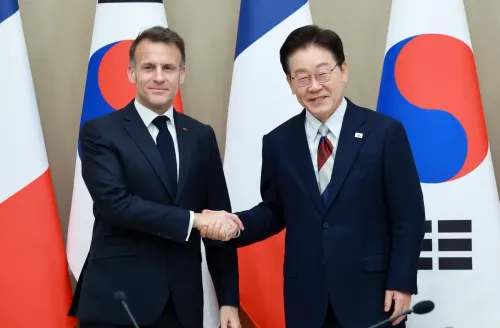
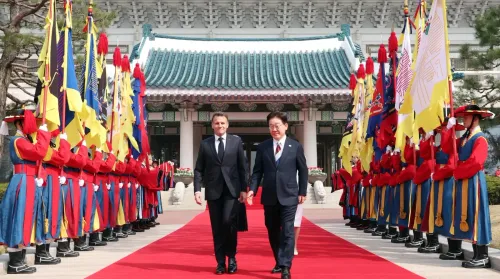
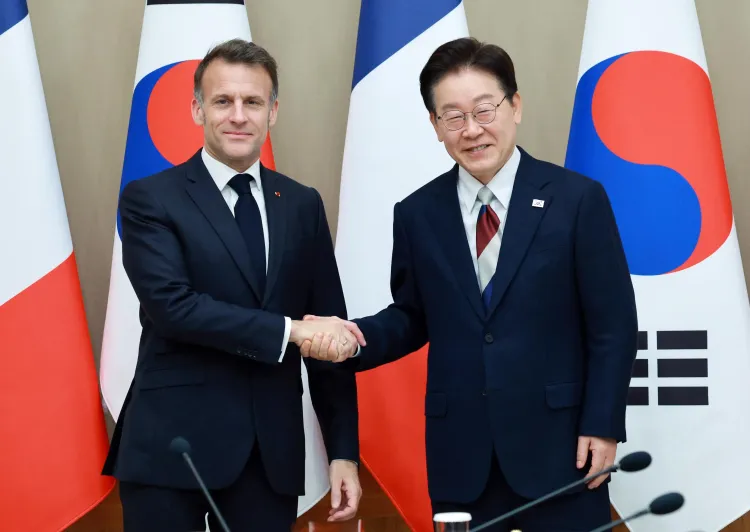
Seoul, April 3 (NationPress) - On Friday, South Korean President Lee Jae Myung announced that he and French President Emmanuel Macron have reached an agreement to collaborate on ensuring safe passage through the Strait of Hormuz and to alleviate the extensive repercussions stemming from the ongoing conflict in the Middle East.
During their summit discussions, Lee expressed concerns regarding the instability in global energy supply chains. The two leaders explored avenues to strengthen their economic partnership and enhance security coordination.
"President Macron and I have decided to exchange our policy experiences and strategies to jointly tackle the economic and energy challenges resulting from the conflict in the Middle East. We are also committed to working together to minimize uncertainty in the global economy," Lee stated during a joint press conference.
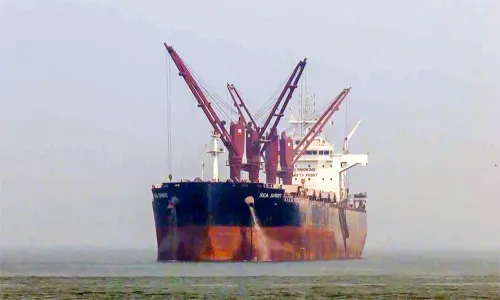
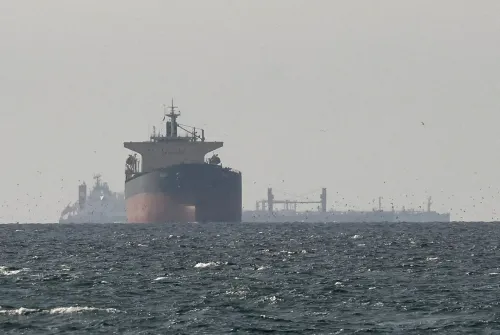
He further emphasized their commitment to enhancing energy security by increasing collaboration in the nuclear and offshore wind energy sectors, alongside efforts to secure safe maritime transport routes through the Strait of Hormuz.
Macron echoed the importance of cooperation between France and South Korea to help reopen the Strait of Hormuz and deescalate tensions in the Middle East, as reported by the Yonhap news agency.
Additionally, the two leaders agreed to elevate trade and investment, setting a target of reaching $20 billion in annual bilateral trade by 2030, an increase from $15 billion last year.
To facilitate collaboration, several memorandums of understanding (MOUs) and related documents were signed by both parties.
The agreements aim to enhance cooperation in advanced technologies and emerging industries such as artificial intelligence, semiconductors, and quantum technology, and to create a ministerial-level joint committee for science and technology.
They also signed a letter of intent focused on cooperation in critical mineral supply chains, merging South Korea's manufacturing strengths with France's processing technologies and infrastructure.
Under this collaboration, Korea Hydro and Nuclear Power signed MOUs with French nuclear entities, Orano and Framatome, along with a separate MOU with EDF for the joint development of an offshore wind power facility in Yeonggwang.
Lee expressed optimism that these agreements would ensure a reliable supply of raw materials for South Korea's nuclear facilities and pave the way for joint endeavors in the global market.
He also outlined plans for collaboration in space and defense, while committing to boost cultural exchange following an MOU signed between the cultural heritage agencies of both nations.
In their discussions, Lee detailed Seoul's initiatives to reestablish dialogue with Pyongyang to foster peace on the Korean Peninsula, with Macron reaffirming Paris' support for stability in the region.
"We both leaders recognize that peace on the Korean Peninsula has significant implications not only for Northeast Asia and Europe but for the entire world," Lee remarked.
Lee highlighted the expanding cooperation between Seoul and Paris across various sectors, including future strategic industries and reiterated the importance of deepening international coordination.
"As responsible global citizens, our two nations are also collaborating to address the rapid shifts in the global environment," he stated.
Lee announced that Macron extended a formal invitation to the upcoming Group of Seven summit scheduled for June in Evian, France, which he accepted. If he attends, it will be his second consecutive appearance at the G7, following last year's participation in Canada.
Point of View
The collaboration between South Korea and France represents a proactive step in addressing pressing global issues. The leaders' commitment to maritime safety and economic resilience highlights the importance of international cooperation in today's uncertain landscape.
NationPress
22 Oct 2026
Frequently Asked Questions
What is the primary goal of the agreement between South Korea and France?
The primary goal is to ensure safe passage through the Strait of Hormuz and to address the economic challenges stemming from the conflict in the Middle East.
How much do South Korea and France aim to increase their bilateral trade by 2030?
They aim to increase their bilateral trade to $20 billion by 2030, up from $15 billion last year.
What sectors will the cooperation focus on?
The cooperation will focus on advanced technologies, nuclear energy, offshore wind power, and critical mineral supply chains.
What was discussed regarding the Korean Peninsula?
President Lee discussed efforts to resume dialogue with Pyongyang, with President Macron reaffirming support for peace and stability in the region.
What significant event is President Lee invited to?
President Lee has been invited to the upcoming Group of Seven summit scheduled for June in Evian, France.