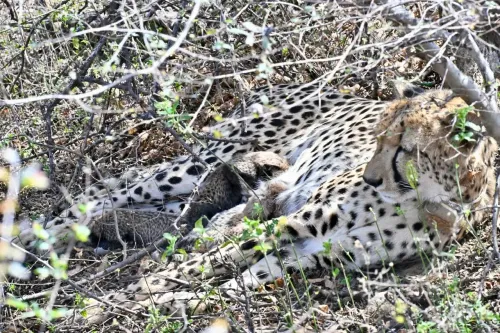
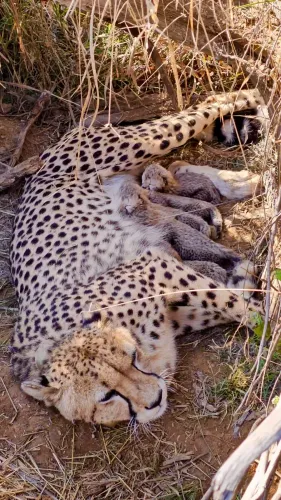
Five cheetah cubs born at Kuno National Park, India's total rises to 60
Synopsis
Five cubs born to an Indian-born cheetah at Kuno National Park have pushed India's total cheetah count to 60 — with 41 now born domestically. Crucially, the father is from Botswana, introducing a new genetic lineage and marking a pivotal second chapter in India's cheetah reintroduction story.
Key Takeaways
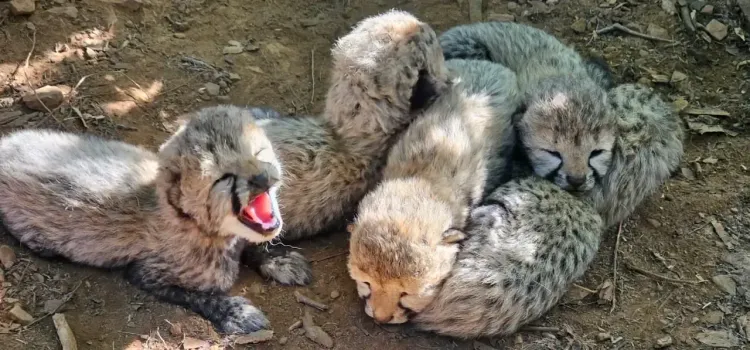
Five cheetah cubs were born at Kuno National Park , Madhya Pradesh, on 5 October 2026 .
India's total cheetah population has reached 60 , with 41 born on Indian soil.
The mother, KJP21 , is a 32-month-old Indian-born female — the third such female to reproduce.
The father is a Botswanan male, introducing a new genetic lineage to the programme.
The births coincide with Wildlife Week 2026 and are being seen as a major milestone for Project Cheetah .
Union Environment Minister Bhupender Yadav called the development 'another historic and joyous milestone.'
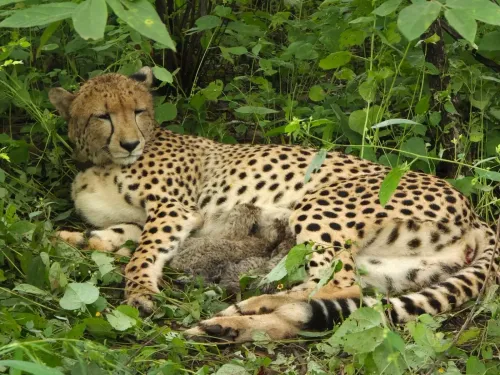
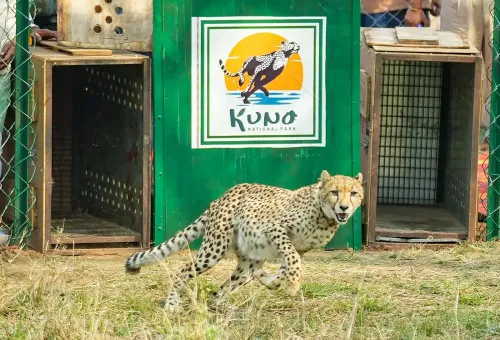
Five cheetah cubs were born at Kuno National Park in Madhya Pradesh on Monday, 5 October 2026, pushing India's total cheetah population to 60 — of which 41 have now been born on Indian soil, Union Environment Minister Bhupender Yadav announced. The birth marks another significant milestone for Project Cheetah, the government's flagship programme to re-establish the species in India after it was declared extinct here in 1952.
The Mother and Her Lineage
The five cubs were born to KJP21, a 32-month-old female cheetah herself born in India, making her the third Indian-born female to successfully reproduce, after Mukhi and KGP12. The father is a male cheetah brought from Botswana, meaning the newborns represent the beginning of a distinct Botswanan genetic lineage within India's growing cheetah population — a development conservationists consider critical for long-term genetic diversity.
Why This Birth Matters for Project Cheetah
The addition of the Botswanan lineage addresses a key concern flagged by wildlife scientists: that a small, isolated population risks inbreeding over successive generations. With cheetahs originally translocated from Namibia in September 2022, later supplemented by individuals from South Africa and Botswana, the programme has deliberately built in genetic variation from three distinct African sub-populations. The birth of cubs to Indian-born females is regarded as a decisive second phase of reintroduction — evidence that the species is not merely surviving in India but beginning to self-sustain.
Minister Yadav's Response
'Another historic and joyous milestone for Project Cheetah!' Minister Yadav said in a post on X upon announcing the births. He added: 'Another generation born on Indian soil, adding yet another beautiful chapter to the remarkable story of cheetah reintroduction in India.' Yadav also congratulated the veterinarians, field staff, managers, and all personnel associated with the project for their continued work.
Timing and Context
The births coincide with Wildlife Week 2026, lending additional symbolic weight to the announcement. Kuno National Park has remained the operational centre of Project Cheetah since the programme's launch, and the park's conservators have faced both praise and scrutiny as mortality rates among translocated adults drew attention in the programme's early years. The rising share of Indian-born cheetahs in the overall count — now 41 of 60, or roughly 68% — signals a population increasingly shaped by births rather than imports.
What Comes Next
With the population at 60 and multiple Indian-born females now capable of reproduction, wildlife managers are expected to evaluate the carrying capacity of Kuno and accelerate planning for a second cheetah habitat. The Gandhi Sagar Wildlife Sanctuary, also in Madhya Pradesh, has previously been identified as a candidate site. How swiftly the government moves on expansion will determine whether the population growth seen at Kuno can be replicated at scale.
Point of View
But the more meaningful signal is the share of Indian-born animals — now 41 of 60, or roughly 68%. That shift from import-dependent to self-sustaining is the real benchmark of reintroduction success. What the announcement does not address is the programme's next spatial challenge: Kuno has finite carrying capacity, and the Gandhi Sagar expansion has moved slowly. A rising population without a credible second habitat plan converts a conservation win into a future overcrowding risk. The Botswanan lineage addition is also scientifically noteworthy — genetic diversity is the quiet variable that determines whether this population survives a disease event or climate shock decades from now.
NationPress
5 Oct 2026
Frequently Asked Questions
How many cheetahs are there in India now?
India's total cheetah population has reached 60 following the birth of five cubs at Kuno National Park on 5 October 2026. Of these, 41 have been born in India since the reintroduction programme began.
What is Project Cheetah?
Project Cheetah is India's programme to reintroduce cheetahs, a species declared extinct in the country in 1952. It was launched in September 2022 with the translocation of cheetahs from Namibia to Kuno National Park in Madhya Pradesh, with subsequent additions from South Africa and Botswana.
Who is KJP21 and why is her role significant?
KJP21 is a 32-month-old female cheetah born in India at Kuno National Park. She is the third Indian-born female to give birth, after Mukhi and KGP12, marking an important phase in which the reintroduced population is beginning to reproduce generationally on Indian soil.
What is the significance of the Botswanan lineage?
The five new cubs' father is a male cheetah brought from Botswana, introducing a distinct genetic lineage to India's cheetah population. Genetic diversity is critical for the long-term health and resilience of a small reintroduced population, reducing the risk of inbreeding over successive generations.
Where could India's cheetah population expand beyond Kuno?
Gandhi Sagar Wildlife Sanctuary in Madhya Pradesh has previously been identified as a candidate site for a second cheetah habitat. Wildlife managers are expected to revisit expansion plans as the population at Kuno approaches the park's carrying capacity.