Project Cheetah at 4: India's population hits 52, 32 Indian-born
Synopsis
Four years in, Project Cheetah has quietly crossed a milestone that few expected so soon: 32 of India's 52 cheetahs are now Indian-born. From a near-collapse in 2023 — when six adults and three cubs died in months — to a self-sustaining breeding population, the turnaround is one of the more remarkable wildlife recoveries in recent Indian conservation history.
Key Takeaways
India's cheetah population stands at 52 as of September 2025 — 49 in Kuno National Park and 3 in Gandhi Sagar Sanctuary .
32 of the 52 cheetahs are Indian-born, a key consolidation benchmark for the reintroduction programme.
17 cheetahs are currently free-ranging in the wild at Kuno; 32 remain in soft-release enclosures.
The Namibian-origin lineage accounts for 25 animals; South African-origin for 18 ; 9 Botswana cheetahs were added on 28 February 2026 .
The crisis period of March–August 2023 saw the loss of 6 introduced adults and 3 cubs; survivor Mukhi has since raised 5 cubs of her own.
The programme now monitors cheetahs across a 12-district inter-state landscape, with expansion to additional sites under way.
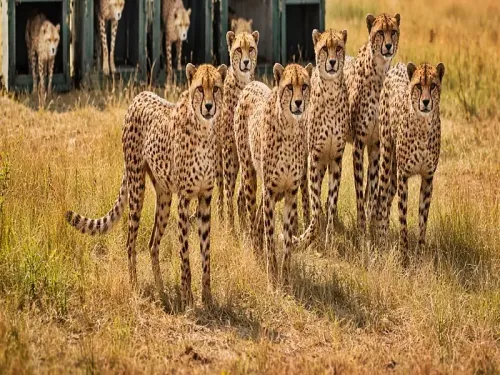
Project Cheetah marked its fourth anniversary on 17 September 2025 with India's cheetah population standing at 52 — 49 at Kuno National Park in Madhya Pradesh and three at Gandhi Sagar Sanctuary. Crucially, 32 of those animals are Indian-born, signalling that the world's largest cheetah reintroduction programme has transitioned from crisis management into a phase of consolidation.
How the Numbers Add Up
Prime Minister Narendra Modi launched the initiative on 17 September 2022 by releasing eight Namibian cheetahs into Kuno. Of that founding cohort, three survive today, joined by 22 of their Indian-born offspring — bringing the Namibian-origin lineage to 25 animals.
A second batch of 12 South African cheetahs arrived on 18 February 2023; eight remain alive, with 10 Indian-born cubs, accounting for 18 animals (15 in Kuno, three in Gandhi Sagar). A third cohort of nine cheetahs from Botswana was introduced on 28 February 2026, further diversifying the gene pool.
Wild vs Enclosure: Where the Animals Are
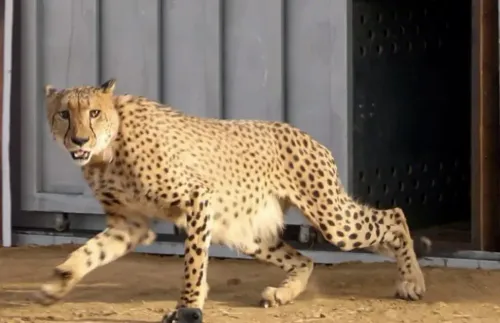
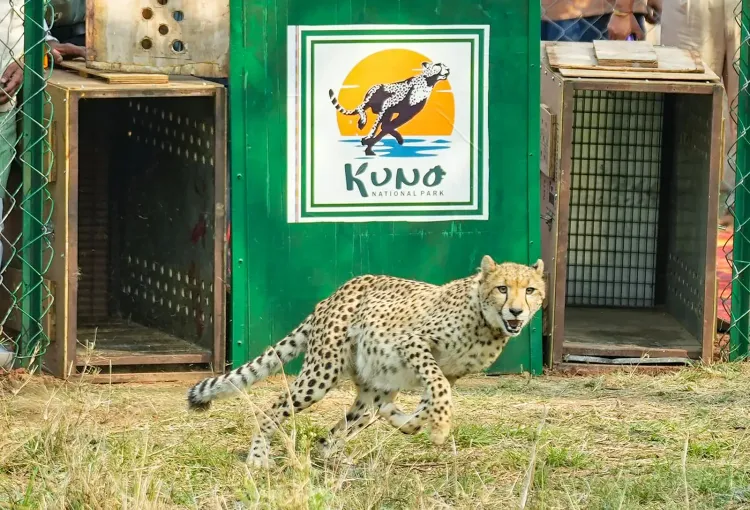
At Kuno, 17 cheetahs — 10 males and 7 females — are currently free-ranging in the wild. A further 32 animals (5 males, 8 females, and 19 cubs under one year of age) remain in soft-release enclosures with access to natural prey, a standard step before full wild release.
The programme's inter-state monitoring footprint now spans 12 districts, with round-the-clock surveillance as cheetahs navigate landscapes across state boundaries.
From Crisis to Consolidation: The Four-Year Arc
Project Cheetah Director Uttam Kumar Sharma has characterised the journey as 'one of constant learning, adaptation, setbacks and recovery' in his status review titled Four Years of Cheetahs in India. The first year was the hardest: between March and August 2023, six introduced cheetahs and three of the first four Indian-born cubs were lost.
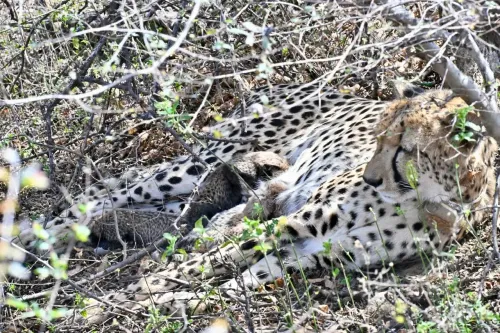
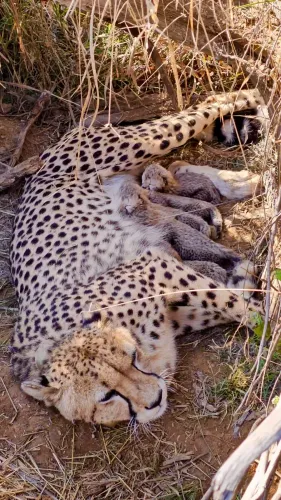
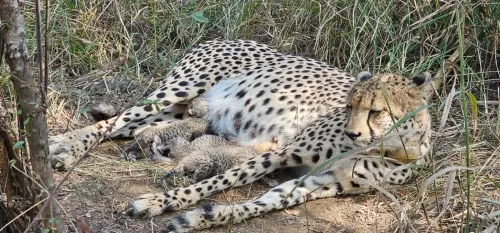
One cub that survived against all odds — abandoned by her mother and widely expected to die — is today known as Mukhi, herself the mother of five healthy cubs. Her story has become emblematic of the project's resilience.
During the same crisis period, the Kuno field team captured 12 cheetahs and returned them safely to enclosures in just 10 days. A separate 21-day search for Nirva, a South African female whose tracking collar failed during the monsoon, ended with her found alive — an experience that, according to the review, 'forged a resilient team and the confidence that would carry the project forward.'
Year-by-Year Progress
The second year delivered the project's first sustained breeding success, with 13 cubs surviving beyond one year. By the third year, cheetahs were being released into open wilderness and monitored across the multi-district landscape, demonstrating that the animals could navigate and survive Indian terrain. The fourth year has seen the animals increasingly display natural behaviours, with the programme now expanding to additional sites beyond Kuno.
What Comes Next
The establishment of breeding females and the survival of second-generation cubs are considered the two key benchmarks for long-term viability in large-carnivore reintroductions. Both have now been met. With Gandhi Sagar Sanctuary absorbing its first three animals and Botswana's cohort newly integrated, the programme's geographic and genetic base is widening — a necessary step before any future population targets can be set with confidence.
Point of View
And they have been met faster than comparable programmes in Africa and Europe. What the status review does not fully address is carrying capacity: Kuno's estimated range can support roughly 20–25 adults at ecological density, meaning the current enclosure-heavy split is a management necessity, not a sign of success. The expansion to Gandhi Sagar and the addition of Botswana's cohort are the right moves, but site preparation and prey-base development at new locations will determine whether India can sustain a genuinely wild, self-regulating population — or remains reliant on managed soft-release indefinitely.
NationPress
16 Sept 2026
Frequently Asked Questions
How many cheetahs does India have in 2025?
India's cheetah population stands at 52 as of September 2025, with 49 at Kuno National Park in Madhya Pradesh and three at Gandhi Sagar Sanctuary. Of these, 32 are Indian-born cubs, marking a significant milestone for Project Cheetah.
When did Project Cheetah begin and who launched it?
Project Cheetah was launched on 17 September 2022 when Prime Minister Narendra Modi released eight Namibian cheetahs into Kuno National Park, coinciding with his birthday. It is the world's largest cheetah reintroduction programme.
How many cheetahs are living freely in the wild at Kuno?
As of the fourth-anniversary review, 17 cheetahs — 10 males and 7 females — are free-ranging in the wild at Kuno National Park. A further 32 animals, including 19 cubs under one year, remain in soft-release enclosures with natural prey access.
What went wrong during the first year of Project Cheetah?
Between March and August 2023, six introduced cheetahs and three of the first four Indian-born cubs died, severely testing the programme. However, the team recovered by capturing 12 cheetahs in 10 days and successfully locating a missing South African female named Nirva after a 21-day search.
Which countries have supplied cheetahs to India under Project Cheetah?
India has received cheetahs from three countries: eight from Namibia in September 2022, twelve from South Africa in February 2023, and nine from Botswana on 28 February 2026. The multi-source approach is intended to ensure genetic diversity in the reintroduced population.