12 Years of Surakshit Bharat: Modi marks India's defence transformation with Tejas, BrahMos, INS Vikrant
Synopsis
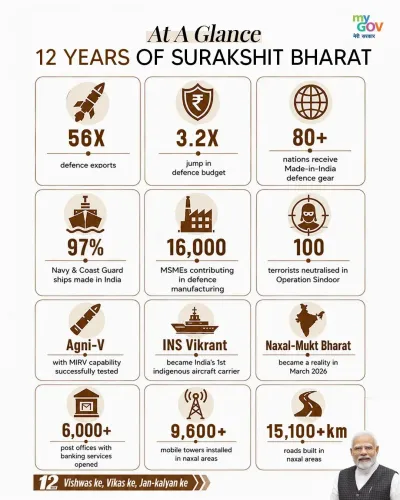
Twelve years after the current defence indigenisation drive began, Modi's #12YearsOfSurakshitBharat post on X catalogues a transformation that spans fighter jets, nuclear submarines, hypersonic missiles, and aircraft carriers — all built at home. The breadth of the list is striking; the harder question is whether India's defence import bill has moved as decisively as the milestone count.
Key Takeaways
PM Narendra Modi marked 12 years of Surakshit Bharat on 17 June , highlighting India's indigenous defence transformation.
Tejas Mk-1A and the in-development Mk-2 form the backbone of India's indigenous combat aviation push by HAL .
Agni-V with MIRV technology places India among a select group of nations with multi-warhead missile capability.
INS Arihant completed India's nuclear triad ; INS Vikrant made India one of few nations to build its own aircraft carrier.
The Akash , BrahMos , Astra , Rudram , and Pinaka systems collectively represent a broad indigenous missile and artillery ecosystem.
The C-295 programme is expanding private-sector participation in India's defence aerospace manufacturing.
Prime Minister Narendra Modi on Wednesday, 17 June highlighted India's sweeping defence transformation over the past 12 years, marking the occasion with the hashtag #12YearsOfSurakshitBharat on X. Modi said India's defence capabilities have been guided by the vision of self-reliance and powered by innovation, technology, and indigenous manufacturing.
The Prime Minister also shared a thread by MyGovIndia cataloguing the strides made across air, land, and naval domains since 2013, underscoring a strategic pivot from import dependence toward an Aatmanirbhar defence ecosystem.
Air Power: Tejas, Akash, and Hypersonic Milestones
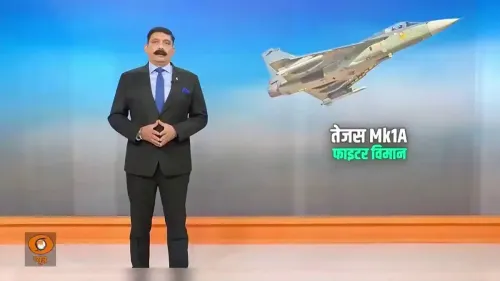
The Tejas light combat aircraft, developed by Hindustan Aeronautics Limited (HAL), has emerged as a centrepiece of India's aerospace ambitions. With the induction of Tejas Mk-1A and the ongoing development of Mk-2, India is building what officials describe as a robust indigenous combat aviation ecosystem. According to MyGovIndia, Tejas demonstrates that India can design and build its own fighter jets — a capability that remained elusive for decades.
The Akash missile system has been positioned as a key pillar of India's air defence architecture, now operational with the armed forces and drawing international interest. The next-generation Akash-NG reportedly offers faster reaction times, improved target tracking, and stronger interception capability.
India's successful test of hypersonic missile technology has, according to MyGovIndia, placed the country among a select group of nations shaping the future of advanced warfare. No specific test date was cited in the government's communication.
Strategic Deterrence: Agni-V MIRV and the Nuclear Triad
A landmark in India's strategic posture came with the successful testing of Agni-V equipped with Multiple Independently Targetable Re-entry Vehicle (MIRV) technology — enabling a single missile to carry multiple warheads aimed at different targets. MyGovIndia noted this places India among a select group of nations with this advanced capability, strengthening its strategic deterrence.
The induction of INS Arihant, India's first nuclear-powered ballistic missile submarine, completed the country's nuclear triad — land, air, and sea-based nuclear strike capability. This, according to the government, significantly enhanced India's second-strike capability and reinforced long-term strategic stability.
Naval Expansion: INS Vikrant and Indigenous Shipbuilding
INS Vikrant, India's first indigenously designed and built aircraft carrier, stands as a symbol of the country's shipbuilding maturity. Its induction places India among a select group of nations capable of constructing aircraft carriers domestically.
Naval modernisation has also accelerated through platforms such as Project 17A stealth frigates, Project 15B destroyers, and Kalvari-class submarines, strengthening maritime security, anti-submarine warfare, and underwater combat capabilities across strategic waters.
Artillery, Missiles, and Aerospace Manufacturing
The Pinaka multi-barrel rocket system has transformed India's artillery capabilities through mobility, precision, and indigenous design, with continuously enhanced range and strike accuracy over successive iterations.
India's missile ecosystem now spans the globally recognised BrahMos supersonic cruise missile alongside the Astra beyond-visual-range air-to-air missile and the Rudram anti-radiation missile — reinforcing strike capability across multiple operational domains.
The C-295 programme, a civil-military aerospace initiative, is expanding private-sector participation in defence manufacturing and building domestic aviation expertise, according to MyGovIndia, reinforcing the Aatmanirbhar defence vision beyond public-sector HAL alone.
What Comes Next
The government's communication frames the 12-year milestone as a foundation rather than a ceiling, with platforms like Tejas Mk-2, Akash-NG, and ongoing naval projects indicating that the indigenisation pipeline remains active. Whether procurement timelines and export ambitions translate into measurable self-reliance ratios will be the metric analysts and defence observers are likely to track going forward.
Point of View
But India's defence import dependence has not collapsed in proportion to the indigenisation rhetoric; the country still ranks among the world's largest arms importers. The MIRV test and INS Vikrant induction are genuine capability leaps, but the gap between milestone announcements and operational readiness at scale — Tejas production rates, for instance — rarely features in government threads. The real measure of Aatmanirbhar Bharat in defence is not the list of systems developed, but the share of the defence capital budget spent on domestic procurement, a figure that tells a more complicated story.
NationPress
19 Sept 2026
Frequently Asked Questions
What is 12 Years of Surakshit Bharat?
#12YearsOfSurakshitBharat is a government campaign marking 12 years of India's defence indigenisation drive, highlighted by PM Modi on 17 June on X. It catalogues milestones across air, land, and naval domains including Tejas, Agni-V, INS Vikrant, and BrahMos.
What is the significance of India's Agni-V MIRV test?
The successful test of Agni-V equipped with Multiple Independently Targetable Re-entry Vehicle (MIRV) technology means a single missile can carry multiple warheads aimed at different targets. This places India among a select group of nations with this advanced strategic capability, strengthening its nuclear deterrence.
Why is INS Vikrant considered a milestone for India?
INS Vikrant is India's first indigenously designed and built aircraft carrier, placing the country among a handful of nations capable of constructing such vessels domestically. It functions as a floating airbase and signals a significant leap in India's naval shipbuilding capability.
How has the Tejas programme advanced India's defence self-reliance?
Developed by HAL, the Tejas light combat aircraft demonstrated that India can design and build its own fighter jets. With Tejas Mk-1A now inducted and Mk-2 under development, India is building an indigenous combat aviation ecosystem that reduces dependence on foreign platforms.
What is India's nuclear triad and how was it completed?
A nuclear triad refers to the ability to deliver nuclear weapons from land, air, and sea-based platforms. India completed its triad with the induction of INS Arihant, a nuclear-powered ballistic missile submarine, which added a credible sea-based second-strike capability to existing land and air options.