Modi, UAE President ink energy and investment pacts worth $5 billion in Abu Dhabi
Synopsis
PM Modi's Abu Dhabi visit yielded $5 billion in UAE investment commitments, a 30-million-barrel petroleum reserve deal with ADNOC, an 8 Exaflop supercomputer tie-up with G-42, and a digital trade corridor — signalling that the India-UAE partnership has moved well beyond oil into finance, tech, and maritime infrastructure.
Key Takeaways
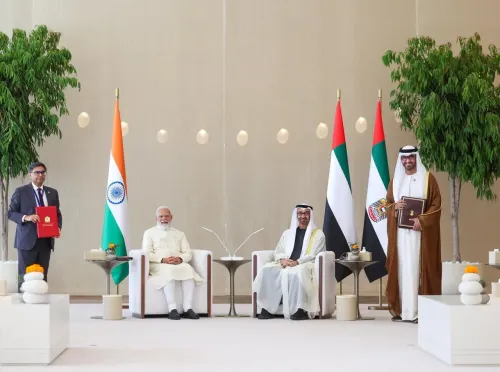
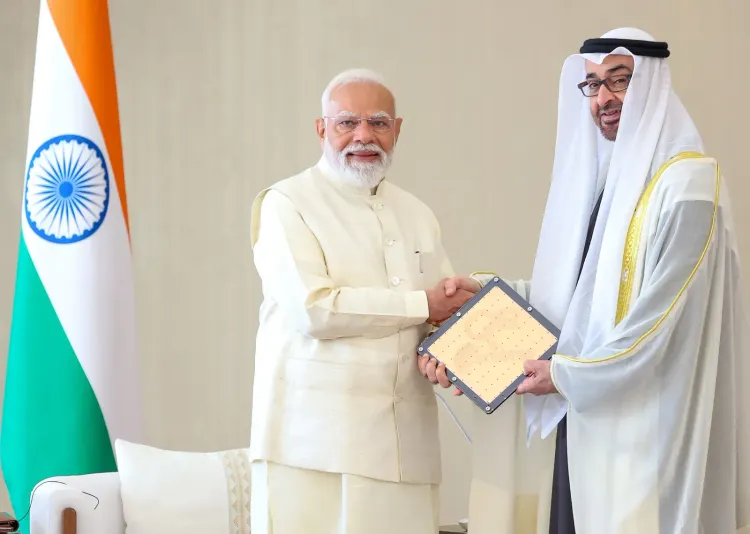
PM Modi and UAE President Sheikh Mohammed bin Zayed Al Nahyan signed multiple pacts in Abu Dhabi on 15 May .
UAE entities committed USD 5 billion in investments: USD 3 billion (Emirates New Development Bank into RBL Bank), USD 1 billion (ADIA into NIIF), and USD 1 billion (International Holding Company into Sammaan Capital).
ISPRL and ADNOC signed a Strategic Collaboration Agreement raising UAE participation in India's petroleum reserves to 30 million barrels and committing to set up strategic gas reserves in India.
Cochin Shipyard Limited and Drydocks World Dubai will establish a Ship Repair Cluster at Vadinar, Gujarat under India's Maritime Development Fund Scheme.
A term sheet was signed for an 8 Exaflop Super Compute Cluster between India's C-DAC and UAE's G-42 .
The MAITRI Virtual Trade Corridor was operationalised to digitally connect customs and port authorities of both countries.
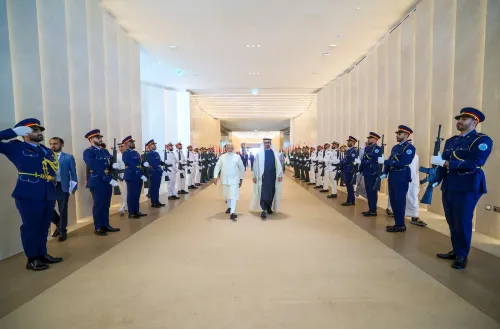
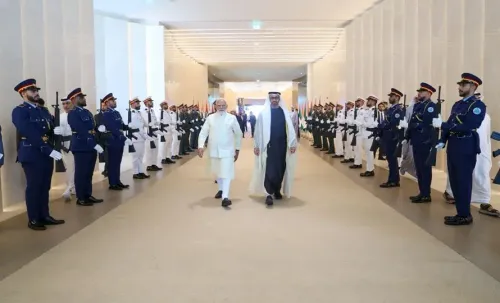
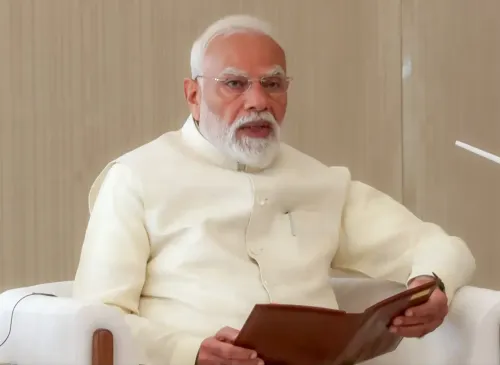
Prime Minister Narendra Modi and UAE President Sheikh Mohammed bin Zayed Al Nahyan on Friday, 15 May oversaw the signing of a series of landmark agreements in Abu Dhabi, covering energy security, strategic investment, maritime cooperation, and digital trade — marking a significant deepening of the India-UAE Comprehensive Strategic Partnership.
Energy Partnership: Strategic Petroleum and LPG Deals
At the centre of the energy agenda was a Strategic Collaboration Agreement between Indian Strategic Petroleum Reserves Limited (ISPRL) and the Abu Dhabi National Oil Company (ADNOC). The pact raises the UAE's participation in India's Strategic Petroleum Reserves to 30 million barrels and commits both sides to jointly establish strategic gas reserves in India, according to a statement issued by the Prime Minister's Office (PMO).
Separately, Indian Oil Corporation Limited (IOCL) and ADNOC formalised an arrangement covering long-term Liquefied Petroleum Gas (LPG) supplies to India — a move that bolsters India's energy supply chain at a time of sustained global commodity volatility.
$5 Billion UAE Investment Commitment to India
The two leaders welcomed a combined USD 5 billion in fresh investment pledges from UAE entities into India. The breakdown, as confirmed by the PMO, is as follows:
USD 3 billion from the Emirates New Development Bank into RBL Bank of India; USD 1 billion from the Abu Dhabi Investment Authority (ADIA) into the National Infrastructure and Investment Fund (NIIF) for priority infrastructure projects; and USD 1 billion from the International Holding Company into Sammaan Capital of India. The PMO statement described these investments as underscoring the UAE's 'sustained, long-term commitment to India's growth story.'
Maritime and Shipbuilding Cooperation
On the maritime front, Cochin Shipyard Limited signed a Memorandum of Understanding (MoU) with Drydocks World, Dubai to establish a Ship Repair Cluster at Vadinar in Gujarat, covering offshore fabrication under India's Maritime Development Fund Scheme. A separate tripartite MoU — between Cochin Shipyard Limited, Drydocks World Dubai, and the Centre of Excellence in Maritime and Shipbuilding — sets up a framework to train and deploy a skilled maritime workforce, positioning India as a regional hub for shipbuilding and ship repair professionals.
Tech and Digital Trade: 8 Exaflop Supercomputer and MAITRI Corridor
Both sides concluded a term sheet to establish an 8 Exaflop Super Compute Cluster, a partnership between India's Centre for Development of Advanced Computing (C-DAC) and the UAE's G-42. The cluster represents one of the most ambitious India-UAE technology collaborations to date.
The two leaders also welcomed the operationalisation of the Virtual Trade Corridor using MAITRI (Master Application for International Trade and Regulatory Interface). The digital framework connects customs and port authorities on both sides, aiming to streamline cargo movement, reduce transit costs, and enable more efficient bilateral trade flows. Notably, the India-UAE Comprehensive Economic Partnership Agreement (CEPA), acknowledged by both leaders, has already driven bilateral trade to record levels since its signing.
Broader Strategic Review
Modi and Sheikh Mohammed also reviewed the full spectrum of bilateral relations, welcoming progress across energy, trade, investment, defence, security, fintech, infrastructure, education, culture, and people-to-people ties. This visit reinforces a pattern of high-frequency engagement between the two nations — Modi's visit to Abu Dhabi is among several bilateral interactions in recent years that have progressively elevated the relationship from a trade partnership to a multi-domain strategic alliance. The next phase of implementation across these agreements will be closely watched by both governments and industry stakeholders.
Point of View
But the structural shift lies elsewhere: India is now using UAE capital to build strategic reserves, not just attract portfolio flows. The ADNOC petroleum deal — expanding India's reserve buffer to 30 million barrels — is a quiet but consequential energy security move at a time when global supply chains remain fragile. The 8 Exaflop supercomputer tie-up with G-42 also signals that both nations are positioning this relationship as a technology corridor, not merely a hydrocarbon partnership. The real test will be disbursement timelines — particularly whether the Emirates New Development Bank's $3 billion RBL Bank commitment translates into on-ground credit deployment or remains a balance-sheet pledge.
NationPress
3 Oct 2026
Frequently Asked Questions
What agreements did PM Modi sign during his UAE visit on 15 May?
PM Modi and UAE President Sheikh Mohammed oversaw the signing of multiple pacts covering strategic petroleum reserves, LPG supply, a $5 billion investment package, a ship repair cluster in Gujarat, an 8 Exaflop supercomputer partnership, and a digital trade corridor. The agreements were detailed in a Prime Minister's Office statement issued after their meeting in Abu Dhabi.
What is the India-UAE petroleum reserve deal about?
Indian Strategic Petroleum Reserves Limited (ISPRL) and Abu Dhabi National Oil Company (ADNOC) signed a Strategic Collaboration Agreement to raise UAE participation in India's Strategic Petroleum Reserves to 30 million barrels. The two sides also agreed to work together to establish strategic gas reserves in India.
How is the $5 billion UAE investment into India structured?
The $5 billion commitment comprises three tranches: USD 3 billion from the Emirates New Development Bank into RBL Bank of India, USD 1 billion from the Abu Dhabi Investment Authority (ADIA) into the National Infrastructure and Investment Fund (NIIF), and USD 1 billion from the International Holding Company into Sammaan Capital of India.
What is the MAITRI Virtual Trade Corridor between India and UAE?
MAITRI — Master Application for International Trade and Regulatory Interface — is a digital framework connecting customs and port authorities of India and the UAE. Its operationalisation, welcomed by both leaders, aims to streamline cargo movement, cut transit costs, and enable more efficient bilateral trade flows.
What is the significance of the Cochin Shipyard and Drydocks World MoU?
The MoU between Cochin Shipyard Limited and Drydocks World Dubai will set up a Ship Repair Cluster at Vadinar in Gujarat, including offshore fabrication, under India's Maritime Development Fund Scheme. A separate tripartite agreement also establishes a framework to train and employ a skilled maritime workforce, positioning India as a hub for shipbuilding professionals.