Did Nehru Really Oppose the Somnath Temple Reconstruction?
Synopsis
BJP MP Sudhanshu Trivedi's revelations about Nehru's opposition to the Somnath temple reconstruction spark renewed debate. Did Nehru truly undermine this historic event? Explore the implications of these claims on India's political landscape.
Key Takeaways
Pandit Jawaharlal Nehru's alleged opposition to the Somnath temple reconstruction raises questions about his secular policies.
Trivedi's claims highlight the complex relationship between politics and religion in India.
The historical significance of the Somnath Temple remains a contentious topic.
Debates over Nehru's legacy continue to shape contemporary political narratives.
Understanding these events is crucial for grasping India's post-Independence history.
New Delhi, Jan 7 (NationPress) BJP MP Sudhanshu Trivedi has once again sparked a political and historical discussion regarding the Somnath temple. On Wednesday, he shared several posts on X, claiming that India’s first Prime Minister Pandit Jawaharlal Nehru not only resisted the rebuilding of this centuries-old temple but also attempted to diminish the significance of its inauguration by discouraging prominent figures, including the then President, from attending the ceremony.
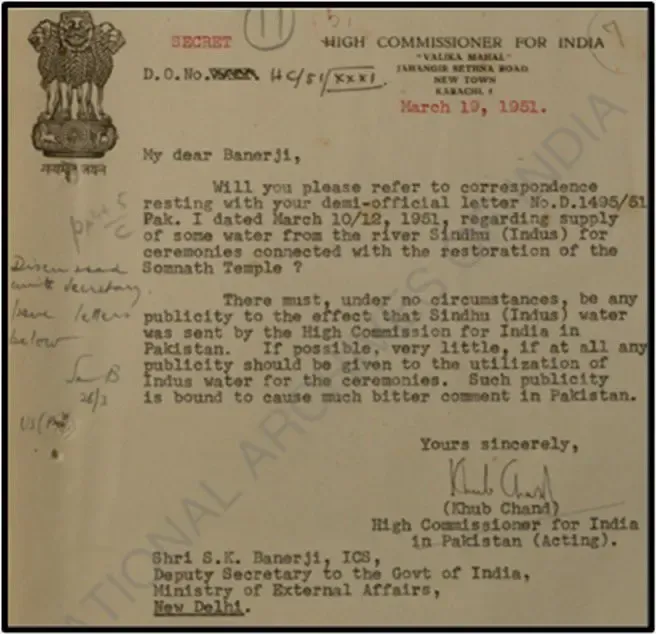
Trivedi presented a collection of letters written by Pandit Jawaharlal Nehru to various Indian ambassadors, including those in China and Pakistan. In these letters, he allegedly instructed that water from the Indus River should not be used for the temple’s consecration ceremony, aiming to create the perception that the Indian government was uninvolved.
In his post on X, Trivedi asserted that Nehru not only maintained neutrality but took “deliberate steps” to downplay the importance of the Somnath Temple consecration ceremony.
Quoting Nehru’s letters, Trivedi noted, “Pandit Nehru wrote to Indian embassies expressly forbidding them from aiding the Somnath Trust, including requests for water from rivers for the consecration ceremony.”
He further accused Nehru of attempting to minimize the President’s role in the event. Citing a letter to K.M. Panikkar, India’s Ambassador to China, Trivedi mentioned, “Pandit Nehru explicitly acknowledged that he sought to ‘minimize the impact’ of the President’s visit to the Somnath Temple.”
Trivedi claimed that Nehru also took diplomatic action to prevent the use of water from the Indus River in the consecration. “In a letter to India’s Ambassador to Pakistan, Pandit Nehru stated that the use of water from the Indus River for the Somnath Temple consecration was formally rejected,” he added, sharing a letter from the then High Commission of India to Pakistan, signed by Khub Chand, to support his assertion.
In another post, Trivedi alleged that Nehru completely opposed the temple's reconstruction.
He stated, “Pandit Jawaharlal Nehru did not even want the reconstruction of the Somnath Temple to occur.” He further claimed that Nehru expressed to President Dr. Rajendra Prasad, Vice President Dr. Sarvepalli Radhakrishnan, and all Indian Chief Ministers that the reconstruction had “damaged India’s image abroad.”
He also referred to a letter to then Information and Broadcasting Minister R.R. Diwakar, where Nehru allegedly requested 'reduced' media coverage of the consecration, labeling the ceremony “ostentatious.”
In a separate communication, Trivedi suggested that Pt Nehru engaged in appeasement in his foreign policy, referencing a letter dated April 21, 1951, to Pakistan Prime Minister Liaquat Ali Khan.
Quoting from the letter, Trivedi highlighted Nehru’s assertion: “The story of the gates of Somnath temple being returned to India from Afghanistan is completely false, and there is not an atom of truth in it.”
Trivedi concluded with a sharp statement, “If this wasn’t the politics of blind appeasement and the glorification of Mughal invaders, then what was it?”
These posts have reignited the political discourse concerning Nehru’s secular vision, the government’s role in religious matters, and the historical context of the Somnath Temple’s reconstruction in post-Independence India.
Point of View
It is crucial to approach this narrative with a balanced perspective. While Sudhanshu Trivedi's claims about Nehru's opposition to the Somnath Temple reconstruction present a compelling historical argument, it is essential to contextualize these events within the broader framework of India's secular values and the complexities of post-Independence governance. The ongoing debate reflects diverse interpretations of history, and it is vital to uphold informed discourse.
NationPress
30 Sept 2026
Frequently Asked Questions
What did Sudhanshu Trivedi claim about Nehru's actions regarding the Somnath Temple?
Trivedi alleged that Nehru opposed the temple's reconstruction and attempted to downplay its inauguration by discouraging prominent figures from attending.
How did Nehru allegedly try to minimize the significance of the temple's inauguration?
Nehru reportedly instructed Indian ambassadors not to assist with the temple's consecration, aiming to create an impression of governmental non-involvement.
What was the reaction to Trivedi's claims?
Trivedi's claims have reignited political debate regarding Nehru's secular vision and the historical interpretation of the Somnath Temple's reconstruction.
Did Nehru express concerns about the temple's reconstruction?
Yes, Trivedi cited letters where Nehru expressed concern that the reconstruction would damage India's image abroad.
What implications do these claims have for modern politics?
These claims prompt discussions about the role of religious symbols in politics and the interpretation of secularism in India.