Nepal Probes China Infrastructure Deals Amid Political Interference Fears
Synopsis
Nepal's new government is auditing multiple China-linked infrastructure deals signed under former PM K. P. Sharma Oli, with projects worth billions frozen or stalled. From the Budhi Gandaki dam to the Kerung-Kathmandu railway, Beijing's BRI promises have largely failed to materialise — and Kathmandu is now demanding answers.
Key Takeaways
Nepal's new government has launched a formal review of all infrastructure agreements signed with China during the K.
Sharma Oli administration.
A moratorium on new China agreements has been declared until the audit is fully completed.
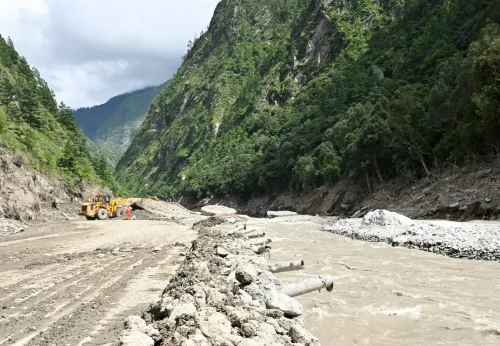
The Budhi Gandaki Hydropower Project , awarded to China Gezhouba Group in May 2017 , has been effectively frozen since 2022 with no meaningful progress.
The Kerung-Kathmandu Railway , announced in 2016–2017 , remains at the feasibility stage as of 2026 , with no financial closure in sight.
The Institute for Conflict Research and Resolution (ICRR) , a Delhi-based think tank, has flagged China's role in Nepal as moving from economic cooperation into strategic and political interference .
Digital expansion projects involving Huawei and ZTE since 2017 have progressed unevenly, raising concerns about Nepal's digital sovereignty .
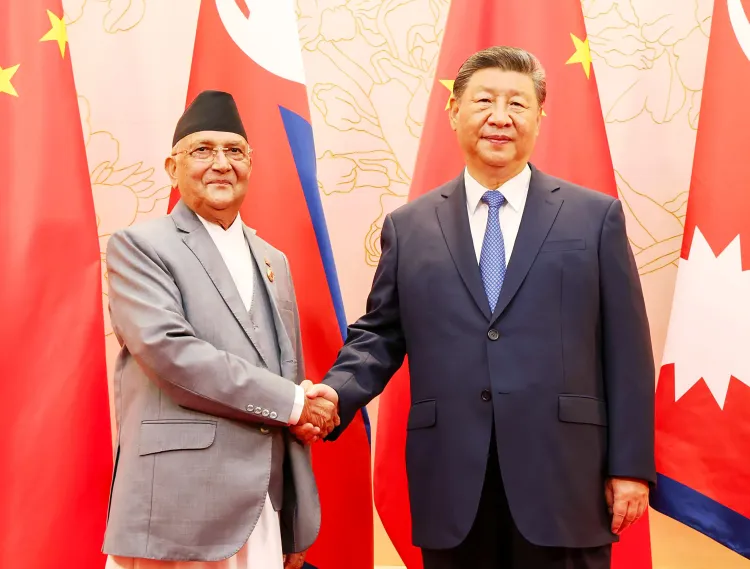
Kathmandu, April 26: Nepal's new government has launched a sweeping review of infrastructure agreements signed with China during the tenure of former Prime Minister K. P. Sharma Oli, amid growing concerns that Beijing has leveraged economic partnerships to exert strategic and political influence over the Himalayan nation. The administration has also declared a moratorium on any fresh agreements with China until the audit is fully concluded.
China's Expanding Footprint in Nepal
According to a detailed analysis published by the Institute for Conflict Research and Resolution (ICRR), a Delhi-based think tank, China's role in Nepal has evolved well beyond conventional economic cooperation. The report states that Beijing's influence now extends into areas of strategic and political interference — including diplomatic pressure on sensitive issues such as Tibet and Taiwan, and attempts to shape Nepal's internal decision-making processes.
The ICRR notes that Kathmandu has seen a significant expansion of China's presence in recent years, raising red flags among policymakers, analysts, and Nepal's traditional partners including India. Critics argue that economic dependency has been deliberately cultivated as a tool of geopolitical leverage — a pattern increasingly visible across South and Southeast Asia.
The Oli Era: BRI Deals and Broken Promises
The inflection point in Nepal-China relations arrived between 2016 and 2018, when the Oli government signed multiple agreements under China's Belt and Road Initiative (BRI), projecting them as transformational milestones that would convert Nepal into a regional connectivity hub. However, critics and independent analysts now point out that many of these deals lacked realistic financial planning and execution frameworks.
The new government is specifically investigating why numerous China-linked projects from the Oli era were stalled, delayed, or quietly abandoned without any transparent explanation to the Nepali public or parliament.
Key Stalled and Frozen Projects
The ICRR report identifies several high-profile projects that have failed to deliver on their initial promise:
The Budhi Gandaki Hydropower Project, awarded to China Gezhouba Group in May 2017, was cancelled in November 2017, reinstated in 2018, and has remained effectively frozen since 2022 with no meaningful progress on the ground.
The proposed Kerung-Kathmandu Railway, announced around 2016–2017, remains stuck at the feasibility study stage as of 2026, reflecting deep technical challenges and the absence of any credible financial closure plan.
The ambitious Trans-Himalayan Multi-Dimensional Connectivity Network, launched under BRI between 2017 and 2018, has not moved beyond conceptual discussions. Cross-border power transmission line projects discussed between 2018 and 2020 also remain unexecuted.
Infrastructure development at the Rasuwagadhi-Kerung border, pushed aggressively between 2017 and 2020, has seen only partial and slow progress. Northern highway connectivity projects initiated between 2016 and 2018 remain incomplete, and the majority of BRI-linked initiatives identified during 2018–2019 have not been implemented even by 2026.
Digital expansion efforts involving Chinese tech giants Huawei and ZTE — active since 2017 — have also progressed unevenly, raising dual concerns over both operational execution and long-term strategic implications for Nepal's digital sovereignty.
Why This Matters: The Debt Trap Debate
The pattern of stalled projects is not unique to Nepal. Across Sri Lanka, Pakistan, and Myanmar, BRI-linked infrastructure deals have faced similar trajectories — grandiose announcements followed by delays, opaque financing terms, and growing sovereign debt burdens. Nepal's decision to audit these agreements signals a rare instance of a smaller nation pushing back on the BRI framework.
Notably, India has long raised concerns about Chinese infrastructure projects in Nepal, viewing Beijing's expanding footprint in its immediate neighbourhood as a direct strategic challenge. The new Kathmandu government's review may offer an opening for India to deepen engagement with Nepal on infrastructure and connectivity on more transparent terms.
What Comes Next
The new Nepali government has made it unambiguous that no fresh agreements with China will be entertained until the comprehensive review of all existing BRI-era projects is completed. The outcome of this audit could reshape Nepal's foreign policy calculus for years to come — determining how Kathmandu balances its relationships with its two giant neighbours, India and China. International observers and regional analysts will be watching closely as the review unfolds in the coming months.
Point of View
Smaller nations have signed BRI agreements under financial pressure and diplomatic charm, only to find themselves saddled with stalled projects and growing leverage in Beijing's hands. The fact that Kathmandu is now demanding accountability is significant, but the deeper question is whether Nepal has the institutional capacity and political will to sustain this pushback against a neighbour that controls its northern border. India, which has watched China's encroachment into its neighbourhood with alarm, should treat this moment as a strategic opening — not just to critique Beijing, but to offer Nepal a credible, transparent alternative in infrastructure and connectivity.
NationPress
7 Oct 2026
Frequently Asked Questions
Why is Nepal reviewing its infrastructure deals with China?
Nepal's new government is reviewing China-linked infrastructure deals signed during the K. P. Sharma Oli era because several projects were stalled, delayed, or abandoned without clear explanation. The government wants to investigate the reasons behind these failures before signing any new agreements with Beijing.
Which China-funded projects in Nepal have been stalled?
Key stalled projects include the Budhi Gandaki Hydropower Project (frozen since 2022), the Kerung-Kathmandu Railway (still at feasibility stage in 2026), the Trans-Himalayan Multi-Dimensional Connectivity Network, and multiple BRI-linked road and border infrastructure initiatives. Most were announced between 2016 and 2019.
What is China's Belt and Road Initiative and how does it affect Nepal?
The Belt and Road Initiative (BRI) is China's global infrastructure investment programme. Nepal joined BRI around 2017, signing multiple agreements for railways, roads, and energy projects. Critics argue these deals came with strategic strings attached, giving Beijing political leverage over Kathmandu.
Has Nepal stopped all new agreements with China?
Yes, Nepal's new government has announced a moratorium on all new agreements with China until a full review of existing BRI-era projects is completed. This is seen as a significant policy shift in Nepal-China relations.
How does China's influence in Nepal affect India?
India views China's growing footprint in Nepal — its immediate northern neighbour — as a direct strategic concern. Beijing's BRI projects and alleged political interference in Kathmandu are seen as part of a broader effort to encircle India. Nepal's audit of Chinese deals may create an opportunity for India to deepen its own engagement with Kathmandu.