Nepal's New Government: A Potential Shift in India Relations
Synopsis
The recent elections in Nepal signal a potential shift in the country's diplomatic relations with India. With the Rastriya Swatantra Party taking charge, there are hopes for improved ties and economic collaboration, despite previous tensions.
Key Takeaways
New Government: Rastriya Swatantra Party set to lead Nepal.
Diplomatic Shift: Potential for improved India-Nepal relations.
Economy Focus: Emphasis on job creation and reviewing currency exchange rates.
Nationalism: Balen Shah's stance on maintaining balance between neighboring powers.
Historical Ties: The importance of the 1950 treaty in bilateral relations.
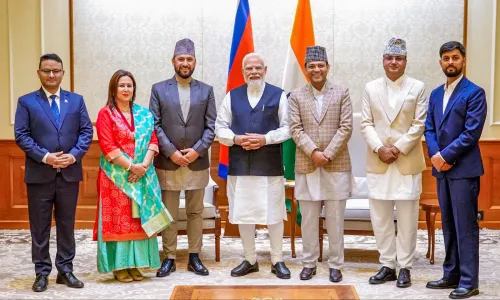
Kathmandu, March 8 (NationPress) The recent election results in Nepal may provide an opportunity to enhance Kathmandu's relations with India, which have been somewhat strained recently. With a robust government anticipated in this Himalayan nation, there is hope for a renewed diplomatic engagement.
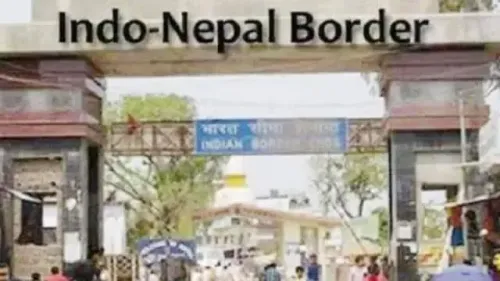
The foundation of India-Nepal relations lies in the 1950 Treaty of Peace and Friendship, advocating open borders and shared cultural ties. India has long been a crucial development ally for Nepal, supporting various trade and investment initiatives. Moreover, the relationship is deeply entwined with social and cultural connections, highlighted by substantial people-to-people interactions.
Despite the strong historical ties, this relationship has experienced fluctuations influenced by political transitions in Nepal. Key challenges, including unresolved border disagreements, a growing trust deficit, security issues, and political meddling, have complicated bilateral dynamics.
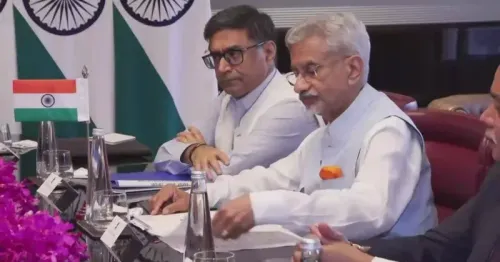
“India has consistently championed peace, progress, and stability in Nepal, and in alignment with our commitment, we provided logistical assistance as requested by the Government of Nepal for these elections,” stated India's External Affairs Ministry, praising the successful execution of elections on March 5.
“We eagerly anticipate collaborating with the new Government of Nepal to strengthen the extensive ties between our nations for mutual benefit,” the statement continued, congratulating both the government and the people of Nepal.
As the election results emerged, Jayant Prasad, a former Ambassador to Nepal, shared with IANS, “My hope and expectation are that the elections yield a clear mandate that will facilitate effective governance in Nepal.”
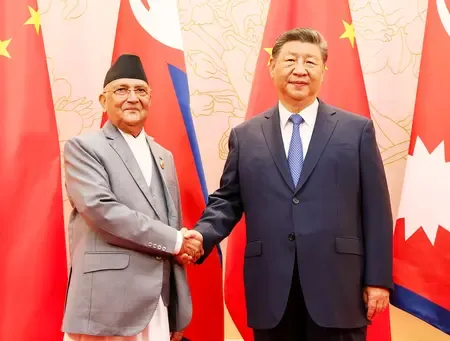
In recent years, China's influence has been on the rise, causing apprehensions in New Delhi. Even though the Rastriya Swatantra Party (RSP) is poised to lead the next government in Nepal, a significant diplomatic shift should not be anticipated immediately.
When the party's manifesto notably omitted a major project in the eastern district of Jhapa, adjacent to India's sensitive Siliguri corridor, it marked a departure from the previous pro-China stance of former Prime Minister K.P. Sharma Oli.
The Damak Industrial Park was part of Beijing’s ambitious Belt and Road Initiative (BRI), which New Delhi had previously flagged due to its strategic implications. Conversely, in its manifesto, the RSP indicated intentions to reassess the exchange rate with India. Since 1993, the rate has remained fixed at 100 Indian rupees equaling 160 Nepali rupees, regardless of global economic conditions.
In the lead-up to the elections, the RSP pledged to alter the currency exchange rate with India if it came to power. “Given that the exchange rate with the Indian rupee has remained stable for three decades, we will investigate and review this framework with input from esteemed international scholars,” the RSP commitment stated. The party aims to consult with prominent global experts for an in-depth analysis of the exchange rate structure with India.
While previous governments have often been categorized as either “pro-India” or “pro-China”, the RSP’s potential Prime Ministerial candidate Balen Shah is viewed as a staunch nationalist. Like many from his generation, he advocates for a balanced stance between the two neighboring powers, avoiding favoritism in the event of tensions.
Emphasizing a “Nepal First” narrative, Balen has sought to appeal to voters ahead of the elections.
In the past, he made remarks on social media that would typically be shunned by politicians or diplomats, but that was in the past. Although reports suggest connections to his student days in India, his supporters now perceive Balen as someone committed solely to the interests of Nepal.
The engineer-rapper notably displayed a “Greater Nepal” map in his mayoral office, which included certain territories claimed by India. This was interpreted as a symbolic counter to India’s “Akhand Bharat” mural in the new Parliament building.
Balen has also called for a ban on Indian films, criticizing one that referred to Goddess Sita as “India’s daughter.” He contested this portrayal, referencing traditions that identify her birthplace within Nepal's territory or near its border with Bihar.
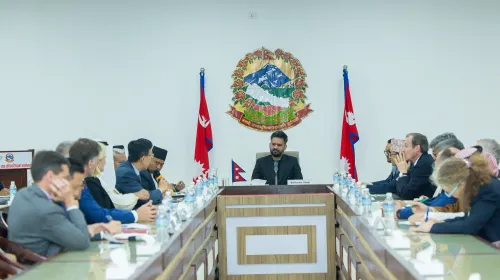
Upon taking office, he will lead a single-party government, marking a first since Nepal adopted its constitution in 2015.
With job creation and economic development as primary focuses, RSP leaders are committed to a 'Nepal First' approach. According to World Bank data, India is Nepal's largest trading partner, responsible for USD 8.6 billion or 63% of imports, while China trails with USD 1.8 billion or 13%.
Point of View
The focus remains on the evolving relationship between Nepal and India. The recent electoral developments highlight a potential for renewed cooperation while navigating the complexities of geopolitical influences from neighboring countries.
NationPress
17 Sept 2026
Frequently Asked Questions
What is the significance of the 1950 Treaty of Peace and Friendship?
The treaty serves as the foundation for India-Nepal relations, promoting open borders and cultural ties, and outlines mutual cooperation in various sectors.
How has China's influence affected Nepal's relations with India?
China's growing presence in Nepal has raised concerns in India, particularly regarding strategic projects and the balance of influence in the region.
What are RSP's key promises regarding Nepal's economy?
The RSP has pledged to review the currency exchange rate with India and focus on job creation and economic development under a 'Nepal First' policy.
Who is Balen Shah and what is his position?
Balen Shah is the projected Prime Ministerial candidate for the RSP, known for his nationalist stance and commitment to prioritizing Nepal's interests.
What impact do the election results have on future India-Nepal relations?
The election results may reshape diplomatic ties, with a potential for improved collaboration and dialogue between the two nations.