Jal Shakti Minister CR Paatil champions water education in schools, colleges at ETF meet
Synopsis
India's Jal Shakti Minister CR Paatil has floated a striking idea at the 20th ETF meeting: make water management a formal academic discipline — from school curricula to university degrees — while reviewing a ₹43,266 crore Namami Gange Programme where 368 of 527 sanctioned projects are now complete. The education push signals a shift from pure infrastructure to building human capital for river conservation.
Key Takeaways
Jal Shakti Minister C.R.
Paatil chaired the 20th Empowered Task Force (ETF) meeting on 8 October 2026 in New Delhi .
He proposed integrating water-specific content into school curricula and offering water management courses at higher educational institutions .
As of August 2026 , 527 projects worth ₹43,266 crore have been sanctioned under the Namami Gange Programme ; 368 are complete.
Under sewerage infrastructure, 147 of 219 sanctioned projects are complete, delivering 4,339 MLD of treatment capacity and 4,615 km of sewer network.
Bihar and West Bengal have notified treated wastewater reuse policies; Jharkhand is awaiting State Cabinet approval.
The revised DPR for the Barauni STP has been sent to IIT-BHU for appraisal; Shantipur STPs DPR approved by the Executive Committee.
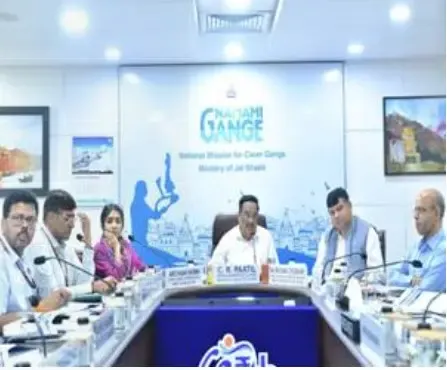
Union Jal Shakti Minister C.R. Paatil on Thursday, 8 October 2026, underscored Prime Minister Narendra Modi's vision of embedding water literacy into India's academic framework — proposing water-specific content in school curricula and dedicated water management and governance courses at higher educational institutions. The remarks came as Paatil chaired the 20th Meeting of the Empowered Task Force (ETF) in New Delhi.
Education as a Tool for River Rejuvenation
Paatil stressed that integrating water studies into formal education can build a robust knowledge base and produce professionals equipped to address the ecological, social, cultural, economic, and policy dimensions of river management. He proposed that such courses be actively promoted at the city and state levels, and that students completing them be considered for river-related assignments in urban administrations.
This marks a notable policy direction — framing water conservation not just as an infrastructural challenge but as an educational and professional development priority, aligning with the Centre's broader push under the Namami Gange Programme.
Namami Gange: Progress at a Glance
As of August 2026, a total of 527 projects have been sanctioned under the Namami Gange Programme at a combined cost of ₹43,266 crore, of which 368 projects have been completed. On the sewerage front alone, 219 projects have been sanctioned, creating a treatment capacity of 6,603 MLD (million litres per day) and a sewer network spanning 5,245 km. Of these, 147 projects have been completed, delivering 4,339 MLD of sewage treatment capacity and 4,615 km of sewer network.
The figures reflect significant forward momentum, though a gap between sanctioned and completed projects — particularly in sewerage — signals execution challenges that persist across states.
Key Interventions Reviewed
The ETF meeting covered a wide range of river rejuvenation levers: improved sewage infrastructure, scientific water management, safe reuse of treated wastewater, ecological restoration, groundwater management, nature-based solutions, and stakeholder coordination. The status of detailed project reports (DPRs), land availability, aquifer mapping, wetlands, City Sanitation Action Plans (CSAPs), aerial drainage mapping, and State Ganga Committee meetings were all reviewed.
Notably, the revised DPR for the Barauni Sewage Treatment Plant (STP) has been received and forwarded to IIT-BHU for appraisal, while the DPR for Shantipur STPs in West Bengal has been approved by the Executive Committee. Bihar and West Bengal have already notified their policies on reuse of treated wastewater; Jharkhand is awaiting State Cabinet approval for its own policy.
Officials Present
The meeting was attended by Minister of State for Jal Shakti Raj Bhushan Chaudhary; Department of Water Resources Secretary Archana Varma; Department of Drinking Water and Sanitation Secretary Ashok K.K. Meena; and Director General of the National Mission for Clean Ganga (NMCG) Rajeev Kumar Mital.
What's Next
With Jharkhand's treated wastewater reuse policy still pending Cabinet clearance and appraisal of key STPs under way, the pace of institutional action over the next quarter will be critical. The push to institutionalise water education at the school and college level, if translated into curriculum reform, could yield a generation of water professionals India urgently needs as river health and groundwater depletion become intensifying concerns.
Point of View
It risks remaining aspirational. The Namami Gange numbers look impressive in aggregate, but completing 368 of 527 projects while sewerage treatment capacity still lags demand in Ganga basin cities suggests pace is outrunning quality checks. The real accountability question — water quality at key Ganga stretches — was conspicuously absent from the reported agenda. Until output metrics shift from projects sanctioned to measurable river health indicators, the programme's public impact will remain hard to verify.
NationPress
8 Oct 2026
Frequently Asked Questions
What did Jal Shakti Minister CR Paatil announce at the ETF meeting on 8 October 2026?
Paatil proposed integrating water-specific content into school curricula and introducing water management and governance courses at higher educational institutions. He also reviewed the progress of the Namami Gange Programme and key river rejuvenation interventions at the 20th Empowered Task Force meeting in New Delhi.
What is the current status of the Namami Gange Programme?
As of August 2026, 527 projects worth ₹43,266 crore have been sanctioned under the Namami Gange Programme, of which 368 have been completed. Under sewerage infrastructure specifically, 147 of 219 sanctioned projects are done, delivering 4,339 MLD of treatment capacity and 4,615 km of sewer network.
Which states have notified policies on reuse of treated wastewater?
Bihar and West Bengal have both notified their policies on safe reuse of treated wastewater. Jharkhand is in the process of obtaining State Cabinet approval for its own policy.
What is the Empowered Task Force (ETF) under Namami Gange?
The Empowered Task Force is a high-level oversight body for the Namami Gange Programme that reviews project progress, sewage infrastructure status, DPR preparation, ecological restoration efforts, and inter-stakeholder coordination. The 8 October 2026 meeting was its 20th such session, chaired by the Jal Shakti Minister.
What is the significance of sending the Barauni STP DPR to IIT-BHU?
The revised detailed project report for the Barauni Sewage Treatment Plant in Bihar has been forwarded to IIT-BHU for technical appraisal, a step required before project execution can proceed. The Shantipur STPs DPR in West Bengal has already cleared Executive Committee approval, putting that project closer to implementation.