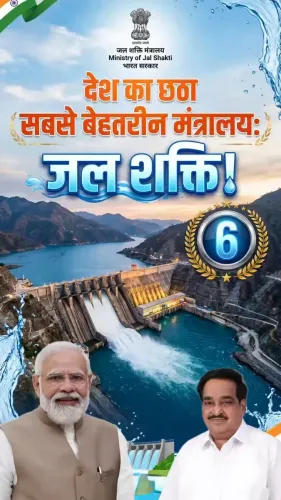
Jal Shakti Minister Paatil reaffirms Namami Gange commitment

Synopsis
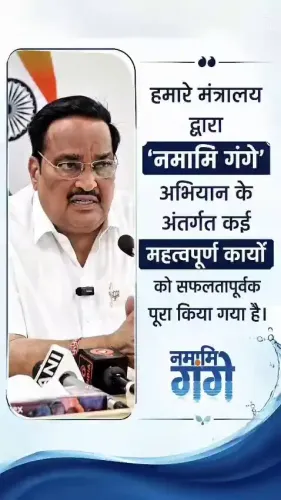
Union Jal Shakti Minister C. R. Paatil on 26 June 2026 reaffirmed the Ministry's commitment to PM Modi's Namami Gange mission, framing the Ganga as the embodiment of India's faith, culture, and the life-giving consciousness of crores of Indians.
Key Takeaways
Union Jal Shakti Minister C.
Paatil posted on 26 June 2026 reaffirming commitment to the Namami Gange mission.
He described the Ganga as 'not merely a river' but the life-giving cultural and spiritual consciousness of crores of Indians.
Namami Gange was announced in the 2014 Union Budget and formally launched in 2015 as a flagship Ganga rejuvenation programme.
The Ministry of Jal Shakti is the nodal body for implementation, integrating sewage treatment, afforestation, and biodiversity conservation.
The programme succeeded the Ganga Action Plan Phase-I of 1985 , which was assessed as inadequate in scope.
The next annual progress report and forthcoming Union Budget allocations will be key indicators of the mission's trajectory.
Union Jal Shakti Minister C. R. Paatil on Friday, 26 June 2026, reaffirmed the Ministry of Jal Shakti's unwavering commitment to implementing the Namami Gange mission, describing the Ganga as the living conscience of India's faith and culture rather than merely a river.
Context
Posting in Hindi, Minister Paatil wrote: 'माँ गंगा केवल एक नदी नहीं, बल्कि हमारी आस्था, संस्कृति और करोड़ों भारतीयों की जीवनदायिनी चेतना का स्वरूप हैं' — 'Mother Ganga is not merely a river, but the embodiment of our faith, our culture, and the life-giving consciousness of crores of Indians.' He added that the Ministry is working with 'complete commitment' to translate Prime Minister Narendra Modi's 'visionary resolve' of the Namami Gange mission into ground-level action.
The post arrives as the government continues to position Ganga conservation as simultaneously an environmental and civilisational priority — a framing that has defined BJP-led governance since 2014.
Policy Backdrop
Namami Gange was first announced in the 2014 Union Budget and formally launched in 2015 as an integrated, flagship programme under the Ministry of Jal Shakti. It brings together sewage treatment infrastructure, industrial effluent control, riverfront development, afforestation along the banks, and biodiversity conservation under a single umbrella.
The programme built on the earlier Ganga Action Plan Phase-I, which was initiated in 1985 but was widely assessed as insufficient in scope and execution. Namami Gange was designed to address those gaps with significantly larger funding and inter-ministerial coordination. The Ministry of Jal Shakti serves as the nodal body overseeing implementation across all Ganga basin states.
Stakeholders and Impact
The Ganga basin spans several Indian states and supports the livelihoods and daily needs of hundreds of millions of people — from farmers dependent on its waters to urban populations relying on it for drinking water supply. Riverine communities, fishermen, and pilgrims visiting its ghats are among the most directly affected stakeholders of any conservation or pollution-control measures undertaken under the mission.
Beyond ecology, the river holds deep religious significance for a large section of India's population, and the government's consistent invocation of that cultural dimension has shaped how the programme is communicated publicly. Paatil's post reflects this dual framing — spiritual reverence alongside institutional resolve.
What's Next
Observers will watch for the next annual progress report of Namami Gange, which typically details sewage treatment plant capacity additions, river-stretch pollution levels, and biodiversity indicators such as the Gangetic dolphin population. Any new project sanctions or enhanced budget allocations in the forthcoming Union Budget will be a key signal of the mission's forward momentum. Minister Paatil's public reaffirmation suggests the Ministry intends to keep Ganga rejuvenation at the centre of its communications and policy agenda in the months ahead.
Point of View
Allowing the government to appeal simultaneously to cultural sentiment and developmental credentials. By invoking PM Modi's 'visionary resolve,' Paatil also reinforces the top-down attribution of the programme that is central to the party's governance narrative. The statement carries no new policy announcement, but its timing and tone suggest the Ministry is priming stakeholders for forthcoming activity on the mission.
NationPress
24 Sept 2026
Frequently Asked Questions
What is the Namami Gange mission?
Namami Gange is India's flagship integrated Ganga conservation programme, announced in the 2014 Union Budget and formally launched in 2015 under the Ministry of Jal Shakti. It covers sewage treatment, industrial effluent control, riverfront development, afforestation, and biodiversity conservation along the Ganga and its tributaries.
Who is C. R. Paatil?
C. R. Paatil is the Union Minister of Jal Shakti in the Government of India and a senior BJP leader. He previously served as president of the BJP's Gujarat state unit.
What did C. R. Paatil say about the Ganga?
On 26 June 2026, Paatil posted in Hindi that 'Mother Ganga is not merely a river, but the embodiment of our faith, our culture, and the life-giving consciousness of crores of Indians,' and reaffirmed the Ministry's commitment to implementing the Namami Gange mission.
What is the Ministry of Jal Shakti's role in Namami Gange?
The Ministry of Jal Shakti is the nodal ministry for the Namami Gange programme, coordinating implementation across Ganga basin states and overseeing infrastructure projects including sewage treatment plants and afforestation drives.
What came before Namami Gange?
The Ganga Action Plan Phase-I, launched in 1985, was the earlier attempt to address Ganga pollution. It was widely assessed as insufficient in scope and execution, which led to the more comprehensive Namami Gange programme being designed under the current government.