Jal Shakti Minister Paatil highlights Namami Gange milestones
Synopsis
Union Jal Shakti Minister C. R. Paatil on 13 June 2026 cited the successful completion of key works under the Namami Gange mission, sharing the update as part of the BJP's #12YearsOfSeva campaign. The Rs 20,000-crore flagship programme, launched in 2015, targets pollution abatement and riverfront development across the Ganga basin.
Key Takeaways
Paatil posted on 13 June 2026 that several important works under Namami Gange have been successfully completed by his ministry.
The update was shared under the #12YearsOfSeva hashtag, marking twelve years of the BJP-led central government.
Namami Gange was launched in June 2015 with an outlay of Rs 20,000 crore , replacing the earlier Ganga Action Plan phases.
The Ministry of Jal Shakti , formed in 2019 , is the nodal body overseeing the mission across Uttarakhand, Uttar Pradesh, Bihar and West Bengal .
The Ganga basin supports over 400 million people , making effective river rejuvenation a matter of large-scale public health and ecology.
The next National Mission for Clean Ganga annual progress report and any cabinet decision on post- 2026 funding will be key milestones to watch.
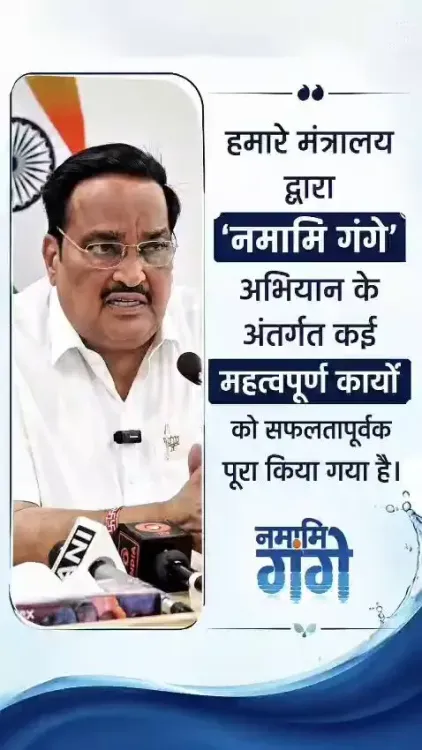
Union Jal Shakti Minister C. R. Paatil on Saturday, 13 June 2026 highlighted the completion of several significant works under the Namami Gange mission, sharing the update via a post on X as part of the ruling party's #12YearsOfSeva campaign marking twelve years of the BJP-led government at the Centre.
In his post, the minister wrote: 'हमारे मंत्रालय द्वारा नमामि गंगे अभियान के अंतर्गत कई महत्वपूर्ण कार्यों को सफलतापूर्वक पूरा किया गया है' — ('Several important works have been successfully completed under the Namami Gange mission by our ministry.') The post was accompanied by a video, which the ministry appears to have used to illustrate the progress claimed.
Context
The #12YearsOfSeva hashtag has been widely used by BJP leaders and Union ministers this week to mark a dozen years of the party's national government, with each ministry highlighting achievements in its respective domain. Minister Paatil, who also serves as a senior BJP leader and was formerly the party's Gujarat state president, has been at the helm of the Ministry of Jal Shakti and has regularly amplified the ministry's Namami Gange deliverables on social media.
Policy Backdrop
Namami Gange was launched in June 2015 as an integrated conservation mission for the Ganga river, backed by an outlay of Rs 20,000 crore. The programme subsumed and significantly expanded the earlier Ganga Action Plan Phase I (launched 1985) and Phase II (launched 1993), which had delivered limited results over three decades.
The Ministry of Jal Shakti — formed in 2019 by merging the erstwhile ministries of Water Resources and Drinking Water and Sanitation — serves as the nodal body overseeing the mission. Implementation has centred on sewage treatment infrastructure, industrial effluent monitoring, and the development of ghats and crematoria across the four main Ganga basin states: Uttarakhand, Uttar Pradesh, Bihar and West Bengal. The mission also converges with the Swachh Bharat and AMRUT programmes to address last-mile sanitation gaps in river-bank towns.
Stakeholders and Impact
The Ganga basin is home to more than 400 million people, making it one of the most densely populated river corridors in the world. Urban local bodies along the river are primary implementation partners, responsible for operating sewage treatment plants and maintaining riverfront infrastructure once central funds are deployed.
Ganga basin residents — particularly in smaller towns and rural stretches — stand to benefit most directly from improved water quality and sanitation outcomes. Civil society groups and environmental researchers have tracked the mission's progress closely, noting that while infrastructure creation has accelerated since 2015, sustained operation and maintenance of treatment facilities remains a continuing challenge for state governments.
What's Next
Attention will now turn to the National Mission for Clean Ganga's next annual progress report, which is expected to provide verified data on project completions, sewage treatment capacity added, and river water quality indices. Any cabinet approval for extended Phase-II funding beyond 2026 will be closely watched by both state governments and environmental stakeholders as the mission approaches a critical funding juncture.
Minister Paatil's post signals that the ministry intends to keep Namami Gange central to the BJP's governance narrative as the government enters its second decade in power — with river rejuvenation likely to feature prominently in official communications in the weeks ahead.
Point of View
Positioning Namami Gange as a flagship delivery story. By anchoring the update to #12YearsOfSeva, the ministry is linking a long-running environmental mission to a broader political narrative of administrative achievement. The move reflects a wider pattern among Union ministers of using social media milestones to pre-empt scrutiny ahead of potential funding renewals — in this case, the expected cabinet decision on Namami Gange's post-2026 phase. How the government substantiates these completion claims with verified data in the forthcoming progress report will determine whether the narrative holds up to independent scrutiny.
NationPress
19 Sept 2026
Frequently Asked Questions
What is Namami Gange and when was it launched?
Namami Gange is the central government's flagship integrated Ganga conservation mission, launched in June 2015 with a budgetary outlay of Rs 20,000 crore . It combines pollution abatement, biodiversity conservation and riverfront development, and subsumed the earlier Ganga Action Plan phases.
What did CR Paatil say about Namami Gange in June 2026?
On 13 June 2026 , Minister C. R. Paatil posted on X that several important works under the Namami Gange mission had been successfully completed by his ministry, sharing the update as part of the #12YearsOfSeva campaign.
Which states are covered under the Namami Gange mission?
The mission primarily covers the four main Ganga basin states — Uttarakhand, Uttar Pradesh, Bihar and West Bengal — focusing on sewage treatment infrastructure, industrial effluent monitoring and ghat development along the river.
Who oversees the Namami Gange programme?
The Ministry of Jal Shakti , formed in 2019 by merging the Water Resources and Drinking Water and Sanitation ministries, is the nodal body overseeing Namami Gange through the National Mission for Clean Ganga .
What is #12YearsOfSeva?
#12YearsOfSeva is a campaign hashtag used by BJP leaders and Union ministers to mark twelve years of the party's government at the Centre, with each ministry highlighting its key achievements under the campaign.