Pinarayi Vijayan faces first internal test in 28 years as Kerala CPI(M) unease grows
Synopsis
For 28 years, Pinarayi Vijayan ran Kerala's CPI(M) without a serious internal challenger. The 2026 election defeat may have changed that — not through open revolt, but through a quiet, growing unease that is now headed for its first real test at the party's Kozhikode state committee meeting on 13–15 September.
Key Takeaways
Pinarayi Vijayan has controlled the Kerala CPI(M) since 1998 , first as state secretary and then as Chief Minister for two consecutive full terms.
The 2026 Kerala Assembly election resulted in a heavy defeat for the Left Democratic Front , including the loss of several traditional CPI(M) strongholds .
Internal unease is growing within the party, with sections questioning whether leadership accountability is being adequately examined post-defeat.
Vijayan's explanations for losses in Kannur have intensified debate, with critics arguing responsibility is being pushed downward.
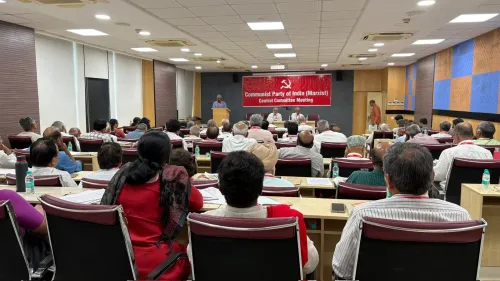
The CPI(M) state committee meeting in Kozhikode from 13 to 15 September is being watched as the most significant internal party gathering since the election.
No open rebellion has emerged so far — the challenge remains one of quiet, internal questioning rather than public confrontation.
After nearly three decades of unchallenged dominance over the Kerala Communist Party of India (Marxist), Pinarayi Vijayan is confronting the first serious stirrings of internal dissent — not an open revolt, but a deepening unease within the organisation following the Left Democratic Front's crushing defeat in the 2026 Kerala Assembly election. The disquiet is now expected to surface at a critical CPI(M) state committee meeting in Kozhikode from 13 to 15 September.
Three Decades of Consolidated Authority
Vijayan's hold over the Kerala CPI(M) traces back to 1998, when he assumed charge as state secretary. Over the following years, his influence expanded steadily through the party's organisational structure, eventually making him the most dominant political figure in the state. By the time the 2016 Assembly election arrived, the internal balance of power had shifted decisively in his favour — even as it was veteran leader V.S. Achuthanandan whose campaign popularity was widely credited with returning the Left Democratic Front (LDF) to power that year.
Vijayan emerged as Chief Minister after that victory and went on to make history as the first leader in Kerala to serve two consecutive full terms as Chief Minister — an unprecedented decade at the helm. During this period, his authority extended well beyond the government into the party apparatus, making him, in practical terms, the final arbiter of most major political decisions in the state.
The 2026 Electoral Setback Changes the Equation
The 2026 Assembly election has fundamentally altered that calculus. The scale of the Left's defeat — which included the loss of several traditional CPI(M) strongholds — has raised questions that can no longer be deflected to individual constituencies or local cadre performance. The breadth of the reversal has made a leadership-level examination unavoidable, at least in the eyes of a growing section within the party.
Notably, Vijayan's explanations for specific defeats — including losses in Kannur, long considered a CPI(M) bastion — have sharpened internal debate. Critics within the organisation argue that responsibility is being pushed downward rather than examined at the apex of the party leadership. This perception, according to reports, has amplified the sense of unease among leaders who remained largely silent through Vijayan's long tenure.
Unease Without Open Rebellion
What distinguishes the current moment is its character: there has been no open rebellion, no public challenge to Vijayan's authority. Instead, what is emerging is a more cautious, internal questioning — one that has been building in the corridors of the party rather than on public platforms. Leaders who held their counsel for years are now reportedly confronting a difficult question: can the party credibly undertake genuine introspection without scrutinising the role of its most powerful figure?
That question gives the forthcoming Kozhikode state committee meeting an outsized significance. It is being described as the most closely watched organisational gathering within the Kerala CPI(M) since the election. The agenda will formally cover specific constituency-level losses — Taliparamba, Payyannur, and other fallen strongholds — but the subtext is expected to be considerably larger.
What the Kozhikode Meeting Could Decide
The September 13–15 Kozhikode meeting could evolve into a broader reckoning over the style of leadership that has prevailed in the Kerala CPI(M) for nearly three decades. Whether the party uses the forum to demand accountability at the leadership level — or whether Vijayan's considerable organisational machinery contains the dissent — will signal the direction of the party's internal politics ahead of the next electoral cycle.
The central question hanging over the meeting is whether the 2026 verdict has finally opened the door to an internal assertion against the Pinarayi era, or whether Vijayan retains sufficient grip to navigate the challenge and emerge with his authority intact.
Point of View
But in what the party's internal culture permits to be said at all. If dissent is again managed rather than heard, the CPI(M) risks repeating the same cycle — a post-defeat review that changes nothing structural — ahead of the next election.
NationPress
17 Oct 2026
Frequently Asked Questions
Why is there unease against Pinarayi Vijayan within Kerala CPI(M)?
The unease stems from the scale of the Left Democratic Front's defeat in the 2026 Kerala Assembly election, including the loss of traditional CPI(M) strongholds. Sections within the party feel that post-defeat accountability is being directed downward rather than examined at the leadership level, where Vijayan has held near-unquestioned authority for nearly 28 years.
How long has Pinarayi Vijayan controlled the Kerala CPI(M)?
Vijayan has been the dominant figure in the Kerala CPI(M) since 1998, when he became state secretary. He subsequently served two consecutive full terms as Chief Minister — the first leader in Kerala to do so — making his consolidated run of influence close to three decades.
What is the significance of the Kozhikode CPI(M) state committee meeting?
The CPI(M) state committee meeting scheduled in Kozhikode from 13 to 15 September is being described as the most closely watched internal party gathering since the 2026 election. While it will formally address specific constituency-level losses, it is expected to become a broader discussion on the style of leadership that has prevailed in the Kerala CPI(M) under Vijayan.
Has there been an open rebellion against Pinarayi Vijayan in the CPI(M)?
No open rebellion has emerged so far. The challenge to Vijayan's authority remains one of quiet internal questioning — leaders who stayed silent during his long tenure are now reportedly raising concerns about whether genuine party introspection is possible without scrutinising his role.
What role did V.S. Achuthanandan play in the 2016 Kerala election?
In the 2016 Kerala Assembly election, V.S. Achuthanandan's campaign and personal popularity were widely credited with returning the Left Democratic Front to power. Despite this, Pinarayi Vijayan emerged as Chief Minister following the victory, cementing his dominance over both the government and the party organisation.