CM Himanta Champions Assam's GI-Tagged Crafts, Gamosa to Globe

Synopsis
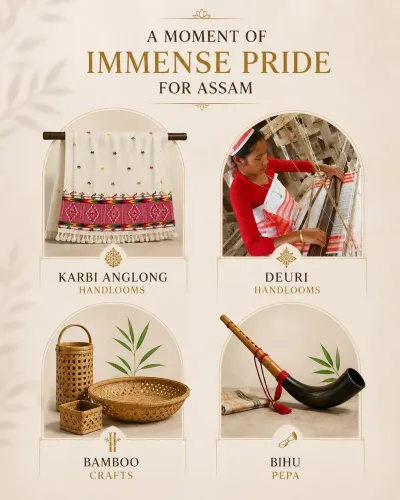
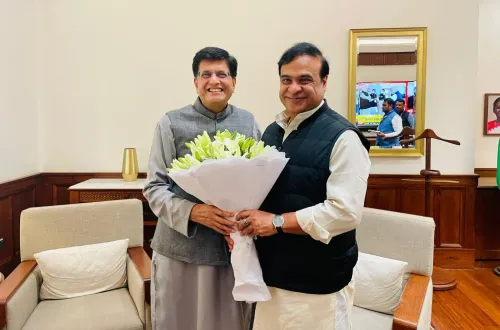
Assam CM Himanta Biswa Sarma, responding to Commerce Minister Piyush Goyal's appreciation of the Gamosa, highlighted that the Bihu Dhol, Japi, Majuli Masks, Sarthebari bell metal and Bodo crafts are all now GI-protected, framing the effort under PM Modi's 'Vikas Bhi, Virasat Bhi' vision.
Key Takeaways
Assam CM Himanta Biswa Sarma acknowledged Union Minister Piyush Goyal's appreciation of Assam's traditional Gamosa .
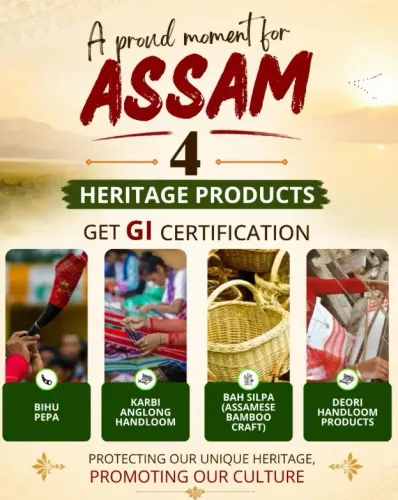
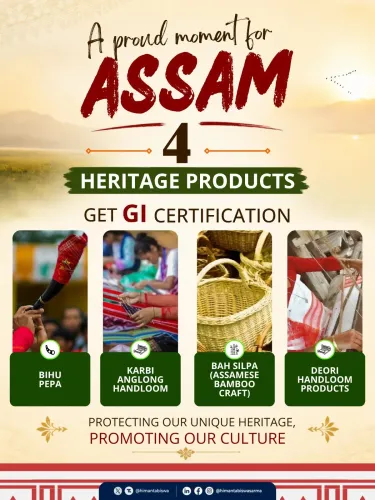
The Gamosa, Bihu Dhol, Japi, Majuli Masks, Sarthebari bell metal craft and Bodo crafts have all been granted Geographical Indication (GI) tags .
GI protection is grounded in India's Geographical Indications of Goods Act, 1999 , which legally certifies regional product origins.
The initiative is framed under PM Narendra Modi 's vision of 'Vikas Bhi, Virasat Bhi' — pairing economic development with heritage preservation.
The stated goal is to open new markets and export opportunities for Assam's weavers and traditional artisans.
The Commerce Ministry's involvement signals a link between GI protection and active trade promotion for these crafts.
A thank-you note on a Saturday morning opened a window onto something far bigger: Assam Chief Minister Himanta Biswa Sarma used Union Commerce Minister Piyush Goyal's public appreciation of the Gamosa to spotlight a quietly ambitious campaign — turning the state's ancient crafts into globally traded, legally protected assets.
What the Gamosa carries beyond its threads
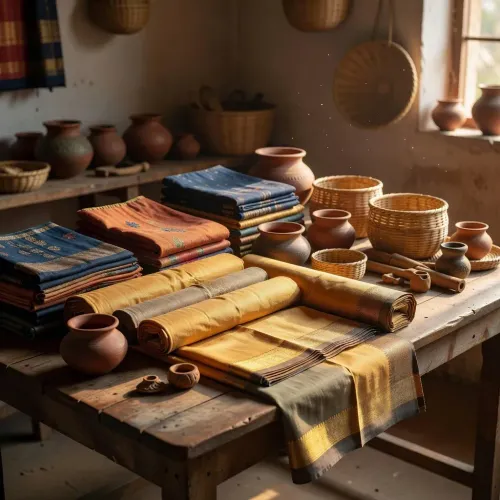
The Gamosa — a hand-woven cotton cloth edged with red motifs, offered as a mark of respect across Assam — is far more than a cultural symbol now. It carries a Geographical Indication (GI) tag, the legal shield granted under India's Geographical Indications of Goods (Registration and Protection) Act, 1999, which certifies a product's origin and guards it against imitation. CM Sarma's post makes clear the Gamosa is not a lone beneficiary. The Bihu Dhol, the Japi (the distinctive conical cane-and-bamboo hat), Majuli Masks, Sarthebari bell metal craft, and Bodo community crafts have all been brought under the same umbrella.
Each of these items represents a distinct artisan tradition — and, crucially, a distinct community of weavers and craftspeople who now hold a documented, enforceable claim to their own heritage.
PM Modi's 'Vikas Bhi, Virasat Bhi' as the policy frame
Sarma explicitly anchors the initiative in Prime Minister Narendra Modi's articulated vision of 'Vikas Bhi, Virasat Bhi' — 'Development too, Heritage too' — a framework that insists the two need not trade off against each other. The GI route is its operational expression: a craft gets its origin authenticated, an artisan gains market credibility, and a buyer anywhere in the world gets a guarantee of authenticity. India has steadily expanded GI registrations over the past two decades, with North-eastern states featuring prominently in recent rounds. Assam's Muga silk was among the region's early GI recipients; the current cluster of registrations suggests that push has widened considerably.
From the loom in Assam to markets beyond
The Commerce Ministry's role — and Goyal's appreciation — is not incidental. GI protection matters most when it is paired with trade promotion: buyer-seller meets, export facilitation, and e-commerce channels that can carry a Sarthebari bell-metal bowl or a Majuli Mask to a buyer in Europe or Southeast Asia. Sarma's phrase 'new markets and limitless opportunities' signals that the protection side of the equation is largely in place; the push now is on the market-access side. For Assam's weavers — many of them women in rural Bodo and riverine communities — that shift is the tangible one.
The political symbolism works on multiple registers simultaneously: cultural pride, economic uplift for a historically marginalised artisan class, and a demonstration that federalism can deliver when state and central government align on a sectoral agenda.
When a loom in rural Assam can authenticate its product to a buyer in Amsterdam, the tag is doing exactly what the law intended — and a century-old craft gets its best shot at the next century.
Point of View
Certified asset class. By tying the announcement to PM Modi's 'Vikas Bhi, Virasat Bhi' rubric, CM Sarma aligns Assam's agenda with the Centre's cultural-economy narrative, reinforcing the BJP's effort to demonstrate that development and tradition are complementary rather than competing. The Commerce Ministry's visible appreciation adds an important layer: it signals that export-promotion machinery is being pointed at these craft clusters, moving the story from registration to revenue. For the North-east broadly, success here could accelerate similar GI drives in neighbouring states, making Assam a template for the region.
NationPress
17 Oct 2026
Frequently Asked Questions
What is the Assam Gamosa and why is it important?
The Gamosa is a traditional Assamese hand-woven cotton cloth, characterised by red border motifs, and is offered as a mark of respect in cultural and social ceremonies across the state. It has been granted a Geographical Indication tag, legally certifying its origin and protecting it from imitation.
Which Assam products have received GI tags?
Among the items CM Himanta Biswa Sarma mentioned as GI-protected are the Gamosa, Bihu Dhol, Japi, Majuli Masks, Sarthebari bell metal craft and Bodo community crafts. Assam's Muga silk was also among earlier GI recipients from the region.
What does a GI tag mean for Assam's weavers?
A Geographical Indication tag provides legal proof of a product's regional origin under India's GI Act of 1999, helping artisans command premium pricing, access formal export markets and protect their craft from counterfeiting.
What is PM Modi's 'Vikas Bhi, Virasat Bhi' vision?
'Vikas Bhi, Virasat Bhi' translates as 'Development too, Heritage too' and is PM Narendra Modi's stated policy framework that seeks to pursue economic growth while simultaneously preserving and promoting India's cultural traditions.
What role does the Commerce Ministry play in promoting GI-tagged crafts?
The Commerce Ministry, led by Minister Piyush Goyal, links GI protection with active trade promotion — facilitating export channels, buyer-seller meets and market-access initiatives that help artisans move their certified products into domestic and international markets.