Saudi Arabia's oil wealth and diversification fail to fix fiscal dependence: Report
Synopsis
A new report finds that Saudi Arabia's oil wealth and diversification drive have not solved its fiscal dependence — a SAR 160 billion deficit consumed 97% of the annual budget by June, and export route vulnerabilities mean the kingdom can no longer assume its crude will reliably reach buyers. The structural problem is deepening even as oil prices remain relatively elevated.
Key Takeaways
A report by India Narrative found Saudi Arabia's diversification efforts shifted risk from reserves to export route reliability, not eliminated it.
The East–West pipeline (Abqaiq to Yanbu) carries up to 7 million barrels per day ; Saudi Arabia used 4–5 million bpd through spring, maintaining 60–70% of pre-war export levels.
Saudi Arabia's fiscal deficit improvement was only about one percentage point of GDP , according to data cited from Goldman Sachs .
The SAR 160 billion deficit — entirely debt-financed — had consumed 97% of the year's budgeted shortfall by June .
Analysts note fiscal sustainability across the GCC is 'mostly unrelated to the degree of economic diversification.' Saudi Arabia's construction activity expanded for a fourth straight month in August, with the Al Rajhi Capital index rising to 55.4 from 55.2 in July.
Saudi Arabia's vast accumulated oil wealth and years of economic diversification efforts have reduced some vulnerability to supply disruptions, but have largely shifted the country's risk profile — from reserve adequacy to the reliability of getting crude oil to buyers, according to a new report.
The report, published by India Narrative, found that while redundancy in export routes helped Riyadh contain damage when the western export corridor was shut, the alternative eastern route depends on external security arrangements, and the western route requires time-consuming repairs to become fully operational again.
Infrastructure Without Autonomy
'Oil abundance is not oil security, infrastructure is not autonomy — the western door depends on repairs and a contested Red Sea, the eastern on American cover Riyadh does not command,' the report stated.
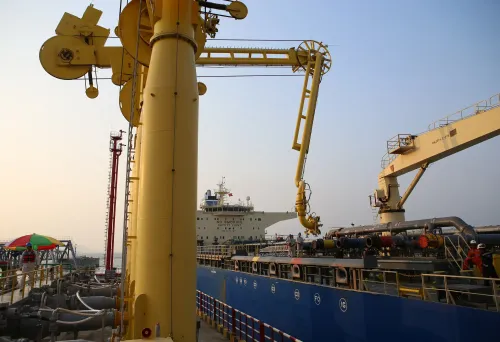
The report noted that the East–West pipeline running from Abqaiq to Yanbu has a capacity of approximately 7 million barrels per day. During the spring period, Saudi Arabia used roughly 4–5 million barrels per day through this corridor, keeping exports at 60–70 per cent of pre-war levels.
The Fiscal Picture Remains Fragile
On the financial front, the report cited Goldman Sachs data indicating that Saudi Arabia's deficit improvement amounted to only about one percentage point of GDP — underscoring that favourable oil prices offer only a shallow cushion against what is described as a structural fiscal problem.
'The fiscal position worsened, in other words, even as the price rose. The SAR 160 billion deficit, entirely debt-financed, had used 97 per cent of the year's budgeted shortfall by June,' the report noted.
The findings align with a broader regional pattern flagged by analysts, who have observed that fiscal sustainability across the Gulf Cooperation Council (GCC) is 'mostly unrelated to the degree of economic diversification.' This suggests that diversification programmes across the Gulf, including Saudi Arabia's own Vision 2030, have yet to translate into meaningful fiscal resilience.
The End of Easy Oil Assumptions
The India Narrative report concluded that the era of easy oil for Saudi Arabia is ending — not because its fields are running dry, but because the barrel can no longer be assumed to reliably reach the buyer. This is a fundamental shift in how energy analysts assess the kingdom's long-term strategic position.
Construction Activity Offers One Bright Spot
Amid the fiscal pressures, Saudi Arabia's construction sector showed continued momentum. According to the Saudi Construction Index released by Al Rajhi Capital last month, construction activity in the kingdom expanded for the fourth consecutive month in August, driven by resilient demand and a recovery in new orders.
The seasonally adjusted index — compiled by S&P Global Market Intelligence for Al Rajhi Capital — climbed to 55.4 in August, up from 55.2 in July, signalling continued, if modest, expansion in the sector.
As geopolitical pressures on shipping lanes persist and domestic spending obligations mount, Saudi Arabia's ability to translate oil wealth into durable fiscal stability remains an open and pressing question.
Point of View
Yet the kingdom's fiscal position deteriorated even when prices were rising. That is not a cyclical problem — it is a structural one, and diversification rhetoric has not yet changed the underlying arithmetic. The more alarming finding is the shift from reserve risk to transit risk: it is one thing to have oil in the ground, quite another to guarantee it reaches markets through a Red Sea under pressure and an eastern route propped up by American security commitments Riyadh does not control. For energy markets and India — one of Saudi Arabia's largest crude customers — this is a supply-chain stability question as much as a Gulf fiscal one.
NationPress
6 Oct 2026
Frequently Asked Questions
What does the India Narrative report say about Saudi Arabia's oil wealth?
The report found that Saudi Arabia's accumulated oil wealth and diversification efforts have not resolved its fiscal dependence on crude revenues. Instead, the risk has shifted from reserve adequacy to the reliability of export routes actually delivering oil to buyers.
How severe is Saudi Arabia's fiscal deficit?
According to the report, Saudi Arabia's SAR 160 billion deficit — entirely debt-financed — had consumed 97 per cent of the year's budgeted shortfall by June. Data cited from Goldman Sachs shows the deficit improved by only about one percentage point of GDP despite relatively elevated oil prices.
What are the risks to Saudi Arabia's oil export routes?
The report identifies two key vulnerabilities: the western export corridor (through the Red Sea) depends on ongoing repairs and operates in a contested maritime environment, while the eastern alternative route relies on external — primarily American — security support that Riyadh does not directly command.
How does this apply to the broader GCC region?
Analysts cited in the report note that fiscal sustainability across Gulf Cooperation Council (GCC) countries is 'mostly unrelated to the degree of economic diversification,' suggesting the structural fiscal challenge extends beyond Saudi Arabia alone.
Is there any positive economic data from Saudi Arabia recently?
Yes — Saudi Arabia's construction sector expanded for the fourth consecutive month in August 2026, according to the Al Rajhi Capital Saudi Construction Index compiled by S&P Global Market Intelligence. The index rose to 55.4 from 55.2 in July, reflecting resilient demand and a recovery in new orders.