Is the Demand for a Shillong District Heating Up? CM Sangma Pledges Thorough Review
Synopsis
Meghalaya's Chief Minister, Conrad K. Sangma, addresses the pressing demand for a separate Shillong district in a politically astute manner. He emphasizes the need for careful examination of the proposal, balancing urban growth with rural needs. This discussion is crucial for governance reform in the region.
Key Takeaways
CM Sangma emphasizes careful evaluation of the demand for a separate Shillong district.
Rapid urbanization is straining existing governance structures.
The proposal will be evaluated based on strict criteria.
Coordination among various administrative bodies is crucial.
The government prioritizes a balanced approach to urban and rural needs.
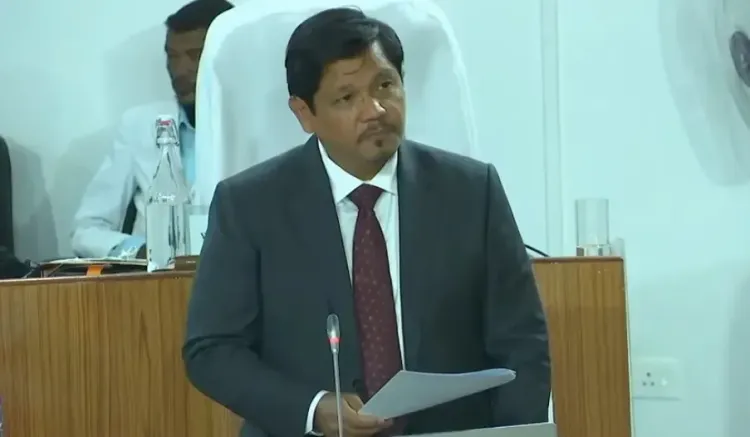
Shillong, Feb 18 (NationPress) Meghalaya's Chief Minister Conrad K. Sangma on Wednesday took a measured yet politically astute approach in the Assembly regarding the proposal to separate the Shillong Urban Agglomeration from the East Khasi Hills district. This indicates that while the government is open to administrative changes, it will not make hasty decisions without comprehensive evaluation.
Responding to a brief discussion initiated by United Democratic Party (UDP) MLA Paul Lyngdoh during the Budget Session, the Chief Minister recognized that the establishment of a distinct Shillong district is of “significant public concern,” especially given the rapid urban growth and increasing pressures on governance in the State capital.
Sangma emphasized that Shillong has transformed from a traditional town into a multifaceted urban agglomeration, which includes the Shillong Municipal Board, Shillong Cantonment Board, and 10 census towns, along with numerous peri-urban villages scattered across East Khasi Hills and parts of Ri-Bhoi district.
This expansion, he noted, has strained civic administration, infrastructure, law enforcement, and public service delivery. However, the Chief Minister was careful to point out that the creation of a new district cannot be solely motivated by political emotions.
He reminded the assembly that strict criteria—including population, area, public convenience, communication, availability of funds, and socio-economic indicators—must guide such decisions. Any proposal will be reviewed by a high-level committee led by the Chief Secretary, with input from key departments such as Home, Finance, Planning, and Rural Development.
In a nuanced political statement, Sangma highlighted the “unique administrative ecosystem” of Shillong, where institutions like the Khasi Hills Autonomous District Council, traditional bodies like Syiemships and Dorbar Shnongs, and various government agencies function concurrently.
He suggested that poor coordination, rather than administrative borders alone, is a key governance challenge. By committing to a “detailed examination,” the Chief Minister effectively left the issue open, balancing urban aspirations with rural sensitivities—a move viewed as politically savvy ahead of upcoming elections in Khasi Hills.
He concluded by expressing gratitude to Lyngdoh for raising the topic, framing the discussion as part of a broader dialogue on governance reform, rather than just a matter of redistricting. His response made it clear: while the demand for focused administration in Shillong is gaining momentum, the government will proceed only on its own terms and timeline.
Point of View
It is vital to recognize that the discussion surrounding the demand for a separate Shillong district is not just about administrative reorganization; it embodies a broader conversation about governance and community needs. The Chief Minister's careful approach highlights the importance of balancing urban development with rural concerns, a perspective that aligns with the ongoing dialogue in our nation's governance landscape.
NationPress
30 Sept 2026
Frequently Asked Questions
What is the main issue discussed by CM Sangma?
The main issue is the proposal to create a separate Shillong district from the East Khasi Hills district, which is driven by the need for better governance amid rapid urban expansion.
Why is the demand for a separate Shillong district significant?
The demand is significant due to the increasing pressure on governance mechanisms in Shillong as it transforms into an urban agglomeration.
What criteria will guide the decision for creating a new district?
The decision will be guided by criteria such as population, area, public convenience, communication, availability of funds, and socio-economic indicators.
Who will review the proposal for a new district?
A high-level committee led by the Chief Secretary, along with key department representatives, will review the proposal.
What does CM Sangma say about poor coordination?
CM Sangma suggests that poor coordination among existing administrative bodies is a significant governance challenge beyond just administrative boundaries.