Why Did Students Dominate Chittagong University Amid Outrage Over Teacher Assault?

Synopsis
A shocking incident at Chittagong University has sparked outrage after a professor was violently assaulted by students. This event raises critical concerns about campus safety and the ethical responsibilities of student leadership. Will the administration take a stand against such violence, or will it succumb to mob rule?
Key Takeaways
Violence in academic settings is alarming.
Student leadership should uphold ethical standards.
University administration's response is critical.
Mob justice undermines educational integrity.
Immediate action is necessary to restore safety.
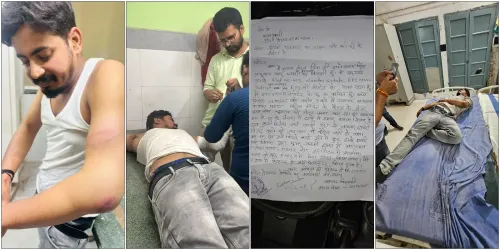
Chittagong, Jan 12 (NationPress) An alarming event at Chittagong University has sparked widespread outrage after Assistant Professor Hasan Muhammad Roman Shuvo was brutally attacked by a faction of students, headed by Abdullah Al Noman, the office secretary of the Chittagong University Central Students’ Union.
Footage shared across social media platforms depicts Noman and his peers dragging the professor by his neck and forcing him into the proctor’s office.
The Daily Star reported that this incident was not merely a random altercation but a calculated act of public aggression, raising serious concerns regarding campus governance and the ethical decline of student leadership. The most troubling aspect is the involvement of Noman, who, as an elected student leader, should have been upholding order, yet he instigated chaos.
Despite substantial evidence, the university administration has failed to take any noticeable disciplinary measures, a silence that critics deem unacceptable. Noman’s assertion that he acted “protectively” because “some students wanted to beat him” has been widely criticized as disingenuous.
The report further elaborates that such claims merely highlight the existence of a mob, with Noman leading the charge. His statement that the professor “was not harassed” has been met with widespread ridicule as an affront to basic logic.
Universities ought to uphold due process, not resort to mob justice. The proctor has already confirmed that Shuvo is facing several inquiries, but ongoing investigations cannot excuse physical violence.
The publication stressed that taking the law into one’s own hands is a clear sign of lawlessness, particularly in an academic environment.
The administration now confronts uncomfortable questions: How could such violence transpire in broad daylight, especially during admission tests? Why was the professor left vulnerable? And why has no action been taken against Noman despite compelling video evidence? By remaining passive, the university risks normalizing violence as a tactic in campus politics.
This incident sends a frightening message to faculty, students, and incoming freshmen—that power, not principle, dictates safety, and that those in elected roles can evade accountability.
Citing the July Uprising to justify the attack has been condemned as a distortion of historical values, undermining the essence of a movement founded on resisting oppression.
The newspaper emphasized the need for immediate action. If violence led by student leaders remains unchecked, universities threaten to become environments of fear rather than centers for learning. How Chittagong University responds will shape its commitment to justice or its willingness to submit to mob rule.
Point of View
This incident underscores a serious erosion of academic values and leadership responsibility. As an institution, Chittagong University must prioritize justice and uphold its commitment to a safe learning environment, confronting this act of violence decisively.
NationPress
23 Sept 2026
Frequently Asked Questions
What happened at Chittagong University?
A professor was violently assaulted by students led by a student union leader, raising questions about campus safety and governance.
Who is Abdullah Al Noman?
He is the office secretary of the Chittagong University Central Students’ Union and was involved in the assault on the professor.
What actions have been taken by the university administration?
So far, the administration has not taken visible disciplinary action against the involved students.
Why is this incident significant?
It reflects a concerning trend of violence in educational settings and challenges the integrity of student leadership.
What does this mean for the future of Chittagong University?
The university's response will determine whether it stands for justice or allows mob rule to prevail on campus.