Oil tanker hits mines, catches fire east of Hormuz Strait, Iran warns of repeat
Synopsis
An oil tanker struck naval mines and caught fire east of the Strait of Hormuz after ignoring Iran's warnings — the same day Iran's IRGC revealed it has moved missile and drone production underground and threatened retaliation for US strikes on Qeshm Island. With Washington calling its attacks 'minor' and Tehran vowing surprises if struck again, one of the world's most vital oil chokepoints is now a live flashpoint.
Key Takeaways
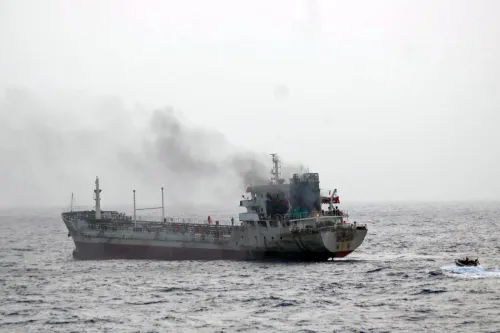
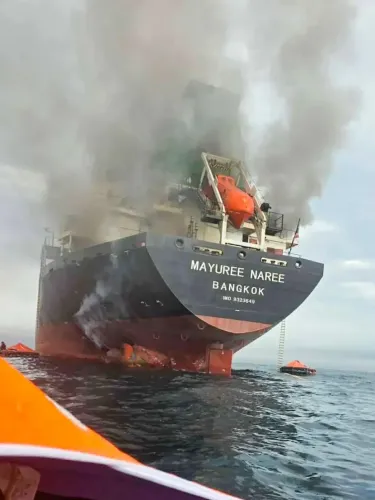
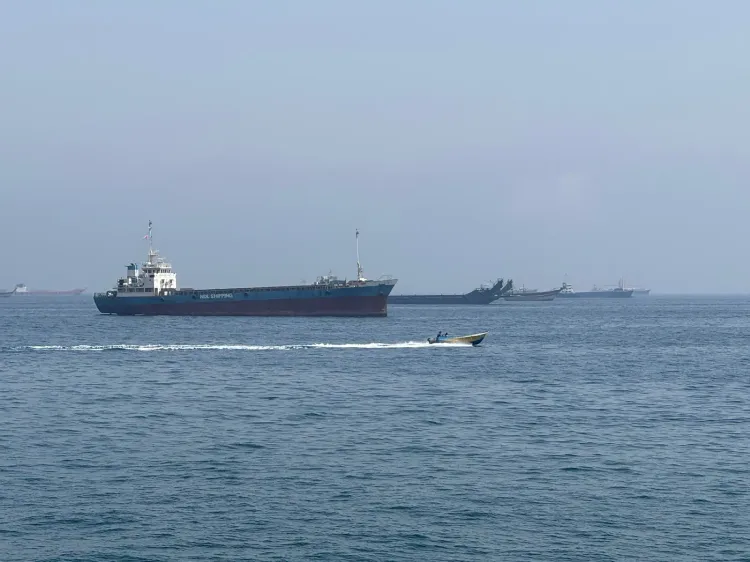
An oil tanker caught fire after hitting naval mines east of the Strait of Hormuz on 7 November 2026 , according to Iran's Army Navy.
Iran warned that any 'violating' vessel entering its forbidden zones faces the same fate.
IRGC spokesman Hossein Mohebbi announced the relocation of missile and drone production to underground facilities , with missile ranges being continuously extended.
US President Donald Trump confirmed new US strikes on Iran's air defence systems , calling the action 'minor'; Iran's Tasnim reported two missiles hit Qeshm Island .
This was reportedly the second US strike on Qeshm Island in one week, with the first occurring on Monday according to The Wall Street Journal .
The Strait of Hormuz handles approximately 20% of global oil trade, making the escalation a significant threat to energy supply chains.
Iran's Army Navy said on Saturday, 7 November 2026 that a 'violating' oil tanker caught fire after striking naval mines in a restricted zone east of the Strait of Hormuz, as tensions in the region escalated sharply amid reported US military strikes on Iranian territory. The incident underscores growing risks to global energy shipping through one of the world's most critical chokepoints.
What Happened to the Tanker
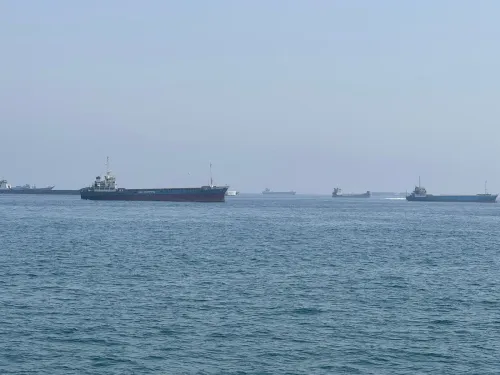
According to a statement published on Iran's Army website, the oil tanker had switched off its navigation systems and entered what the navy described as a 'forbidden and unsafe' area east of the strait, ignoring repeated warnings. Upon striking the mines, the vessel caught fire. Iran's navy issued a stark warning that the same fate awaits any vessel that disregards warnings and enters the restricted zone. No details on casualties or the tanker's flag state were immediately provided in the statement.
IRGC Reveals Underground Weapons Facilities
Separately, Iran's Islamic Revolutionary Guard Corps (IRGC) announced on the same day that its aerospace division has established underground missile and drone production facilities and is steadily extending missile ranges. IRGC spokesman Hossein Mohebbi said at a press conference in Tehran, 'We managed to rapidly relocate the production of missiles and drones from the surface to underground (facilities).' He added, 'We are constantly enhancing the range of our missiles, and we will not stop in this regard,' warning that all tangible and intangible assets of a 'hostile country' are within Iran's reach. Mohebbi also warned that if the enemy renews strikes, Iran will 'unveil its military surprises,' saying the country is 'prepared without any geographical limitation to defend the country's existence, identity, and territorial integrity.'
US Strikes on Qeshm Island
Mohebbi's remarks came amid a rapidly deteriorating security environment. US President Donald Trump said on Friday that US forces had launched new strikes targeting Iran's air defence systems, characterising the military action as 'minor.' Iran's semi-official Tasnim news agency reported earlier on Saturday that two missiles struck Qeshm Island in Iran's south, though details of any damage were not provided. This was reportedly the second such strike on the island within the week — the first reportedly occurring on Monday, according to The Wall Street Journal, citing US officials.
Regional and Global Stakes
The Strait of Hormuz handles roughly 20% of global oil trade, making any disruption to navigation in its waters a matter of immediate concern for energy markets worldwide. The tanker incident, combined with IRGC declarations of expanded underground weapons capacity and back-to-back US strikes, signals a significant escalation in the Iran-US confrontation. This is the latest in a series of confrontations in the strait region, which has seen tanker seizures, drone incidents, and maritime standoffs over the past several years. Analysts note that mine usage marks a particularly dangerous escalation, as it poses indiscriminate risk to commercial shipping.
What Comes Next
Iran's explicit warning that further vessels entering restricted zones face the same fate as the stricken tanker will likely prompt major shipping insurers and operators to reassess routes through the Persian Gulf and the Strait of Hormuz. With the IRGC signalling expanded offensive capability and the US conducting what it describes as limited retaliatory strikes, the trajectory points toward continued, if not deepening, confrontation in the coming days.
Point of View
Because mines are indiscriminate and their presence alone is a deterrent that shipping insurers and operators cannot ignore. Paired with the IRGC's public declaration of underground weapons factories and expanding missile range, Tehran is sending a message calibrated for multiple audiences: domestic, regional, and Washington. The US framing of its Qeshm strikes as 'minor' risks normalising a cycle of limited strikes that could spiral — the second US strike in a week without a defined objective or offramp is exactly the kind of incremental escalation that historically precedes larger confrontations.
NationPress
8 Nov 2026
Frequently Asked Questions
What happened to the oil tanker near the Strait of Hormuz?
Iran's Army Navy said the tanker struck naval mines and caught fire on 7 November 2026 after entering a restricted zone east of the Strait of Hormuz with its navigation systems switched off, ignoring warnings. Iran has warned that other vessels violating the zone face the same outcome.
What did the IRGC announce about its missile programme?
IRGC spokesman Hossein Mohebbi announced at a press conference in Tehran that Iran has moved missile and drone production to underground facilities and is continuously extending its missile range. He warned that if the enemy strikes again, Iran will 'unveil its military surprises.'
Did the US carry out strikes on Iran?
Yes. US President Donald Trump confirmed on Friday that US forces launched strikes targeting Iran's air defence systems, describing them as 'minor.' Iran's Tasnim news agency reported two missiles struck Qeshm Island on Saturday, the second such reported US strike on the island in one week.
Why does the Strait of Hormuz matter globally?
The Strait of Hormuz is the world's most critical oil chokepoint, handling roughly 20% of global oil trade. Any disruption to shipping in the region — through mines, vessel seizures, or military action — directly threatens global energy supply and prices.
What are the implications for shipping in the Persian Gulf?
Iran's explicit warning that further vessels entering its restricted zones risk the same fate as the stricken tanker is expected to prompt major shipping insurers and operators to reassess Persian Gulf routes. Mine usage is particularly alarming as it poses risks to all commercial vessels, not just those targeted deliberately.