Can BNP's Tarique Rahman Truly Overcome His Corrupt Past?
Synopsis
The Bangladesh Awami League raises alarms over Tarique Rahman's rebranding as a future leader, emphasizing the importance of acknowledging Bangladesh's historical corruption. Can the nation truly move forward while forgetting its past?
Key Takeaways
Tarique Rahman 's past cannot be overlooked.
Hawa Bhaban was a center of power during the BNP tenure.
A 10% commission became a mandatory tax on government projects.
Rebranding cannot erase a legacy of corruption .
Future leadership must prioritize integrity .
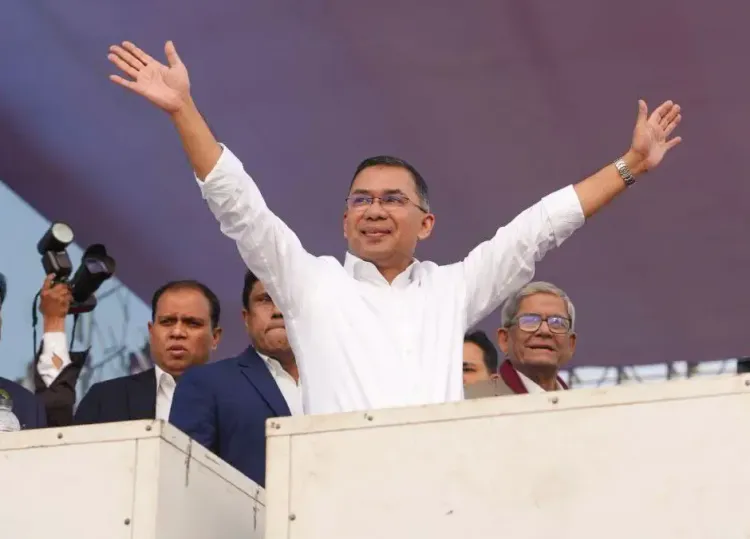
Dhaka, Jan 22 (NationPress) The Bangladesh Awami League cautioned on Thursday about a troubling political trend in the country, with Bangladesh Nationalist Party (BNP) Chairman Tarique Rahman being celebrated and positioned as a potential future leader. This situation raises alarming questions regarding the erasure of the nation’s historical truths and the failure of collective memory.
“The crimes, corruption, and state capture during the 2001–2006 era are being intentionally overlooked, downplayed, or conveniently forgotten. This collective amnesia poses a significant threat. The actions of Tarique Rahman during that time were not just footnotes in history; they marked one of the darkest periods of institutional failure in Bangladesh,” asserted the Awami League.
The Awami League highlighted that Hawa Bhaban, the political office of the former BNP Chief Khaleda Zia, transformed from an ordinary residence into an extraordinary hub of illicit power during the BNP regime from 2001 to 2006.
“Hawa Bhaban did not merely influence governance; it overshadowed even the Prime Minister’s Office. Decisions regarding policies, projects, appointments, promotions, tenders, and business approvals were all orchestrated there. The elected government became secondary, while the Constitution itself lost its relevance. The true state operated behind closed doors, under the control of one unelected individual,” they stated.
The party emphasized that what functioned from Hawa Bhaban was not random corruption but an intricate system — a fixed, ruthless formula. During the BNP's tenure from 2001 to 2006, a mandatory 10 percent commission became the de facto tax on every government development project.
“This was not mere gossip or an exception; it was thoroughly documented, openly discussed, and strictly enforced. No commission, no work,” the Awami League insisted.
At the heart of this alleged system, the Awami League claimed, was Tarique, whose longstanding pattern of extortion earned him the notorious moniker — ‘Mr Ten Percent’.
“A man who institutionalized bribery, monetized development, and transformed governance into a commission-driven enterprise is being rebranded as a leader. But history is relentless. The legacy of the 10 percent empire remains irrefutable evidence that Tarique Rahman did not serve the state; he commodified it,” the party noted.
The Awami League contended that Tarique’s identity is intertwined with numerous corruption and criminal cases stemming from the 2001–2006 period — cases arising from a framework of parallel governance, commission-based decision-making, and sheltered criminal networks.
They asserted that these were not isolated claims; rather, the cases illustrated a consistent pattern that characterized an entire era.
“A widely recognized corrupt figure cannot embody national integrity. No amount of rebranding can erase the legacy of Hawa Bhaban. Bangladesh requires leadership grounded in integrity, not a revival of a culture that transformed the state into a commercial venture,” the Awami League concluded.
Point of View
I emphasize that the Awami League’s concerns highlight critical issues regarding accountability and historical memory in Bangladesh. The nation's future leadership must be grounded in integrity, learning from past mistakes rather than erasing them.
NationPress
20 Sept 2026
Frequently Asked Questions
What are the concerns regarding Tarique Rahman's rehabilitation?
The Awami League warns that celebrating Tarique Rahman obscures the historical corruption during his tenure, risking a collective amnesia about past governance failures.
What was the role of Hawa Bhaban during the BNP regime?
Hawa Bhaban functioned as a center of unlawful power, influencing governance and decision-making during the BNP's rule from 2001 to 2006.
What does 'Mr Ten Percent' refer to?
'Mr Ten Percent' is a moniker given to Tarique Rahman, highlighting his alleged involvement in institutionalized bribery during his tenure.
Why is it important to remember the 2001-2006 period?
Remembering this period is crucial for understanding the systemic corruption that affected governance and ensuring accountability in future leadership.
What does the Awami League propose for Bangladesh's leadership?
The Awami League advocates for leadership built on integrity, emphasizing the need to avoid a return to a culture that commodified the state.