Will TN Government Take Action Following SC's Directive on Jawahar Navodaya Vidyalayas?

Synopsis
The Tamil Nadu BJP insists on the urgent establishment of Jawahar Navodaya Vidyalayas, following a Supreme Court directive. The call highlights the pressing need for educational equity in the state, emphasizing the rights of rural children to quality education. Will the state government respond swiftly to this call for action?
Key Takeaways
Immediate establishment of JNVs is demanded by the Tamil Nadu BJP.
The Supreme Court's directive highlights the urgency of addressing educational equity.
1.2 crore rural children lack access to quality education in Tamil Nadu.
Other states have successfully established JNVs without compromising their linguistic identity .
JNVs serve as a model for social mobility through education.
Chennai, Dec 2 (NationPress) The BJP in Tamil Nadu is demanding the swift establishment of Jawahar Navodaya Vidyalayas (JNVs) in the state after the Supreme Court's emphatic order, which calls for substantial discussions between the State and Union Governments regarding this long-overdue issue.
A Division Bench comprising Justices B.V. Nagarathna and R. Mahadevan has set December 15 for the next hearing, indicating that the judiciary anticipates tangible advancements.
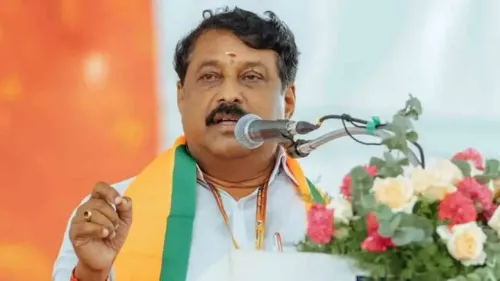
BJP spokesperson A.N.S. Prasad remarked that the Supreme Court’s comments left “no room for excuses” and emphasized that the constitutional right to quality education under Article 21A must not be influenced by political factors.
The controversy traces back to 2017, when the Madras High Court ordered the Tamil Nadu Government to procure land and build infrastructure for a fully operational JNV in each district.
This ruling was celebrated as a significant stride towards educational equality but was later put on hold due to technical reasons.
“After eight years, Tamil Nadu is the only state that lacks a single JNV, thereby denying 1.2 crore rural children access to high-quality, wholly free residential education,” Prasad stated.
He dismissed the state’s persistent concerns about the “two-language policy” and apprehensions regarding “Hindi imposition”.
According to the guidelines from the Navodaya Vidyalaya Samiti, Tamil can be used as the medium of instruction up to Class VIII, as the primary language in Classes IX and X, and as an optional subject in higher secondary grades.
Prasad noted that states like Kerala, Karnataka, and Andhra Pradesh collectively have over 30 JNVs without jeopardizing their linguistic heritage.
Referencing national statistics, he mentioned that 662 JNVs are functioning across the country, consistently achieving a 100% pass rate in CBSE exams.
The JNVs provide 75% reservation for rural students, 33% for girls, and additional advantages for SC/ST candidates, making them “India’s most effective model for social mobility.”
Prasad highlighted that the Union Government, under the Concurrent List, has the authority to set up and finance JNVs, while the State’s role is confined to providing 10–15 acres of land and basic infrastructure—obligations that have been met by every other State.
He called this a test of Chief Minister M.K. Stalin’s commitment to social justice, urging the government to form a high-level committee within a week, identify land in at least ten educationally disadvantaged districts, and present a comprehensive report to the Supreme Court by December 15.
“Let history note that Tamil Nadu prioritized its children’s futures over political pride,” Prasad remarked.
Point of View
It's clear that the establishment of Jawahar Navodaya Vidyalayas in Tamil Nadu is not just a political issue; it's about ensuring educational equity for millions of children. The Supreme Court's directive underscores the importance of prioritizing education over political agendas, and it is crucial for the state to take decisive action.
NationPress
30 Sept 2026
Frequently Asked Questions
What are Jawahar Navodaya Vidyalayas?
Jawahar Navodaya Vidyalayas (JNVs) are a system of schools in India aimed at providing quality education to rural children, completely free of charge.
Why is the establishment of JNVs important?
JNVs are crucial for ensuring educational equity, particularly for rural students who otherwise may not have access to quality education.
What is the current status of JNVs in Tamil Nadu?
Currently, Tamil Nadu is the only state in India without a single JNV, leaving millions of rural children without access to these educational opportunities.
How does the reservation system work in JNVs?
JNVs provide 75% reservation for rural students and 33% for girls, along with additional weightage for SC/ST candidates.
What did the Supreme Court order regarding JNVs?
The Supreme Court directed the Tamil Nadu Government to engage in meaningful consultations to expedite the establishment of JNVs in the state.