Trump claims 'total military victory' over Iran, says US strikes crippled Tehran's capabilities
Synopsis
Aboard Air Force One on 16 May, Trump declared a 'total military victory' over Iran — claiming US strikes destroyed Tehran's naval and air assets, degraded missile production, and left the Strait of Hormuz under effective American control. He also revealed the ceasefire came at the request of other nations, naming Pakistan, while warning Iran will 'never' acquire a nuclear weapon.
Key Takeaways
President Donald Trump declared a 'total military victory' over Iran on 16 May , speaking aboard Air Force One en route to Anchorage, Alaska .
Trump claimed US strikes destroyed Iran's naval and air assets and degraded missile production facilities .
He said the Strait of Hormuz remained effectively under US control, with Iranian-linked shipping halted for over two and a half weeks .
The ceasefire was agreed 'at the request of other nations' , with Trump naming Pakistan among those who asked for it.
Trump said Chinese President Xi Jinping shares Washington's position that Iran must not acquire nuclear weapons .
Trump made 'no commitment either way' on future US policy regarding Taiwan .
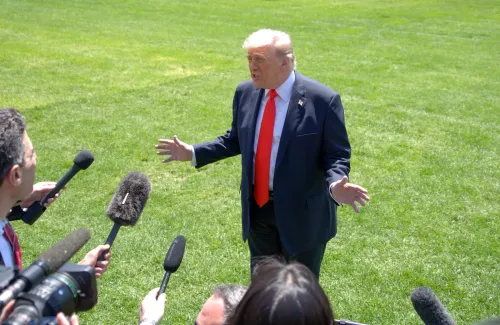
US President Donald Trump on 16 May declared a 'total military victory' over Iran, asserting that American military operations had severely damaged Tehran's naval and air assets while degrading its missile production facilities. Trump made the remarks to reporters aboard Air Force One while travelling to Anchorage, Alaska.
Trump's Claims on the Military Campaign
Speaking in sweeping terms, Trump said the United States had effectively dismantled key pillars of Iran's military infrastructure. 'We had a total military victory,' he told reporters, citing the destruction of naval and air assets and the degradation of missile production capacity.
He also claimed that the Strait of Hormuz — one of the world's most critical oil shipping lanes — remained effectively under US control following operations in the region. 'They've done no business — literally, they've done no business in the last two and a half weeks,' Trump said, referring to Iranian-linked shipping activity through the strategic waterway.
Ceasefire: 'At the Request of Other Nations'
Trump acknowledged agreeing to a ceasefire despite personal reservations, framing it as a concession to allied pressure. 'We really did the cease-fire at the request of other nations. I wouldn't have really been in favour of it…' he said.
Notably, Trump cited Pakistan among the nations that had requested the ceasefire, though he did not elaborate on the exact nature of Islamabad's involvement. The remarks represent one of the more specific public attributions of diplomatic pressure in the episode.
Nuclear Weapons: 'Iran Will Never Have One'
Trump was unambiguous on the question of Iranian nuclear ambitions. 'I can say this with very, very strong conviction, Iran will never have a nuclear weapon, not going to happen,' he said.
He added that Chinese President Xi Jinping shared Washington's position on this matter, citing recent conversations between the two leaders. 'He feels strongly they can't have a nuclear weapon,' Trump said, describing Xi's stance. This comes amid broader US-China engagement spanning artificial intelligence cooperation, trade, and denuclearisation.
Taiwan and Future Military Options
During the wide-ranging exchange, Trump indicated he was still weighing future military options against Iran if circumstances required. On Taiwan, he said Xi opposed any move toward Taiwanese independence and warned against confrontation, while Trump himself noted he had made 'no commitment either way' regarding future US policy on the island.
The remarks signal that while a ceasefire is in place, the White House views the Iran situation as unresolved — and diplomatic channels, particularly with Beijing, as central to what comes next.
Point of View
Which he admits he opposed, complicates the triumphalist narrative: victories rarely require ceasefires requested by third parties. The naming of Pakistan as a ceasefire interlocutor is the most underreported detail in his remarks, raising questions about Islamabad's back-channel role that neither government has publicly explained. Meanwhile, invoking Xi Jinping as a co-guarantor of Iranian denuclearisation is a significant diplomatic signal — one that acknowledges Washington cannot manage Tehran without Beijing, even as US-China tensions simmer over Taiwan and trade.
NationPress
16 Sept 2026
Frequently Asked Questions
What did Trump mean by 'total military victory' over Iran?
Trump claimed that US military operations had destroyed Iran's naval and air assets and degraded its missile production facilities, calling the outcome a 'total military victory.' He also said the Strait of Hormuz remained effectively under US control, with Iranian-linked shipping halted for more than two and a half weeks.
Why did Trump agree to a ceasefire if he opposed it?
Trump said the ceasefire was agreed 'at the request of other nations,' including Pakistan, despite his personal reservations. He indicated it was a diplomatic concession rather than a military necessity, though he did not elaborate on the specific terms or Pakistan's precise role.
What is Trump's position on Iran acquiring nuclear weapons?
Trump stated with 'very, very strong conviction' that Iran will never be allowed to possess a nuclear weapon. He added that Chinese President Xi Jinping shares this position, citing their recent conversations.
What did Trump say about China and Taiwan during the same interaction?
Trump said his discussions with Xi Jinping covered artificial intelligence cooperation, trade, Taiwan tensions, and denuclearisation. On Taiwan, he noted Xi opposed independence moves, while Trump himself said he had made 'no commitment either way' on future US policy toward the island.
What is the significance of the Strait of Hormuz in Trump's remarks?
The Strait of Hormuz is one of the world's most critical oil shipping routes. Trump claimed it remained effectively under US control following military operations, and said Iranian-linked shipping through the waterway had been halted for over two and a half weeks — a claim that, if accurate, would have significant implications for global energy markets.