57th GST Council meeting kicks off in Delhi; refund, registration reforms on table

Synopsis
The 57th GST Council meeting, chaired by Nirmala Sitharaman, is deliberating reforms that could fundamentally change how Indian businesses register, file returns, claim refunds, and face enforcement — including a push to decriminalise a large swath of GST offences and automate 90% of refund releases within 10 days.
Key Takeaways
The 57th GST Council meeting commenced on 8 October 2026 in New Delhi , chaired by Finance Minister Nirmala Sitharaman .
Reforms span five pillars : process reforms, structural reforms, ease of doing business, e-commerce, and exports of services.
90% of GST refunds may be released within 10 days via automated risk checks under the proposed framework.
Invoice matching reforms aim to validate Input Tax Credit at the recording stage, reducing mismatch notices.
61% of registrations are already processed in 3 working days ; proposals seek to extend this to all applicants.
A significant number of GST offences are proposed to be removed from criminal provisions under a trust-based administration model.
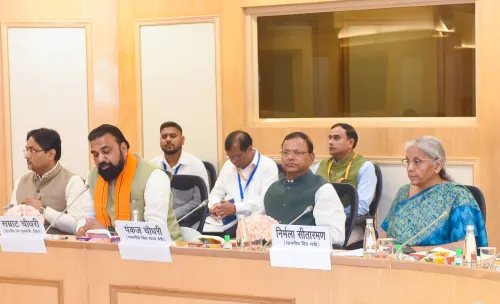
Finance Minister Nirmala Sitharaman on Thursday, 8 October 2026 chaired the 57th GST Council meeting in New Delhi, opening deliberations on a sweeping next phase of Goods and Services Tax (GST) reforms that the Centre intends to roll out. The session brings together Chief Ministers, Deputy Chief Ministers, and Finance Ministers from states and Union Territories, signalling the federal scope of the overhaul being considered.
Who Is at the Table
The meeting's participants include Chief Ministers of Delhi, Goa, Haryana, Jammu & Kashmir, Karnataka, Kerala, Maharashtra, and Meghalaya; Deputy Chief Ministers of Manipur and Telangana; Finance Ministers and senior officials from states and UTs; the Secretary of the Department of Revenue; and the Chairman and Members of the Central Board of Indirect Taxes and Customs (CBIC), along with senior officials of the Ministry of Finance.
Key Reform Areas Under Discussion
According to sources, the proposals before the Council span five key pillars: process reforms, structural reforms, ease of doing business, e-commerce, and exports of services. The overarching philosophy, sources said, is that 'the system should do what can be done from data — the officer should be left with what needs judgement.'
On refunds, the proposed framework would require acknowledgement within 10 days, with 90 per cent of refund amounts released after an automated risk check that draws data from customs and banking systems — reducing manual intervention significantly.
For litigation, a common standard for notices, hearings, and orders is being worked out, along with a proposal to issue no notice at all below a specified threshold — a move aimed at cutting compliance friction for smaller taxpayers.
Streamlining Returns and Invoice Matching
The Council is also examining a revamped return-filing process where corrections are recorded with a full audit trail, and corresponding changes are automatically reflected in the buyer's ledger. This invoice-matching mechanism would validate Input Tax Credit (ITC) at the point of recording, potentially eliminating a large volume of mismatch notices that currently burden both taxpayers and the department.
Registration and Business Closure Reforms
Currently, 61 per cent of GST registrations are granted within three working days without officer intervention. The reforms propose extending a similar streamlined process to the remaining registrants by eliminating unnecessary queries and reducing rejections.
Notably, the Council is also considering making business closure as simple as business registration. A registration suspended for a procedural lapse would, under the proposal, restore itself automatically once the lapse is rectified — removing the need for officer involvement.
Decriminalisation of GST Offences
One of the more structurally significant proposals is to move a large number of offences out of the criminal provisions of the GST framework, replacing penal exposure with civil or administrative remedies. This 'trust-based administration' approach is intended to reduce the compliance burden on businesses and improve the ease of doing business ranking.
With the 57th GST Council covering both process and structural dimensions of the tax framework, the outcomes of Thursday's deliberations are expected to shape the GST compliance landscape for businesses and taxpayers across India in the coming months.
Point of View
Officer-driven tax administration to a data-automated, trust-based one. Decriminalising GST offences and automating refunds will matter most to India's mid-sized businesses, which have borne the highest compliance cost relative to size. The real test, however, is implementation: past GST council meetings have produced reform proposals that moved slowly through the system. The invoice-matching mechanism, if genuinely deployed, could be transformative — but it requires back-end infrastructure and inter-agency data sharing that has historically lagged political intent.
NationPress
8 Oct 2026
Frequently Asked Questions
What is the 57th GST Council meeting about?
The 57th GST Council meeting, chaired by Finance Minister Nirmala Sitharaman on 8 October 2026 in New Delhi, is deliberating the next phase of GST reforms covering refunds, registration, return filing, invoice matching, and decriminalisation of certain offences. The agenda spans five pillars: process reforms, structural reforms, ease of doing business, e-commerce, and exports of services.
How will the proposed GST refund reform work?
Under the proposed framework, GST refunds would be acknowledged within 10 days, with 90 per cent of the refund amount released after an automated risk check drawing data from customs and banking systems — significantly reducing manual officer intervention. This is designed to improve cash-flow certainty for exporters and other eligible taxpayers.
What does the GST decriminalisation proposal mean for businesses?
The proposal would move a large number of offences out of the criminal provisions of GST law, replacing them with civil or administrative remedies under a 'trust-based administration' model. For businesses, this reduces the risk of criminal exposure for procedural or technical lapses, lowering the compliance-anxiety cost of doing business in India.
What is the GST invoice-matching reform and why does it matter?
The invoice-matching reform proposes that Input Tax Credit be validated at the point of recording itself, with corrections automatically reflected in the buyer's ledger and a full audit trail maintained. This would eliminate a large number of mismatch notices that currently result in litigation and compliance costs for taxpayers.
Who participated in the 57th GST Council meeting?
Participants included Chief Ministers of Delhi, Goa, Haryana, Jammu & Kashmir, Karnataka, Kerala, Maharashtra, and Meghalaya; Deputy Chief Ministers of Manipur and Telangana; state and UT Finance Ministers; the Secretary of the Department of Revenue; and the Chairman and Members of CBIC, along with senior Ministry of Finance officials.